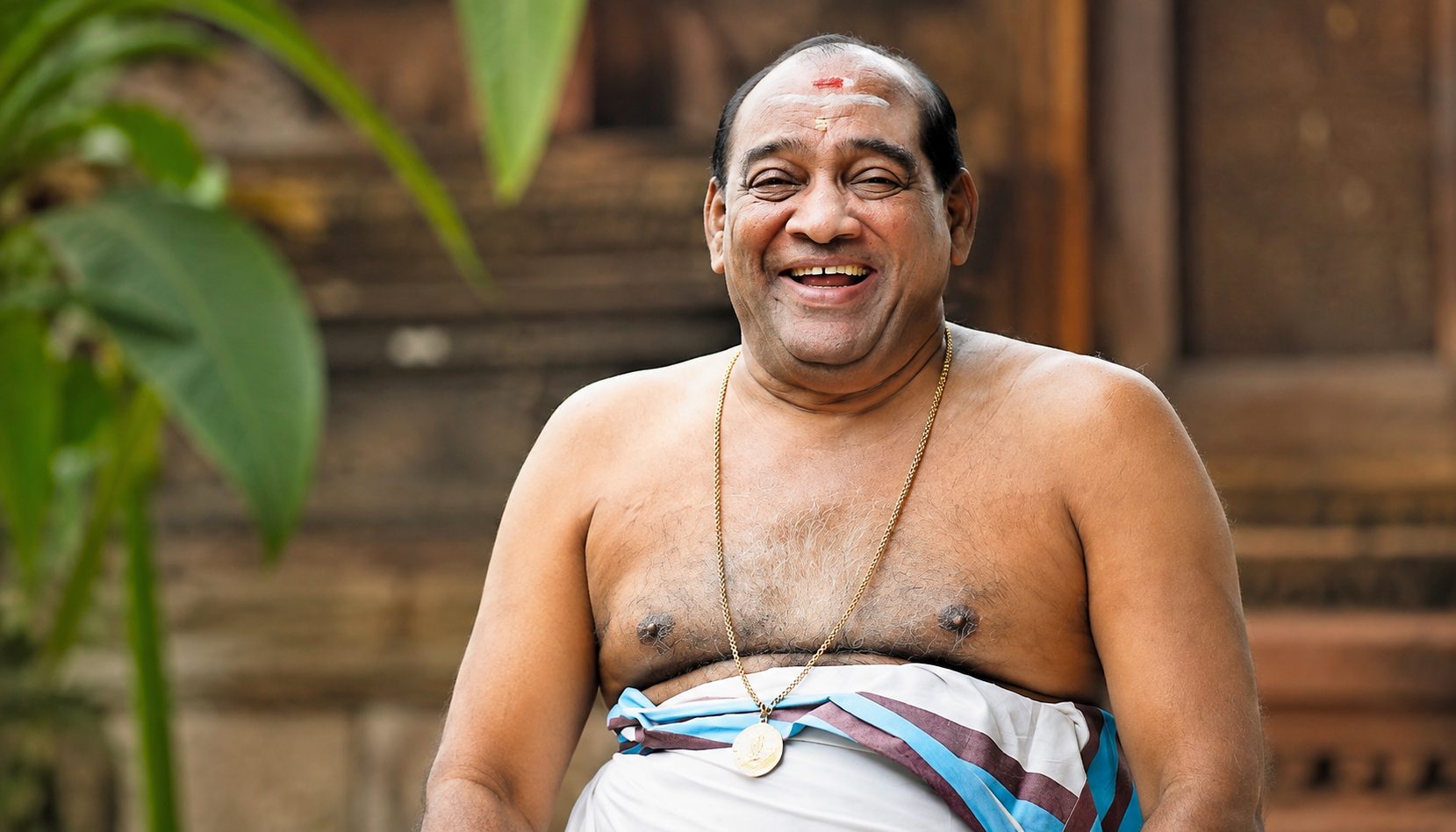
Mattannur Sankarankutty Marar
Powerful Thayambaka and chenda performances
Mattannur Sankarankutty Marar, also known as M. P. Sankara Marar, is one of Kerala’s most celebrated percussionists and a distinguished exponent of the state’s traditional percussion arts. Renowned for his mastery of the chenda, Thayambaka, Panchari Melam and Panchavadyam, he has played an important role in taking Kerala’s traditional rhythmic arts to audiences across the country and beyond.
Key Facts
Full Name: Mattannur Sankarankutty Marar (M. P. Sankara Marar)
Born: Mattannur, Kannur, Kerala
Profession: Percussionist
Specialities: Chenda, Thayambaka, Panchari Melam, Panchavadyam
Notable For: Powerful Thayambaka and chenda performances
Padma Shri: 2009
Born in Mattannur in Kannur district, he belongs to a region with a strong tradition of percussion and temple arts. Over a career spanning several decades, he has established a distinctive identity through his command of rhythm, precision and powerful stage performances.
Roots in Mattannur
Mattannur, in northern Kerala, has long been associated with traditional percussion traditions. Growing up in this cultural environment, Sankarankutty Marar developed a deep connection with the chenda and the rhythmic traditions surrounding temple festivals and cultural performances.
The chenda is central to several of Kerala’s traditional musical ensembles. It demands exceptional physical control, rhythmic discipline and an understanding of complex patterns. Sankarankutty Marar went on to master not only chenda performance but also major forms such as Thayambaka, Panchari Melam and Panchavadyam.
Mastery of Thayambaka
One of the art forms most closely associated with Mattannur Sankarankutty Marar is Thayambaka.
Thayambaka is a solo-oriented chenda performance tradition in which the principal artist develops intricate rhythmic patterns while maintaining a strong connection with the accompanying percussion ensemble. The performance gradually builds in intensity and complexity, demanding concentration, timing and exceptional command of the instrument.
Sankarankutty Marar is widely recognised for his powerful approach to Thayambaka. His performances have contributed to the continuing popularity of the art form among both traditional audiences and younger generations.
A Versatile Percussionist
Although particularly celebrated for Thayambaka, Mattannur Sankarankutty Marar’s artistic repertoire extends across several major Kerala percussion traditions.
His work encompasses:
- Chenda
- Thayambaka
- Panchari Melam
- Panchavadyam
This versatility has enabled him to participate in a wide variety of temple festivals, cultural programmes and traditional performances.
His artistry reflects the depth of Kerala’s percussion heritage, where individual instruments and ensemble traditions come together to create elaborate rhythmic performances.
A Family Continuing the Tradition
For Sankarankutty Marar, the tradition of percussion has also become a family legacy.
He is married to Bharathi, a native of Tirur in Malappuram district. They have three children: sons Mattannur Sreekanth and Mattannur Sreeraj, and daughter Mattannur Saranya.
Sreekanth and Sreeraj have followed their father’s artistic path and are also recognised Thayambaka artists. Performances featuring Sankarankutty Marar alongside his two sons have become particularly popular in Kerala.
The father-and-sons triple Thayambaka performances represent an especially striking example of how traditional artistic knowledge can continue from one generation to the next.
Recognition and Honours
Mattannur Sankarankutty Marar’s contribution to Kerala’s traditional arts has earned him several prestigious honours.
He received the Kerala Sangeetha Nataka Akademi Award in 1996, recognising his contribution to the performing arts.
In 2009, the Government of India honoured him with the Padma Shri, one of the country’s prestigious civilian awards, for his contribution to the field of art.
He was subsequently honoured with the Sangeet Natak Akademi Award in 2012, further recognising his contribution to Indian traditional performing arts.
These honours reflect his standing not only as a leading exponent of Kerala’s percussion traditions but also as an important representative of India’s broader performing-arts heritage.
Preserving a Living Tradition
Kerala’s traditional percussion arts are deeply connected with the cultural life of the state. Chenda performances accompany major temple festivals and celebrations, while forms such as Thayambaka and Panchavadyam have become important elements of Kerala’s performing-arts identity.
Artists such as Mattannur Sankarankutty Marar play a crucial role in keeping these traditions alive. Their work ensures that complex rhythmic traditions developed and refined over generations continue to be performed, taught and appreciated.
His influence is particularly significant because of the way the tradition has continued within his own family. The artistic careers of his sons demonstrate that Kerala’s percussion heritage is not merely a link to the past but a living tradition that continues to evolve.
The Legacy of a Percussion Maestro
Mattannur Sankarankutty Marar’s journey represents the strength and continuity of Kerala’s traditional percussion culture. From Mattannur to major cultural stages, his chenda and Thayambaka performances have helped showcase the sophistication and energy of Kerala’s rhythmic traditions.
His Padma Shri and other major honours recognise a career dedicated to traditional art. Yet perhaps one of his most significant contributions is the continuation of his artistic lineage through the next generation.
Through his performances, teaching and family tradition, Mattannur Sankarankutty Marar remains an influential figure in Kerala’s percussion heritage — a maestro whose rhythms continue to resonate across generations.