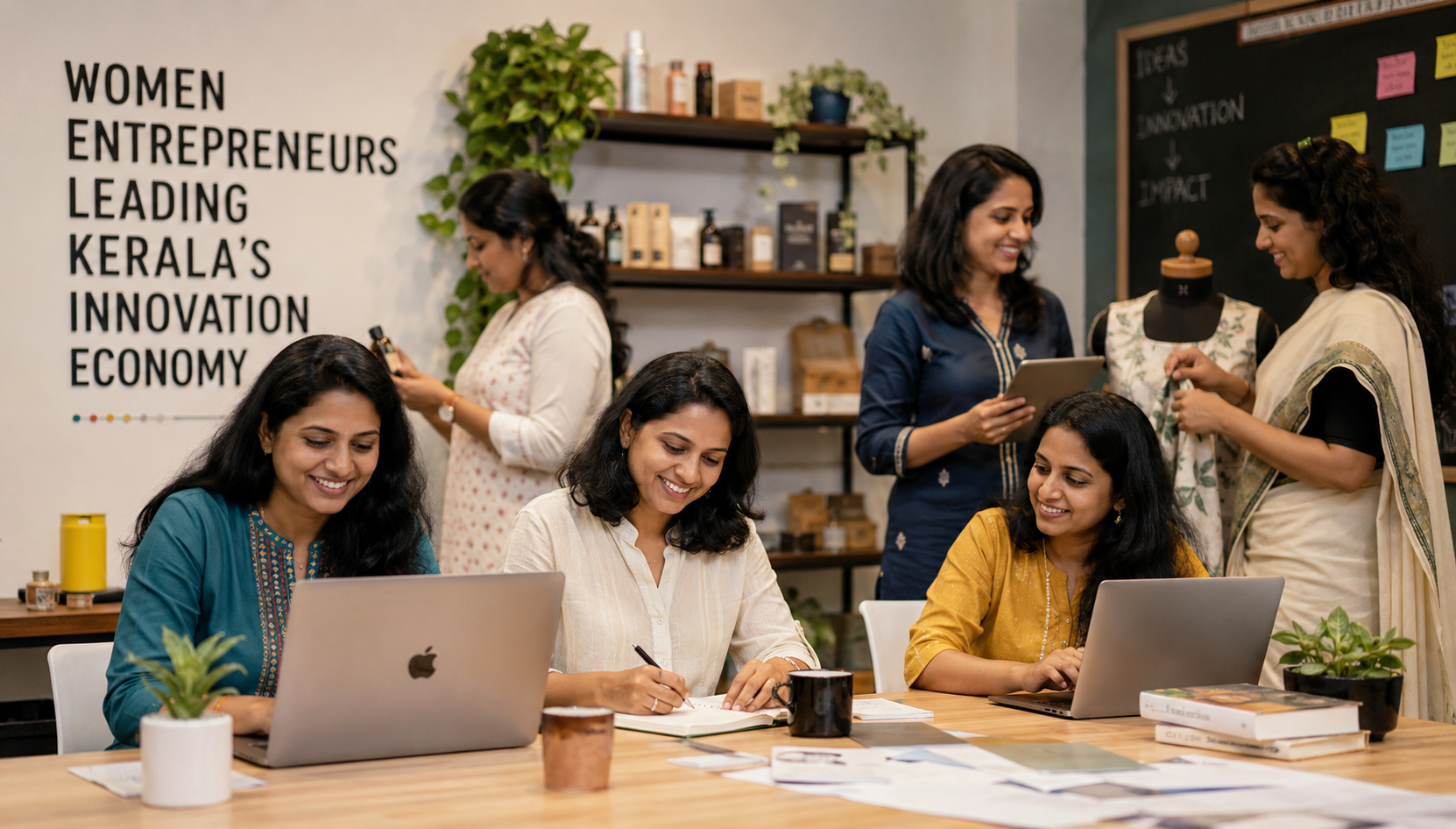
For decades, Kerala has earned recognition for its high literacy, strong healthcare system, and skilled workforce. Today, another transformation is quietly taking shape across the state. An increasing number of women are stepping beyond traditional career paths to build businesses, launch startups, and introduce innovative ideas across sectors ranging from technology and healthcare to food processing, fashion, sustainability, and digital services. Their journeys are not just inspiring personal success stories—they are reshaping Kerala’s entrepreneurial ecosystem and proving that innovation can flourish when talent meets opportunity.
Unlike earlier generations, many of today’s women entrepreneurs are creating businesses that solve real-world problems rather than simply filling market gaps. Technology has become an equaliser, allowing women to build companies from home, manage remote teams, and reach customers across India and abroad. The rapid growth of digital payments, e-commerce platforms, and social media has reduced many of the barriers that once made entrepreneurship difficult. Combined with Kerala’s educated population and expanding startup ecosystem, these developments have created fertile ground for women-led enterprises.
One of the strongest contributors to this shift has been the Kerala Startup Mission (KSUM), which has introduced programmes aimed at supporting women founders through incubation, mentoring, networking opportunities, and financial assistance. These initiatives have encouraged many first-generation entrepreneurs who may never have considered starting a business. Universities, engineering colleges, and innovation hubs across the state are also nurturing young women with entrepreneurial ambitions, creating a pipeline of future business leaders.
Technology remains one of the fastest-growing sectors for women entrepreneurs in Kerala. Increasingly, women are founding startups focused on artificial intelligence, healthcare technology, educational platforms, financial technology, and software development. Many of these companies address practical challenges faced by businesses and consumers while creating high-value employment opportunities. Unlike traditional enterprises that depend heavily on physical infrastructure, technology startups allow founders to scale nationally and internationally with relatively modest initial investments.
Healthcare has also emerged as an important area of innovation. Kerala’s reputation for quality medical services has encouraged women entrepreneurs to develop businesses in telemedicine, wellness, nutrition, rehabilitation, mental health services, and digital healthcare platforms. Many of these ventures combine professional expertise with technology, making healthcare more accessible while responding to changing consumer expectations following the pandemic.
Kerala’s food and agriculture sectors are witnessing similar innovation. Women-led businesses are transforming traditional products into premium brands by focusing on quality, packaging, traceability, and online marketing. From organic spices and value-added coconut products to millet-based foods and artisanal snacks, entrepreneurs are finding ways to bring Kerala’s rich agricultural heritage to customers across the country. Instead of competing solely on price, they are building brands that emphasise authenticity and sustainability.
Fashion and lifestyle businesses have also evolved considerably. Designers, artisans, and entrepreneurs are blending Kerala’s handloom traditions with contemporary design, creating products that appeal to modern consumers without losing their cultural identity. Sustainable fashion, handcrafted jewellery, eco-friendly home décor, and ethical beauty products are becoming increasingly popular, allowing women-owned businesses to occupy specialised market segments where creativity matters as much as scale.
Tourism, one of Kerala’s largest industries, has opened new opportunities as well. Women entrepreneurs are managing boutique homestays, wellness retreats, travel consultancies, experiential tourism companies, and culinary ventures that showcase local culture. Rather than focusing only on conventional sightseeing, many businesses now offer personalised travel experiences built around village life, local cuisine, responsible tourism, and wellness. These ventures not only generate income but also create employment within local communities.
Social entrepreneurship has become another defining feature of Kerala’s innovation landscape. Many women founders measure success not only through profits but also through social impact. Their businesses work with self-help groups, rural artisans, farmers, and marginalised communities, creating sustainable livelihoods while preserving traditional skills. This combination of commercial sustainability and community development reflects Kerala’s broader emphasis on inclusive growth.
Access to finance, while improving, continues to be one of the biggest challenges for many women-led startups. First-generation entrepreneurs often face greater difficulty in securing private investment compared to their male counterparts. Although government grants, startup schemes, and bank loans have become more accessible, scaling a business beyond its early stages still requires stronger investor confidence and larger funding networks. Encouragingly, the number of angel investors and venture capital firms actively engaging with women-led startups has gradually increased over the past few years.
Another challenge lies in balancing entrepreneurship with family responsibilities. While societal attitudes are changing, many women continue to shoulder a disproportionate share of household responsibilities alongside running businesses. Flexible work arrangements, supportive families, professional networks, and mentorship programmes have become essential factors in helping entrepreneurs navigate these demands successfully.
Role models are playing an increasingly important role in encouraging future entrepreneurs. Successful women founders regularly participate in startup events, college programmes, and business forums, sharing their experiences with aspiring entrepreneurs. Their visibility demonstrates that entrepreneurship is no longer confined to metropolitan cities or established business families. A promising business idea, combined with determination and access to the right support systems, can emerge from almost any part of Kerala.
The private sector is also recognising the value of diversity in innovation. Investors, accelerators, and corporate partners increasingly understand that diverse leadership often brings fresh perspectives, stronger problem-solving abilities, and better customer understanding. As a result, more women-led startups are finding opportunities to collaborate with larger companies and expand into national and international markets.
Looking ahead, Kerala’s innovation economy is likely to benefit significantly from greater participation by women entrepreneurs. Emerging sectors such as artificial intelligence, climate technology, clean energy, biotechnology, digital healthcare, advanced manufacturing, and agritech offer enormous potential for new businesses. With continued investment in education, digital infrastructure, mentoring, and access to capital, the state can further strengthen its position as one of India’s leading centres for innovation-driven entrepreneurship.
The rise of women entrepreneurs in Kerala represents more than an economic trend. It reflects a broader social transformation where talent, education, creativity, and determination are creating new pathways for growth. Every successful venture not only generates employment and economic value but also inspires countless young women to pursue their own entrepreneurial ambitions. As these businesses continue to grow, they will play an increasingly important role in shaping Kerala’s economy, proving that innovation becomes stronger when opportunities are shared equally.