
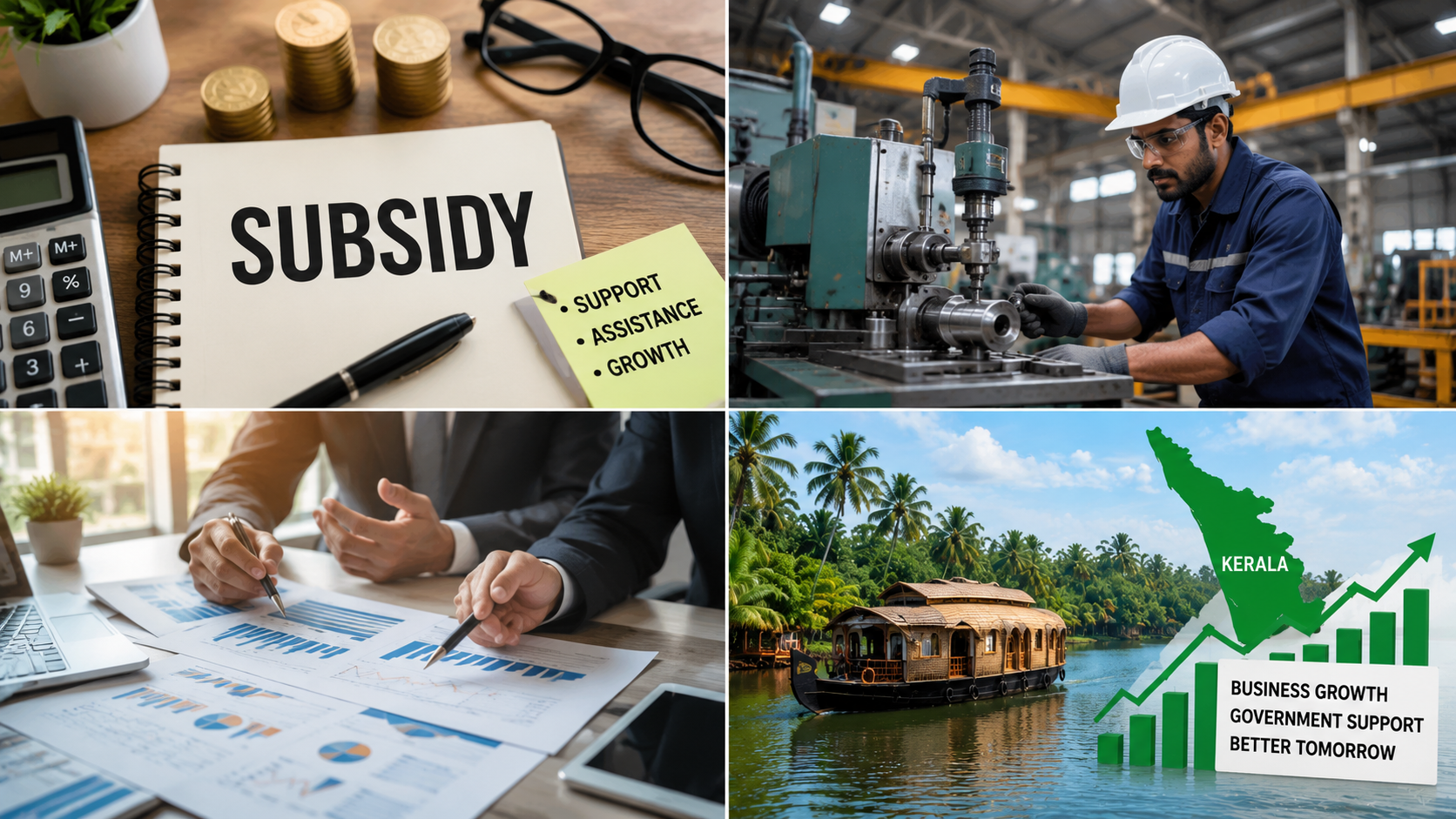
Kerala has long been known for its educated workforce, strong social indicators, and growing entrepreneurial culture. Over the last decade, however, another trend has quietly gained momentum. Increasingly, the state government has been positioning itself as a supporter of small businesses, startups, manufacturing units, and innovative enterprises through a range of subsidy programs and financial incentives.
For many entrepreneurs, the biggest challenge is not finding a business idea. It is finding the capital to turn that idea into a sustainable enterprise. Machinery costs, infrastructure expenses, employee salaries, technology investments, and operational expenses can quickly overwhelm a new business. This is where government subsidies become particularly valuable.
Yet many business owners remain unaware of the assistance available to them. Some assume subsidies are difficult to obtain. Others simply do not know where to begin. The reality is that Kerala offers several schemes designed to reduce financial pressure on entrepreneurs and encourage investment across different sectors.
Why Subsidies Matter
Walk into any small manufacturing unit or startup office, and the conversation often revolves around costs. Rent is rising. Equipment is expensive. Competition is intense. For first-generation entrepreneurs, securing financing can be especially difficult.
Subsidies help bridge that gap.
Unlike traditional loans, subsidies generally do not need to be repaid if eligibility conditions are met. They reduce the initial financial burden and allow entrepreneurs to focus on growth rather than survival.
In Kerala, subsidy programs are often linked to broader economic goals such as employment generation, industrial development, innovation, sustainability, and regional growth.
Investment Subsidy for MSMEs
One of the most widely used support mechanisms in Kerala is the investment subsidy available to Micro, Small, and Medium Enterprises (MSMEs).
The scheme is intended to encourage entrepreneurs to establish new industrial units or expand existing ones. Businesses investing in plant, machinery, and productive assets may qualify for financial assistance based on their investment size and eligibility criteria.
For a small entrepreneur setting up a food processing unit, engineering workshop, or manufacturing facility, this subsidy can significantly reduce startup costs.
The objective is straightforward: lower the financial barriers that prevent businesses from taking their first step.
Interest Subsidy Schemes
Access to affordable credit remains one of the biggest challenges facing small businesses.
Recognizing this reality, Kerala provides interest subsidy support under various programs. These initiatives help reduce the effective interest burden on loans taken for approved industrial or business activities.
For entrepreneurs, the impact can be substantial.
A reduction of even a few percentage points in borrowing costs can free up capital for marketing, recruitment, technology upgrades, or expansion plans.
In sectors where profit margins are narrow, interest subsidies often make the difference between a viable project and an unviable one.
Startup Support Through Kerala Startup Mission
Over the past several years, Kerala has earned recognition as one of India’s emerging startup ecosystems.
A major reason is the work of Kerala Startup Mission, commonly known as KSUM.
The organization provides a variety of support mechanisms for technology startups and innovation-driven ventures. These include funding assistance, incubation support, mentoring programs, market access initiatives, and innovation grants.
For young founders working on software platforms, artificial intelligence applications, health technology solutions, or digital products, startup-focused assistance often proves more valuable than conventional subsidy programs.
The goal is not merely to fund businesses but to create an ecosystem where innovation can thrive.
Support for Women Entrepreneurs
Across India, women-owned businesses continue to face challenges related to access to finance, networks, and business resources.
Kerala has introduced several initiatives intended to encourage female entrepreneurship and economic participation.
These programs may include capital subsidies, special financial assistance, skill-development opportunities, and priority support under selected schemes.
The state’s focus on women’s entrepreneurship reflects a broader understanding that economic growth becomes more inclusive when barriers to participation are reduced.
Many successful enterprises operating in Kerala today began with support mechanisms specifically designed for women entrepreneurs.
Subsidies for SC/ST Entrepreneurs
Inclusive development remains an important policy objective.
To promote entrepreneurship among Scheduled Caste and Scheduled Tribe communities, Kerala offers targeted support programs that may include capital assistance, training support, and concessional financial benefits.
Such initiatives aim to expand economic opportunities and encourage business ownership among historically underrepresented groups.
For many first-generation entrepreneurs, these programs provide access to resources that might otherwise be difficult to obtain.
Technology and Modernization Assistance
Business competitiveness increasingly depends on technology.
Whether it involves automation, digital systems, advanced machinery, or quality-control equipment, modernization requires investment.
Kerala’s industrial support programs often include provisions encouraging businesses to adopt modern technologies and improve operational efficiency.
The rationale is simple.
Companies equipped with better technology are more productive, more competitive, and more likely to generate employment in the long term.
For manufacturing businesses especially, modernization support can help improve both productivity and profitability.
Export Promotion Incentives
Kerala’s businesses are not limited to local markets.
From spices and food products to engineering goods and software services, many enterprises increasingly look beyond state and national boundaries.
To encourage exports, various assistance programs help businesses participate in trade fairs, improve product quality, obtain certifications, and explore international markets.
Export-oriented support recognizes that globally competitive businesses contribute significantly to economic growth and foreign exchange earnings.
For smaller firms, these incentives often provide the confidence needed to enter new markets.
Renewable Energy and Sustainability Incentives
Sustainability is no longer just a corporate buzzword.
Businesses are increasingly investing in solar power, energy efficiency measures, waste-management systems, and environmentally responsible practices.
Government incentives related to renewable energy and sustainable operations can help offset some of the costs associated with these investments.
The long-term benefits are often twofold: lower operating expenses and reduced environmental impact.
As sustainability becomes a competitive advantage, such support is likely to become increasingly important.
The Importance of Staying Updated
One challenge entrepreneurs face is that subsidy schemes evolve over time.
Eligibility requirements, funding limits, application procedures, and program priorities can change. New schemes are introduced while others may be modified or replaced.
As a result, business owners should regularly monitor announcements from organizations such as the Kerala State Industrial Development Corporation, Directorate of Industries and Commerce Kerala, and Kerala Startup Mission.
Entrepreneurs who stay informed are often better positioned to take advantage of available opportunities.
Conclusion
Behind every successful business is a story of risk, determination, and investment. While passion and hard work remain essential, financial support can make the entrepreneurial journey significantly easier.
Kerala’s subsidy ecosystem reflects a recognition that businesses play a crucial role in job creation, innovation, and economic development. From MSME incentives and startup grants to support for women entrepreneurs and technology adoption, the state offers a range of programs designed to help businesses grow.
The challenge for entrepreneurs is not simply finding the right subsidy. It is understanding which opportunities align with their business goals and acting before those opportunities pass by.
In a competitive business environment, government support may not guarantee success. But for many entrepreneurs, it can provide the critical push that turns an idea on paper into a thriving enterprise.