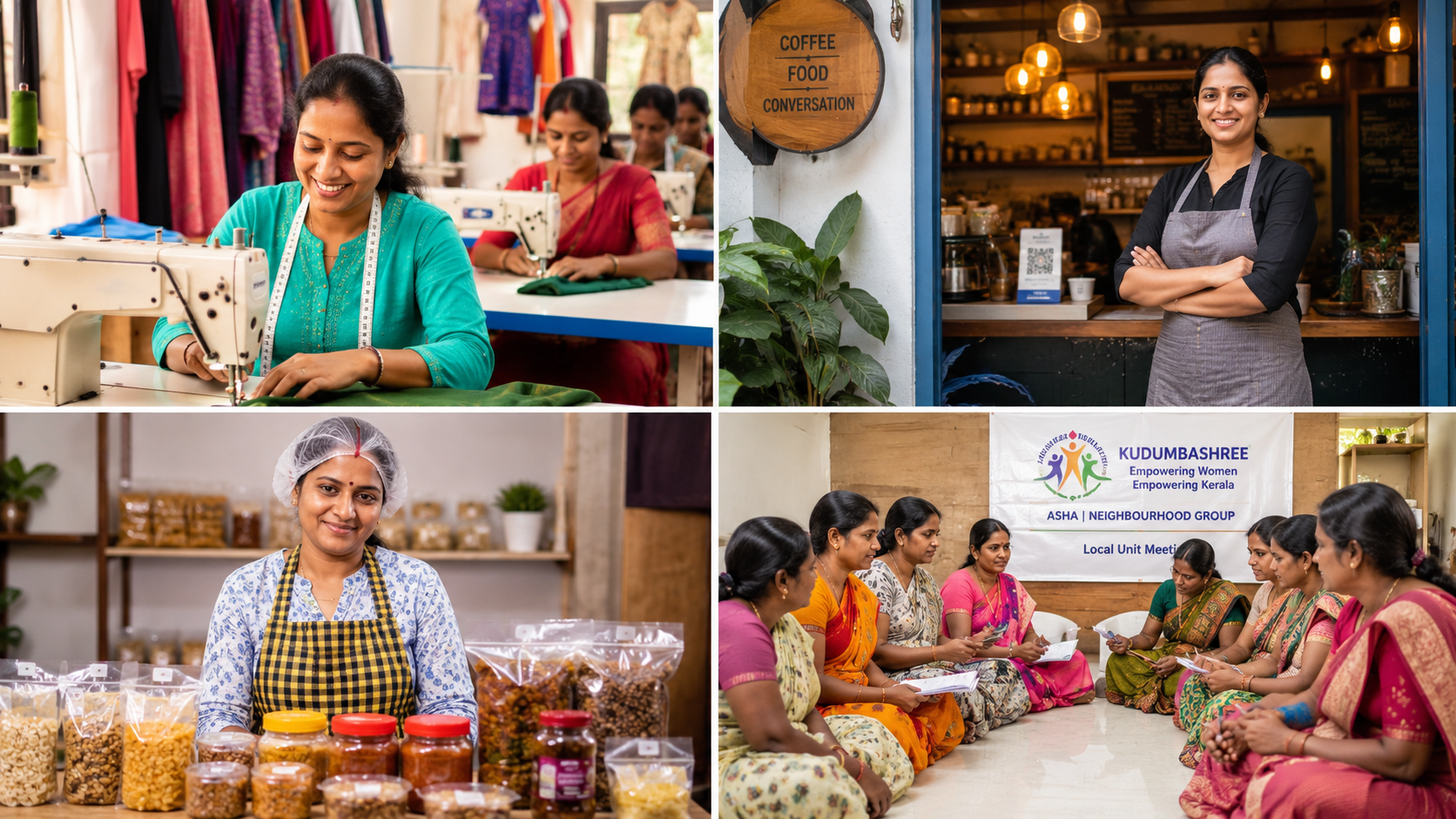
You can see it happening quietly across Kerala—in small towns, village roads, and even busy urban corners. A small café run by a first-time business owner. A tailoring unit that began in a single room and now supplies uniforms to nearby schools. A homemade food brand delivering through WhatsApp orders. Behind many of these stories is a simple but powerful shift: more women are stepping into entrepreneurship, often starting with financial support that was not easily accessible a generation ago.
Kerala has long had strong social indicators in education and health, but entrepreneurship among women is a more recent and steadily growing story. A combination of government-backed schemes, cooperative banking systems, and self-help group networks has made it easier for women to access credit, training, and small business support.
At the center of this ecosystem are multiple structured loan and support programs designed specifically to reduce financial barriers. These are not just large policy announcements—they are often practical, small-scale interventions that help women start something local and manageable, rather than immediately aiming for large industrial ventures.
One of the most visible support systems is the network of Self Help Groups (SHGs) under the Kudumbashree mission. Kudumbashree has become one of the largest women empowerment programs in India, and its reach extends into almost every panchayat in the state. Through these groups, women pool savings, access microcredit, and receive training in basic financial management and entrepreneurship.
The structure is simple but effective. Small groups of women meet regularly, contribute small savings, and become eligible for internal lending or bank-linked loans. Over time, this builds financial discipline and trust, which then opens doors to larger credit opportunities. Many micro-enterprises in Kerala—especially in food production, tailoring, and retail—have emerged directly from this system.
Alongside Kudumbashree, commercial and cooperative banks in Kerala play a major role in supporting women entrepreneurs. Schemes like the Mudra loan program under the Government of India provide collateral-free credit for micro and small enterprises. Women often use these loans to start ventures such as mobile food units, beauty salons, stationery shops, and home-based production units.
What makes Kerala’s ecosystem distinctive is not just the availability of loans, but the density of support structures around them. Local self-government institutions, women’s development corporations, and banking networks often coordinate in ways that make it easier for first-time entrepreneurs to navigate paperwork, eligibility, and repayment systems.
The Kerala State Women’s Development Corporation also provides targeted financial assistance, training programs, and entrepreneurship development courses. These programs are particularly important for women who may have the idea and motivation but lack formal business experience or exposure to financial systems.
In recent years, digital platforms have added a new layer to this ecosystem. Many women entrepreneurs now use social media and messaging apps to sell products directly, reducing dependence on traditional retail channels. This shift has lowered entry barriers further, especially for home-based businesses.
But the story is not just about access to money. It is also about changing social patterns. In many parts of Kerala, entrepreneurship among women is gradually becoming more socially accepted, especially when it contributes to household income or offers flexible work arrangements. This social acceptance plays a quiet but important role in enabling financial independence.
At the same time, challenges remain. Access to larger-scale credit is still limited for many women-led enterprises. Some businesses struggle with scaling beyond micro levels due to lack of market linkages, training in advanced business skills, or exposure to wider distribution networks. Repayment pressures can also affect very small ventures that are vulnerable to seasonal fluctuations.
There is also a gap between rural and urban opportunities. While urban women may have better access to markets, technology, and mentorship, rural entrepreneurs often depend more heavily on local demand and cooperative systems. Bridging this gap remains an ongoing policy focus.
Despite these challenges, the overall direction is clear. Women entrepreneurship in Kerala is no longer an exception—it is becoming part of the local economic landscape. Small enterprises run by women are contributing to household incomes, local employment, and community-level economic activity.
What makes this movement significant is its incremental nature. It is not driven by sudden large-scale industrial shifts but by thousands of small decisions—one loan, one micro-business, one family deciding to support a woman’s idea. Over time, these decisions accumulate into visible economic change.
The broader impact is also cultural. When women run businesses in neighborhoods, manage finances, and interact with customers daily, it slowly reshapes perceptions of leadership and economic participation. Entrepreneurship becomes not just a financial activity but a form of social visibility and agency.
Kerala’s model shows that entrepreneurship growth does not always depend on large venture capital ecosystems. Sometimes it grows through structured community banking, targeted government support, and local trust networks.
And in many ways, the real story is still unfolding—quietly, one small enterprise at a time.