
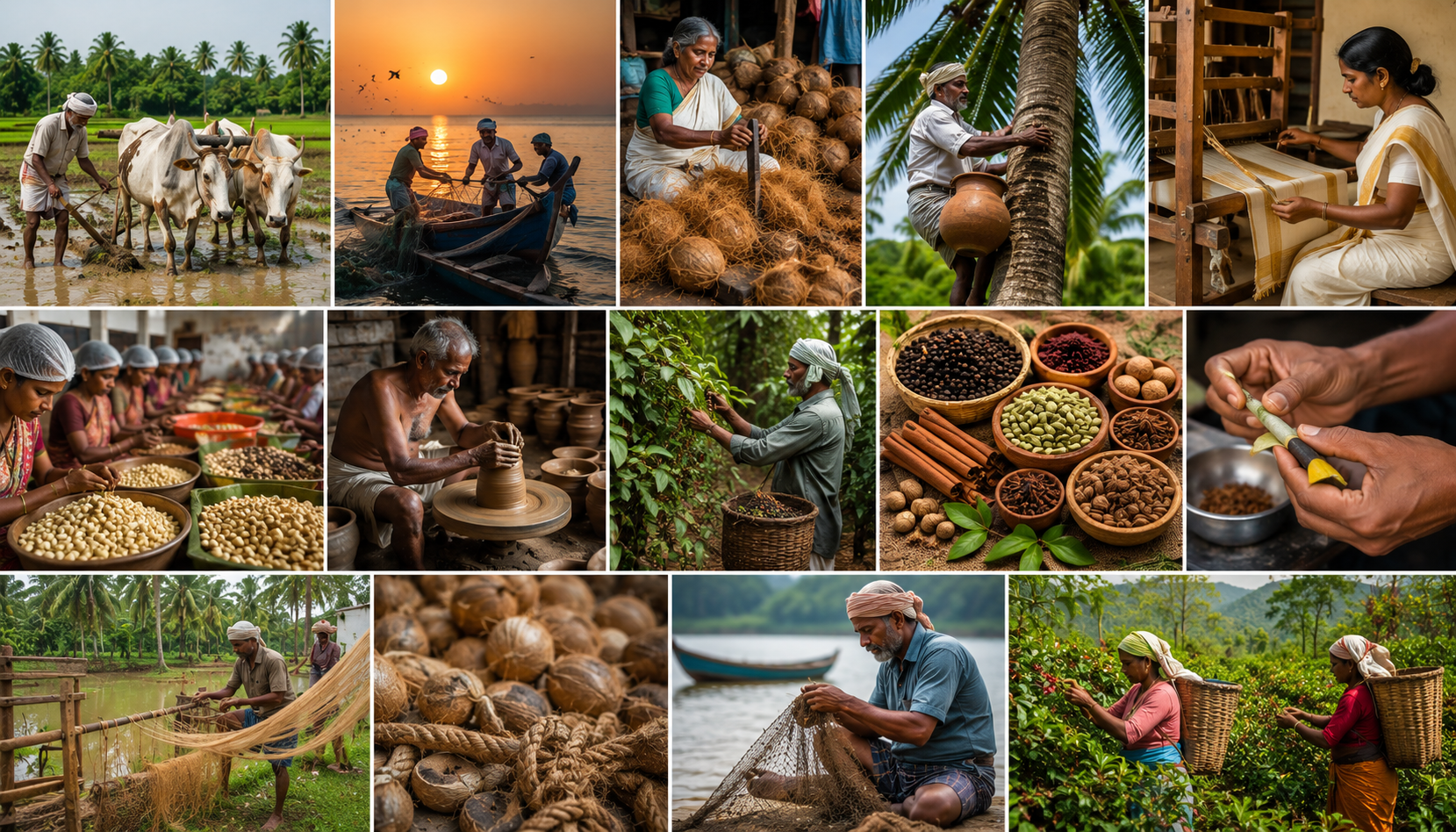
Top 10 Most Famous, Well-Known, and Popular Kerala Occupations
1. Agriculture and Paddy Farming
2. Fishing
3. Coir Making
4. Coconut Cultivation and Processing
5. Handloom Weaving
6. Toddy Tapping
7. Cashew Processing
8. Pottery Making
9. Spice Cultivation
10. Beedi Rolling
Kerala’s story is often told through its lush landscapes, rich culture, and centuries-old traditions. Yet behind every chapter of the state’s history stands a workforce that shaped its economy long before the arrival of modern industries and technology. For generations, people across Kerala depended on occupations closely tied to the land, rivers, forests, backwaters, and the Arabian Sea. These professions were not merely ways of earning a living; they formed the backbone of communities, influenced local customs, and helped define the identity of entire regions.
The traditional occupations of Kerala emerged from the state’s unique geography. Fertile paddy fields supported farming communities, while the long coastline nurtured fishing villages. Coconut groves gave rise to thriving coir and oil industries, and the spice-rich hills connected Kerala to global trade routes centuries before globalization became a familiar term.
Many of these occupations demanded remarkable skill, patience, and knowledge passed down through generations. Though modernization has transformed Kerala’s economy, these traditional livelihoods continue to hold an important place in the state’s cultural memory. They tell the story of hard work, resilience, and a deep connection between people and nature.
1. Agriculture and Paddy Farming
For centuries, agriculture was the foundation upon which Kerala’s economy was built. Before the growth of service industries and overseas employment, farming sustained a majority of the population. Vast stretches of paddy fields covered regions such as Kuttanad, Palakkad, and Thrissur, creating landscapes that became synonymous with rural Kerala.
Kuttanad, often called the “Rice Bowl of Kerala,” is particularly remarkable because much of its farming takes place below sea level. Farmers developed ingenious methods to cultivate rice in challenging conditions, demonstrating an intimate understanding of water management and seasonal cycles.
Agriculture in Kerala extended beyond rice cultivation. Farmers also grew coconut, banana, tapioca, vegetables, arecanut, and a variety of fruits. The rhythm of village life revolved around sowing and harvesting seasons. Festivals, local markets, and community gatherings were closely linked to agricultural activities. Even today, despite a decline in the agricultural workforce, farming remains one of the most respected symbols of Kerala’s heritage.
2. Fishing
Few occupations are as deeply woven into Kerala’s identity as fishing. Stretching along nearly 600 kilometres of coastline, Kerala has depended on the sea for food, trade, and livelihood for countless generations. Traditional fishing communities developed their own customs, folklore, and knowledge systems based on life at sea.
Long before modern fishing vessels arrived, fishermen ventured into the Arabian Sea in wooden boats, relying on experience and instinct to understand tides, currents, and weather patterns. Their ability to read the sea was often passed from father to son.
Fishing is more than an occupation in Kerala’s coastal villages. It shapes local cuisine, festivals, and social life. Markets across the state thrive on the daily arrival of fresh seafood, while exports of fish and marine products contribute significantly to Kerala’s economy. Despite challenges such as climate change and changing marine ecosystems, fishing continues to support thousands of families.
3. Coir Making
The coir industry stands as one of Kerala’s most distinctive traditional occupations and one that gained international recognition. Derived from coconut husks, coir is a natural fibre used to manufacture ropes, mats, carpets, brushes, and a variety of eco-friendly products.
Alappuzha emerged as the centre of the coir industry and became known globally for its exports. For decades, coir production provided employment to large numbers of workers, particularly women. The process involved soaking coconut husks, extracting fibre, spinning yarn, and weaving finished products.
What made the industry unique was its combination of traditional craftsmanship and export potential. Kerala’s coir products reached markets across Europe, North America, and Asia, turning a simple natural resource into a globally traded commodity.
4. Coconut Cultivation and Processing
It is impossible to imagine Kerala without coconut trees. In fact, many historians believe the state’s very name is derived from the words “Kera” (coconut tree) and “Alam” (land), meaning “Land of Coconuts.”
For generations, coconut cultivation has supported millions of people directly and indirectly. Farmers harvested coconuts for food, oil production, copra processing, and numerous household uses. Every part of the tree found a purpose, from leaves used in roofing to husks used in coir manufacturing.
The coconut economy created a network of occupations involving cultivation, processing, transportation, trading, and manufacturing. It remains one of the most important agricultural sectors in Kerala and continues to play a crucial role in rural livelihoods.
5. Handloom Weaving
Kerala’s handloom tradition reflects centuries of artistry and craftsmanship. Communities of weavers in places such as Balaramapuram, Chendamangalam, and Kuthampully became renowned for producing elegant handwoven textiles.
The iconic kasavu saree, with its golden border and timeless simplicity, remains one of Kerala’s most recognizable cultural symbols. Handloom weaving required precision, patience, and a mastery of techniques that were passed down through generations.
Beyond clothing, handloom products carried social and cultural significance. They became an integral part of weddings, festivals, and religious ceremonies. Even in the age of machine-made fabrics, Kerala’s handloom sector continues to preserve a rich artistic legacy.
6. Toddy Tapping
Toddy tapping is among Kerala’s oldest and most physically demanding occupations. The profession involves climbing coconut and palm trees to collect sap, which is then fermented to produce toddy, a traditional beverage enjoyed across the state.
A skilled toddy tapper may climb dozens of trees each day, often without modern safety equipment. The work requires exceptional balance, strength, and experience. Historically, toddy shops served as important social spaces in villages and towns, making toddy production an integral part of Kerala’s social and culinary culture.
Though the profession faces challenges today, toddy tapping remains a visible reminder of Kerala’s rural traditions.
7. Cashew Processing
Few industries transformed Kerala’s labour landscape as dramatically as cashew processing. Kollam emerged as India’s cashew capital and became home to hundreds of processing units that supplied markets around the world.
The industry created employment opportunities for thousands of workers, particularly women. Processing cashews involves several labour-intensive stages, including roasting, shelling, peeling, grading, and packaging.
At its peak, the cashew industry played a vital role in Kerala’s export economy and helped improve the financial independence of many families. Its influence can still be seen in communities where generations worked in the sector.
8. Pottery Making
Before steel, plastic, and modern kitchenware became common, clay vessels were an essential part of everyday life in Kerala. Pottery making was therefore an important occupation that supported communities across the state.
Traditional potters used locally sourced clay to create cooking pots, water containers, lamps, storage jars, and decorative items. The craft required both technical skill and artistic creativity.
Pottery also held cultural significance. Clay lamps continue to be used during festivals and religious ceremonies, while traditional earthen cookware remains popular among those who appreciate authentic flavours and sustainable living.
9. Spice Cultivation
Kerala’s history cannot be separated from spices. For over two thousand years, the state’s pepper, cardamom, cinnamon, cloves, and nutmeg attracted traders from Arabia, China, Europe, and beyond.
The spice-growing regions of Idukki, Wayanad, and the Western Ghats became centres of agricultural prosperity. Pepper, often called “Black Gold,” was especially valuable and played a major role in shaping international trade routes.
Even today, spices remain among Kerala’s most prized agricultural products. The industry supports farmers, traders, exporters, and processing units, continuing a legacy that helped place Kerala on the world map.
10. Beedi Rolling
For much of the twentieth century, beedi rolling provided a livelihood to thousands of families, especially in northern Kerala districts such as Kannur and Kasaragod. The occupation became particularly important for women, many of whom worked from home while managing household responsibilities.
The work involved carefully rolling tobacco in tendu leaves and tying each beedi by hand. Though seemingly simple, the process required speed, consistency, and skill.
At one time, the beedi industry was one of the largest sources of employment in northern Kerala. It played a significant role in supporting working-class households and contributed to the social and economic development of the region. While the industry has declined over the years, its impact on Kerala’s labour history remains undeniable.
Final Hands
The traditional occupations of Kerala are more than economic activities from a bygone era. They represent generations of knowledge, skill, and perseverance. From the paddy fields of Kuttanad to the fishing harbours of the coast and the spice plantations of the Western Ghats, these professions shaped the state’s economy, culture, and identity.
Although modern Kerala has diversified into technology, healthcare, education, and global business, the legacy of these occupations continues to endure. They remind us of a time when livelihoods were closely connected to nature and when communities thrived through craftsmanship, hard work, and local enterprise. Understanding these occupations is, in many ways, understanding the story of Kerala itself.