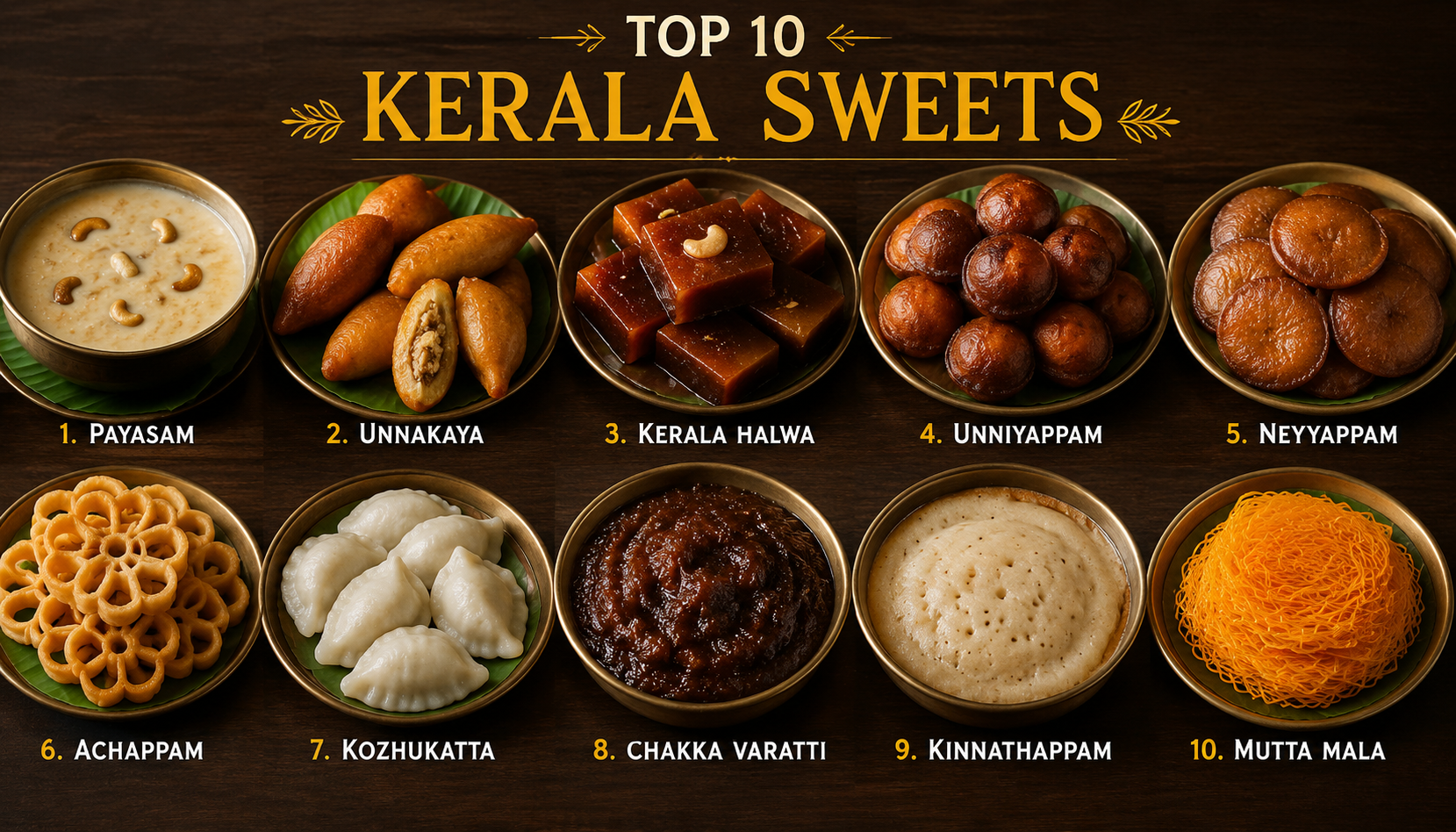
Top 10 Most Famous, Well-Known, and Popular Kerala Sweets
1. Payasam
2. Unnakaya
3. Kerala Halwa
4. Unniyappam
5. Neyyappam
6. Achappam
7. Kozhukatta
8. Chakka Varatti
9. Kinnathappam
10. Mutta Mala
Kerala sweets are less about “dessert after food” and more about culture on a plate. They come from temple kitchens, home celebrations, coastal traditions, and slow cooking methods that haven’t changed much for generations.
1. Payasam
If Kerala had a signature dessert identity, it would be payasam.
Payasam is not one single recipe—it is a family of sweets made with rice, milk, coconut milk, jaggery, sugar, and ghee. What makes it special is not complexity, but patience. It is always cooked slowly, stirred carefully, and allowed to thicken naturally.
In many homes, payasam is treated like an emotional finish to a meal. It appears in Onam sadya, weddings, housewarmings, and temple offerings. The first spoon is often shared or offered before anyone eats properly, especially in traditional settings.
The taste varies from house to house—some versions are thick and rich with coconut milk, while others are light and milky. But in every version, there is one common feeling: warmth.
2. Unnakaya
Unnakaya belongs to the Malabar side of Kerala and feels like something made with patience and care.
It starts with ripe plantains that are steamed or boiled, then mashed into a smooth dough. The filling is where the personality comes in—grated coconut, sugar or jaggery, cardamom, and sometimes nuts or raisins.
This mixture is shaped into oval forms, sealed carefully, and deep-fried until golden. The outside becomes crisp, but the inside stays soft and almost creamy.
Unnakaya is often made during evening tea time, Ramadan evenings, and family gatherings. It is not just sweet—it is filling, warm, and slightly nostalgic, like something passed down without being written down.
3. Kerala Halwa
Kerala halwa, especially the Kozhikode style, is bold and unforgettable.
Unlike lighter desserts, halwa is dense, sticky, and glossy. It is made by slowly cooking flour (rice or wheat depending on version), sugar, ghee, and water until it becomes thick and almost jelly-like. The transformation is slow but dramatic.
What makes it famous is not just taste but presentation—bright colors like red, green, and black, often displayed in glass counters in old sweet shops. It looks almost jewel-like.
People rarely eat halwa casually. It is something you buy during travel, festivals, or as a gift. It holds a sense of occasion every time.
4. Unniyappam
Unniyappam is small, but it carries huge emotional value in Kerala households.
Made from rice flour, ripe banana, jaggery, and a hint of cardamom, the batter is poured into a special pan with small round molds. Each piece is fried in oil or ghee until it turns deep brown and slightly crisp on the outside.
Inside, it remains soft and fragrant. The banana gives it a natural sweetness, while jaggery adds depth.
It is commonly made during temple festivals and home celebrations. Many people remember childhood evenings when unniyappam was made in batches, and the waiting was harder than the eating.
5. Neyyappam
Neyyappam is similar in shape to unniyappam but richer in taste and aroma.
The key difference is the generous use of ghee (“neyy”), which gives it a deeper flavor and softer texture inside. The batter is usually fermented slightly, which adds a subtle complexity.
When cooked, neyyappam develops a dark golden-brown surface with a caramelized edge. The smell itself is enough to attract people to the kitchen.
It is often associated with temple offerings, especially in central Kerala. It carries a sense of devotion as much as taste.
6. Achappam
Achappam is one of the most visually distinct Kerala snacks.
Made using a special patterned iron mold, it is dipped into a rice-flour batter and deep-fried until crisp. The result is a lace-like, flower-shaped snack that looks delicate but has a strong crunch.
It is mildly sweet, often flavored with coconut milk and sesame seeds. Traditionally, it is prepared during Christmas and special family gatherings.
Achappam also has a nostalgic value—it is one of those snacks that older generations often learned from their mothers or grandmothers, without written recipes.
7. Kozhukatta
Kozhukatta is soft, steamed, and quietly comforting.
It is made from rice flour dough shaped into small dumplings, filled with a mixture of grated coconut and jaggery. Once steamed, the outer layer becomes soft and slightly chewy, while the inside melts gently.
Unlike fried sweets, kozhukatta feels light and wholesome. It is often made during prayer days in Christian and Hindu households in Kerala.
There is something peaceful about it—it is not flashy, but it feels deeply homely.
8. Chakka Varatti
Chakka varatti is Kerala’s answer to preserving jackfruit for the long term.
Ripe jackfruit is cleaned, mashed, and cooked slowly with jaggery and ghee until it becomes a thick, dark, jam-like paste. The process takes time and constant stirring, often done in large batches during jackfruit season.
The result is intense in flavor—sweet, slightly smoky, and deeply fruity.
It is not just eaten directly. It is used as a base for many sweets like unniyappam stuffing, payasam variations, and even spread on bread or rice cakes. It represents Kerala’s “no waste” food culture beautifully.
9. Kinnathappam
Kinnathappam is soft, spongy, and quietly unique.
It is made from rice batter that is fermented slightly and steamed in a bowl-like vessel (kinnam), which gives it its shape and name. The texture is airy but slightly dense, almost like a soft cake with a traditional touch.
The sweetness is mild, not overpowering. It is often enjoyed as an evening snack rather than a festive dessert.
What makes it special is its simplicity—it doesn’t try to impress, yet it stays memorable.
10. Mutta Mala
Mutta mala is one of Kerala’s most visually dramatic sweets.
It is made from egg yolks passed through a fine sieve into boiling sugar syrup, forming thin golden strands. These strands are carefully layered to form a lace-like structure.
It is usually paired with mutta surka (sweetened egg white mixture), creating a rich and contrasting dessert combination.
Mutta mala is not an everyday sweet. It is made for special occasions—weddings, Ramadan evenings, and celebrations where food itself feels ceremonial.
Final Taste
Kerala sweets don’t rely on fancy techniques or imported ingredients. They rely on coconut, banana, jaggery, rice, and patience. And somehow, that simplicity creates flavors that stay longer in memory than on the tongue.