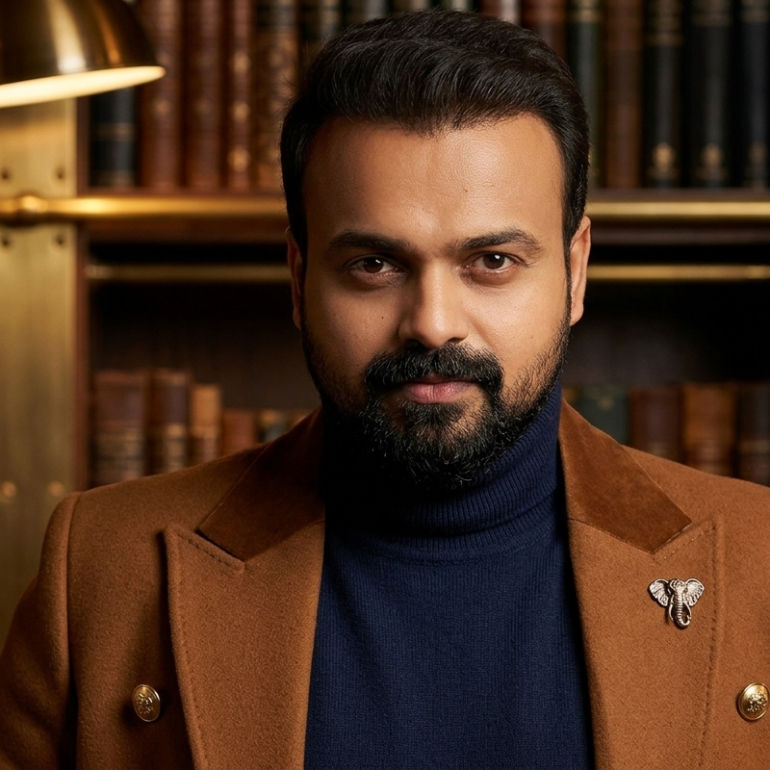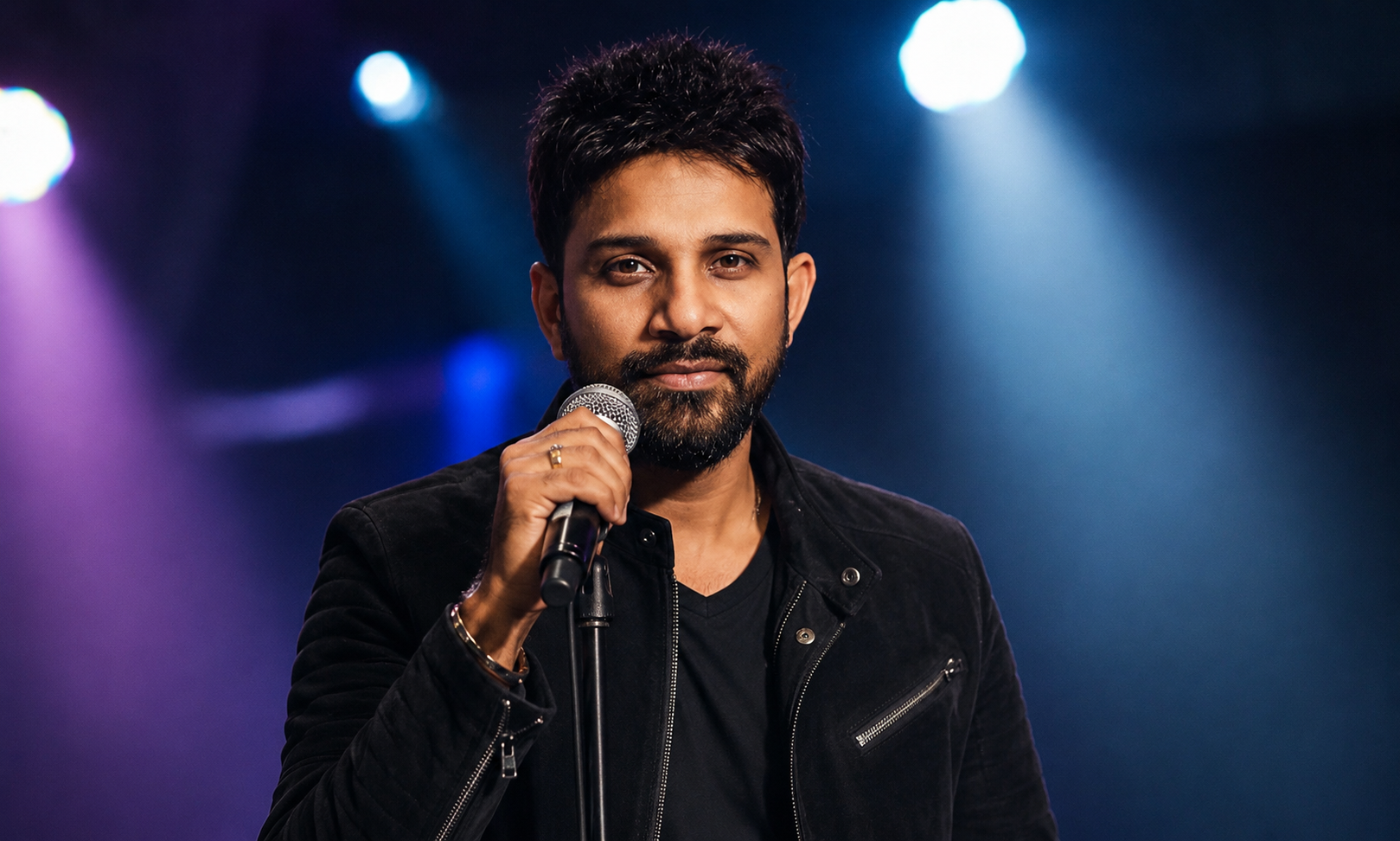
Karthik
Playback Singer
Karthik is an Indian playback singer and composer. Karthik started his professional singing career as a backing vocalist and has since been working as a playback singer. He has sung more than 8000 songs in 15+ Indian languages including Tamil, Telugu, Kannada, Malayalam, Odia, Bengali, Marathi and Hindi. Karthik was a CA aspirant before he became a professional singer.
Key Factors
Full Name: Karthik
Date of Birth: 7 November 1980
Occupation: Playback Singer, Composer
Major Collaborations: A. R. Rahman, Harris Jayaraj, Ilaiyaraaja, Devi Sri Prasad, Vidyasagar, Mani Sharma
Karthik belongs to a rare generation of Indian playback singers whose voices became inseparable from memory itself. For listeners who grew up during the explosive musical transformation of South Indian cinema in the 2000s, his songs were everywhere: in college buses and late-night FM radio shows, in headphone playlists shared between friends, in heartbreak montages, weddings, road trips, and quiet personal moments no one else ever saw. There was always something outstanding about the emotional accessibility of Karthik’s singing. He could move effortlessly from youthful romance to aching melancholy, from classical precision to playful modernity, without losing the warmth that made his voice instantly human.
Across Tamil, Telugu, Malayalam, Kannada, and Hindi cinema, Karthik emerged as one of the defining playback voices of his era. His collaborations with composers like A. R. Rahman, Harris Jayaraj, Ilaiyaraaja, and Vidyasagar shaped the soundscape of modern Indian film music. Yet beyond the technical brilliance and multilingual versatility lies something more enduring: Karthik’s ability to sound emotionally truthful, even inside the most elaborate orchestration. From Chennai’s music classrooms to the emotional heart of South Indian cinema, Karthik became the soundtrack of longing, youth, and memory.
The Voice That Defined a Generation
There are some voices that do not merely sing songs. They carry time within them.
For many Indians who came of age in the 2000s, hearing Karthik’s voice today feels like opening a carefully preserved memory box. A few seconds into “Mundhinam Paarthene,” and suddenly the world returns: crowded engineering college corridors, Nokia phones glowing in dark hostel rooms, rain-soaked bus journeys, unfinished love stories, internet cafés, handwritten letters, and the emotional turbulence of an entire generation trying to understand itself.
The remarkable thing about Karthik was not simply that he sang hit songs. South Indian cinema has always produced successful playback singers. What made him special was the emotional texture of his voice. It sounded intimate without becoming fragile, technically refined without becoming cold. He sang as though he understood the emotional life of ordinary listeners.
And perhaps that is why his songs continue to survive long after trends have faded.
A Childhood Surrounded by Music
Karthik was born on 7 November 1980 into a Tamil family with roots in the culturally rich Tiruvarur region, a landscape deeply connected to Carnatic music traditions. But it was Chennai that shaped him musically.
The city during the 1990s was undergoing a fascinating transformation. Classical music sabhas coexisted with rapidly modernizing film music studios. Cassette culture was booming. Television channels were introducing younger audiences to global music. And in the middle of all this emerged the revolutionary sound of A. R. Rahman, whose arrival permanently changed Indian film music.
Young Karthik absorbed all of it.
He trained formally in Carnatic music from an early age, developing strong classical foundations that would later become one of his greatest strengths as a playback singer. But unlike some classically trained musicians who remained confined to rigid musical structures, Karthik possessed unusual adaptability. He loved melody, experimentation, and emotional expression equally.
College cultural festivals also played a crucial role in his formation. Chennai’s competitive music circuit, especially events like Saarang at IIT Madras, became spaces where aspiring musicians discovered each other. It was a generation obsessed with Rahman’s sound, and Karthik was among the countless young dreamers hoping to somehow enter that world.
At the time, however, playback singing still felt impossibly distant.
The Chartered Accountant Who Could Not Ignore Music
Like many middle-class South Indian students of his generation, Karthik initially pursued a conventional professional path. He enrolled in Chartered Accountancy studies, attempting to balance practicality with artistic ambition.
But music refused to stay secondary.
An important turning point came through singer Srinivas, whose encouragement reportedly pushed Karthik back toward serious musical training and playback opportunities. That encouragement mattered enormously. The Indian film industry has always depended on invisible mentorships, small moments where established artists recognize potential before the world does.
Soon, Karthik found himself working as a backing vocalist in A. R. Rahman’s recording ecosystem.
To young singers of that era, Rahman’s studio represented something close to mythology. It was experimental, unpredictable, technologically advanced, and emotionally demanding. Singers were expected not merely to perform compositions, but to inhabit sonic atmospheres.
Karthik adapted quickly.
During recording sessions connected to films like Pukar, Rahman reportedly noticed the freshness and flexibility in his voice. For a young aspiring singer, there could have been no greater validation.
The boy studying accountancy was slowly becoming a playback singer.
The Arrival of a New Playback Voice
Early songs such as “Nendhukittaen” from Star announced the arrival of a singer with unusual tonal fluidity. But the real breakthrough came with youthful, energetic tracks that matched the changing sound of Indian cinema in the early 2000s.
“Enakku Oru Girlfriend” from Boys became culturally explosive. The song captured urban youth culture at a moment when Indian cinema itself was becoming more globalized, more technologically vibrant, and more rhythm-driven.
Karthik’s voice fit perfectly into this transition.
He sounded modern without sounding artificial. There was elasticity in his singing, the ability to switch between flirtation, vulnerability, mischief, and emotional sincerity within a single track.
Soon, he became one of the defining male playback voices of the decade.
A Singer Without Linguistic Borders
One of Karthik’s greatest achievements is how naturally he moved across languages.
In Indian playback singing, multilingual success is common. But true linguistic emotional authenticity is rare. Many singers master pronunciation without fully capturing emotional rhythm. Karthik managed both.
In Tamil cinema, songs like “Oru Maalai,” “Mundhinam Paarthene,” and “Ava Enna” became emotional landmarks for listeners. “Mundhinam Paarthene,” especially, evolved into one of the defining romantic songs of urban Tamil cinema, balancing tenderness and conversational intimacy with extraordinary finesse.
In Telugu cinema, he developed an equally devoted audience through tracks such as “Nijanga Nenena,” “Yedhuta Nilichindi Choodu,” and “Oh My Friend.” Telugu composers discovered that Karthik could handle both emotionally loaded melodies and energetic youth tracks with equal ease.
Kannada audiences embraced songs like “Arare Arare,” where his voice carried softness without losing emotional weight.
In Malayalam cinema too, songs such as “Pularmanjupol Nee” found listeners who connected deeply with his gentle melodic phrasing.
Then there was Hindi cinema.
Songs like “Behka” from Ghajini and “Behene De” from Raavan revealed another dimension of his artistry. “Behene De,” especially, remains one of the most emotionally textured Rahman compositions of that era. Karthik’s performance carried both surrender and spiritual yearning, floating delicately through Rahman’s layered orchestration.
Very few singers could sound this emotionally transparent in multiple languages.
The Composers and the Many Shades of Karthik
Different composers discovered different emotional colors within Karthik’s voice.
A. R. Rahman often used him for emotionally layered compositions requiring subtlety and tonal sophistication.
Harris Jayaraj leaned into Karthik’s romantic warmth, especially during the golden era of melody-heavy urban Tamil cinema.
Ilaiyaraaja, a composer notoriously demanding of technical precision, used Karthik in compositions requiring classical discipline and emotional restraint.
Composers like Devi Sri Prasad explored his youthful energy, while Vidyasagar and Mani Sharma utilized his ability to move fluidly between classical influence and cinematic accessibility.
This adaptability became Karthik’s greatest professional strength.
He never sounded trapped within one musical identity.
The Emotional Mechanics of His Voice
Technically, Karthik possesses remarkable control.
His Carnatic grounding gives him stability across difficult melodic transitions and improvisational passages. But technicality alone never explains emotional connection.
What truly defines Karthik’s singing is softness.
Even at emotional peaks, his voice rarely feels aggressive. There is a conversational humanity in his phrasing. He understands breath spaces, pauses, emotional hesitation. In romantic songs, he often sounds as though he is speaking privately to the listener rather than performing publicly.
This quality made him particularly effective in melody-driven compositions during the 2000s, an era when Indian film music still valued emotional melodic architecture before algorithmic streaming trends changed listening habits.
Compared to some contemporaries with larger, more dramatic vocal styles, Karthik specialized in emotional immediacy.
Listeners trusted his voice.
Beyond Cinema: The Search for Artistic Expansion
Like many mature playback singers, Karthik eventually sought spaces beyond film music.
Projects such as Sandham: Symphony Meets Classical Tamil revealed a musician deeply interested in literary and classical traditions. The project blended ancient Tamil poetry with contemporary musical arrangements, creating a bridge between heritage and modern listening cultures.
Songs like “Yayum Ngayum” demonstrated his ability to inhabit music outside commercial film structures.
The album gained international recognition and entered Amazon’s Top 10 International Music Albums list, proving that Karthik’s artistic ambitions extended beyond playback success.
This phase of his career reflected artistic evolution rather than reinvention.
He was no longer merely singing for cinema. He was exploring music itself.
The Man Behind the Voice
Despite enormous popularity, Karthik has largely maintained a restrained public image.
Married to Ambika Karthik, he is often described within industry circles as approachable, disciplined, and deeply respectful toward fellow musicians. Younger singers frequently speak about his humility and encouragement.
That warmth matters.
Playback singing can be intensely competitive, especially in industries where trends shift rapidly. Yet Karthik has retained goodwill across generations because he never projected arrogance.
Perhaps his voice and personality share the same emotional quality: gentleness without weakness.
Legacy of a Playback Era
Indian film music changes constantly. Genres shift. Streaming algorithms reshape listening behavior. Attention spans shorten.
Yet certain voices endure because they become attached to emotional memory rather than temporary trends.
Karthik belongs firmly in that category.
His songs helped define the soundtrack culture of the 2000s and early 2010s, a period many listeners now revisit with profound nostalgia. He arrived during a unique moment in South Indian music history, when melody, experimentation, and emotional sincerity coexisted beautifully.
More importantly, he reminded audiences that technical excellence and emotional vulnerability need not exist separately.
Today, younger singers continue to draw inspiration from his phrasing, multilingual adaptability, and emotional intelligence. But beyond influence and achievement lies something harder to measure: emotional permanence.
Long after specific film scenes fade from public memory, Karthik’s songs continue to live quietly inside people’s lives. They return unexpectedly through headphones, late-night playlists, wedding orchestras, FM radio reruns, and old conversations about youth and love.
And perhaps that is the true measure of an outstanding playback singer, not merely how successfully he sang, but how deeply his voice became part of collective memory.