Aathira Krishna
Indian violinist
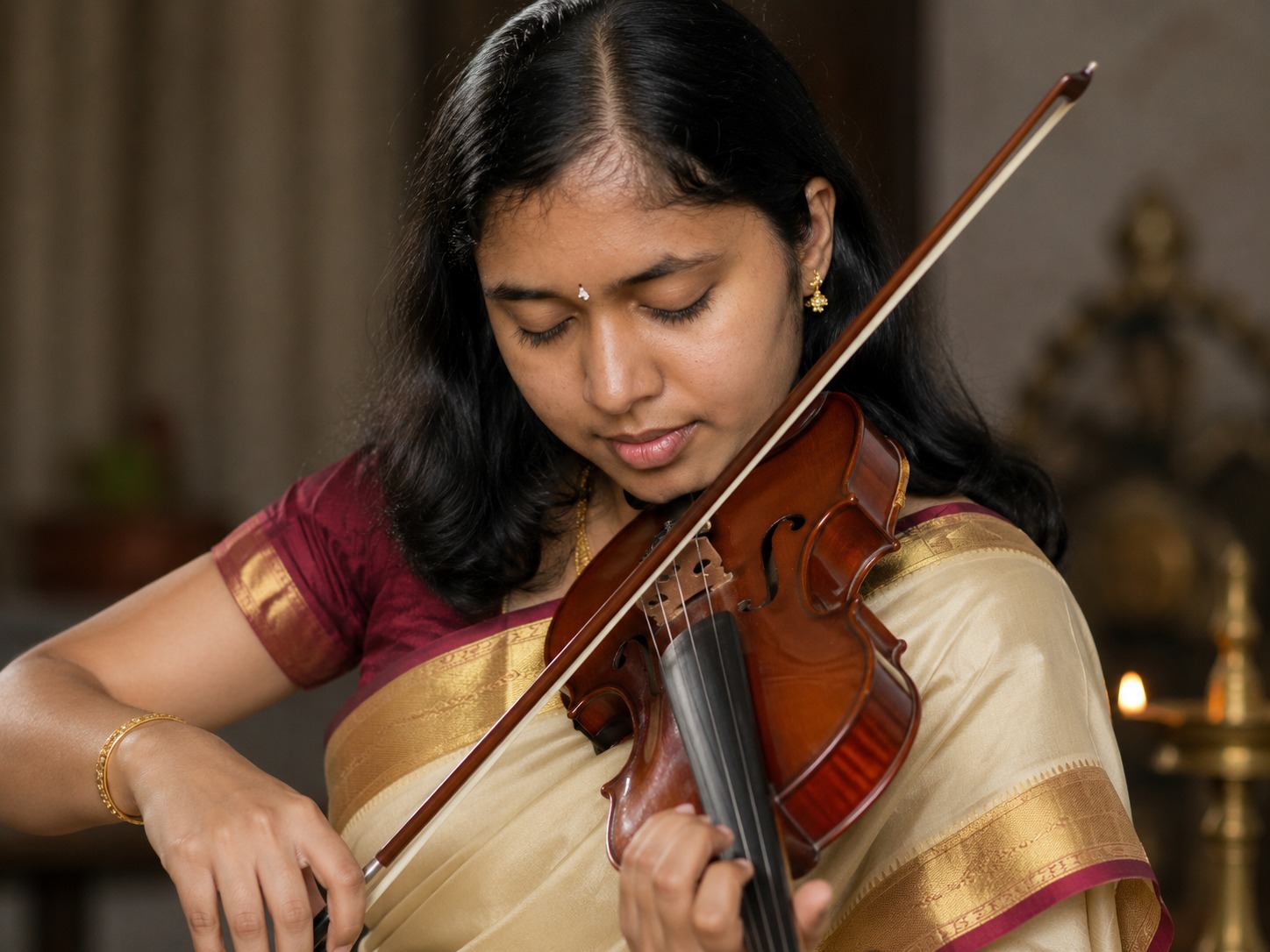
Aathira Krishna is an Indian violinist. She holds the Guinness World Record for her 32-hour-long non-stop Carnatic violin solo concert. She is among the youngest cultural ambassadors of India. Hailing from a musical family in Kerala, one of her ancestors was Vidwan Shri Gopala Pillai, a musician who belonged to the renowned Tanjore Tradition of Carnatic music.
Key Factors
Full Name: Aathira Krishna
Occupation: Violinist
Genre: Carnatic Classical Music
Known For: Guinness World Record for 32-hour non-stop Carnatic violin concert
Major Achievements: Guinness World Record, Limca Book of Records recognition
Awards & Honors: President’s National Balasree Honour, Yuva Kala Bharathi Award, Princess of Strings Award
Titles Received: “Princess of Indian Violin”, “The Musical Gem of India”
Somewhere between endurance and devotion lies the soul of Indian classical music. It is found in the unbroken vibration of a violin string, in the silence between ragas, and in the rare artist capable of transforming performance into spiritual experience. Aathira Krishna belongs to that rare tradition. An outstanding Carnatic violinist from Kerala, she emerged as a child prodigy before evolving into one of the youngest cultural ambassadors of Indian classical music on the global stage.
Best known for her astonishing 32-hour non-stop Carnatic violin solo concert that earned her a place in the Guinness World Records, Aathira Krishna’s journey extends far beyond records and accolades. Her music has travelled from the intimate discipline of Kerala’s classical households to Rashtrapati Bhavan, European churches, international festivals, and world music forums. She represents a generation of Indian classical musicians who carried ancient traditions into modern global spaces without diluting their artistic soul.
What makes her story remarkable is not merely technical brilliance, but the emotional and cultural weight behind her music, a lifelong conversation between discipline, inheritance, spirituality, and artistic endurance.
An Unbroken Vibration of a Violin string
Long before international recognition arrived, before world records and presidential invitations, music entered Aathira Krishna’s life in the most intimate way possible, through memory, repetition, and listening.
In her family home in Kerala, music was not treated as performance alone. It existed as inheritance.
The roots of that inheritance stretched deep into the Tanjore tradition of Carnatic music through Vidwan Shri Gopala Pillai, one of her ancestors associated with the respected classical lineage. In South Indian classical culture, lineage matters profoundly. Musical knowledge is often carried not merely through formal institutions, but through households where ragas drift through corridors like everyday conversation.
Aathira was born into exactly such an atmosphere.
Her father, K. C. Krishna Pillai, and mother, S. Leela Kurup, recognized her unusual sensitivity to sound early in childhood. Family members would later recall how the young child could repeat musical phrases almost instinctively after hearing her father sing them. It was not imitation alone. There was memory, pitch awareness, and emotional instinct within it.
Her most formative training came under her grandfather, Sangitha Vidwan, whose disciplined guidance shaped the foundation of her artistry. In Carnatic music, rigorous early training is indispensable. Technique is built through repetition so exhaustive that the body eventually internalizes rhythm itself.
For young Aathira, childhood was inseparable from practice.
When the Violin Became Her Voice
Interestingly, music did not begin with the violin.
Like many Carnatic musicians, Aathira initially trained in vocal music. But at the age of eight, something changed. She shifted toward the violin, an instrument capable of reproducing the human voice with astonishing emotional precision in South Indian classical music.
The transformation was rapid.
Within a remarkably short period, she began attracting attention as a prodigy. By the age of nine, she was already performing solo Carnatic violin concerts, an achievement that carried extraordinary weight in the classical music world. Solo performance in Carnatic tradition requires not only technical mastery but also emotional maturity, improvisational intelligence, and stamina.
Audiences began noticing the child with remarkable poise and astonishing control over the violin’s emotional textures.
There was discipline behind that elegance.
Carnatic violin demands absolute synchronization between rhythm and melodic imagination. Unlike purely written traditions, Carnatic music depends heavily on improvisation, especially during alapana, neraval, and kalpana swaras. For a child musician to navigate these complexities convincingly was rare.
Aathira Krishna did more than navigate them. She inhabited them naturally.
Her stage presence soon earned her affectionate titles such as “Princess of Indian Violin,” while former First Lady Usha Narayanan famously described her as “The Musical Gem of India” after witnessing her performance at Rashtrapati Bhavan.
These titles reflected not celebrity glamour, but cultural admiration for a young musician preserving classical depth while radiating unusual charisma.
The Night That Became History
In 2003, Aathira Krishna undertook a challenge that bordered on the unimaginable.
The concert was titled Nadhabrahma.
In Indian philosophical traditions, the word suggests the idea of sound itself as divine consciousness. It was an ambitious title, but what followed justified its scale.
For thirty-two continuous hours, Aathira performed a non-stop South Indian classical violin concert dedicated to global peace and harmony.
To understand the enormity of this feat, one must understand the physical demands of Carnatic violin performance. Unlike short concert formats, extended performance requires relentless muscular control, rhythmic concentration, emotional consistency, and mental clarity under exhaustion.
As hours passed, Nadhabrahma transformed from performance into endurance ritual.
Audiences arrived and left. Musicians observed in disbelief. Organizers monitored the attempt carefully. Yet Aathira continued, maintaining musical coherence through fatigue, sleep deprivation, and physical strain.
The violin became an extension of sheer willpower.
When the performance concluded after thirty-two hours, it entered the Guinness World Records and later the Limca Book of Records as well.
But the achievement resonated beyond records.
Indian classical music has historically emphasized spiritual discipline alongside technical brilliance. Nadhabrahma embodied that philosophy dramatically. It was not simply a test of stamina; it became a statement about devotion to art itself.
For many observers, the event permanently transformed Aathira Krishna from prodigy into cultural phenomenon.
Carrying Carnatic Music Across Borders
Indian classical music often struggles against assumptions that it belongs exclusively within traditional spaces. Aathira Krishna’s career quietly challenged that perception.
She represented Carnatic music internationally at a remarkably young age.
Twice invited to perform at Rashtrapati Bhavan, she emerged as a visible cultural representative of India’s classical traditions. In 2005, she was invited to present the inaugural concert celebrating the 74th birthday of President A. P. J. Abdul Kalam, a figure deeply associated with Indian scientific and cultural aspiration.
Yet her journey extended far beyond India.
At the prestigious International Children’s Assembly in New Delhi in 2001, she presented a paper on “Violin in South Indian Classical Music,” demonstrating not only performance talent but also intellectual engagement with musical history.
In Kazakhstan during the Millennium Celebrations, she presented a thematic “World Music Night” incorporating musical traditions from more than twenty nations. Such performances reflected a broader vision, positioning Carnatic music not as isolated heritage but as part of global musical dialogue.
Her appearances in Russia further reinforced this cultural role. She became one of the youngest speakers at the lecture-demonstration section of the Internal MuSIC Festival, discussing the violin’s place within Indian classical traditions.
Then came Germany.
At the international festival Jazz Meets Classics in Menden, Aathira Krishna performed before audiences accustomed to vastly different musical structures. Yet the emotional universality of her playing transcended linguistic and cultural barriers.
Perhaps most symbolically, she became the first Indian classical musician to perform at the thousand-year-old church at Kaiserwerth in Germany.
The image itself feels cinematic, a Carnatic violin resonating within ancient European architecture, centuries and civilizations meeting through sound.
The Emotional Architecture of Her Music
Technically, Aathira Krishna’s violin playing reflects strong grounding in Carnatic orthodoxy. But what distinguishes her artistry is emotional accessibility.
Carnatic violin can often appear intimidating to unfamiliar listeners because of its mathematical complexity and improvisational density. Aathira’s performances retained classical rigor while remaining emotionally open.
Her bowing style carried remarkable fluidity. Notes unfolded with vocal-like continuity, preserving the gamaka-rich emotionality central to Carnatic expression. Critics and listeners frequently observed the lyrical softness within her phrasing, even during technically demanding passages.
There was also unusual emotional discipline in her stage presence.
Unlike performers relying on theatrical gestures, Aathira often projected calm concentration. The music itself carried the emotional architecture.
This combination, technical purity without emotional distance, helped broaden her appeal internationally.
Recognition Beyond Records
Awards followed naturally, though they rarely define classical artists fully.
Aathira Krishna received the prestigious President’s National Balasree Honour for being recognized as “the best outstanding creative child musician of India.” The recognition acknowledged not simply talent but extraordinary artistic maturity at a young age.
She also received the Yuva Kala Bharathi Award from Bharat Kalachar, an institution respected within Indian classical arts.
At the Rotasia World Conference in 2006, she was honored with the Princess of Strings Award, further cementing her image as one of India’s most promising violinists.
Yet perhaps her most important contribution lies elsewhere.
In an era when younger audiences increasingly drifted toward digital entertainment and global pop culture, Aathira Krishna represented the possibility that Indian classical music could remain internationally relevant without sacrificing authenticity.
She became proof that Carnatic traditions could travel globally while preserving their spiritual and artistic depth.
A Violin Beyond Boundaries
Every generation of classical musicians faces the same challenge: how to preserve tradition without freezing it into museum culture.
Aathira Krishna’s journey offers one compelling answer.
Her career stands at the intersection of discipline, heritage, endurance, and cultural diplomacy. From Kerala’s musical households to international concert stages, from childhood prodigy to Guinness World Record holder, she carried Carnatic violin into spaces where Indian classical music was often unfamiliar yet deeply welcomed.
What makes her story enduring is not simply achievement, but intention. Her music consistently attempted to connect, between generations, nations, traditions, and emotional worlds.
In the end, perhaps that is the deepest meaning of Nadhabrahma. Sound not merely as performance, but as shared human experience.
And through decades of dedication, Aathira Krishna continues to embody that outstanding possibility, that music, when pursued with sincerity and discipline, can travel beyond language, geography, and time itself.
Awards and honours
Honored with the title of “The Musical Gem of India” by the former first lady of India, Usha Narayanan
“President’s National Balasree Honour” for “the best outstanding creative child musician of India”
Guinness book of world records for her unique 32 hour-long non-stop violin concert dedicated to global peace and harmony
Yuva Kala Bharathi Awards by Bharat Kalachar.
Princess of Strings Award 2006 from Rotasia World Conference
She is the only Indian classical musician to perform at the prestigious International Music Festival Jazz Meets Classics in Germany