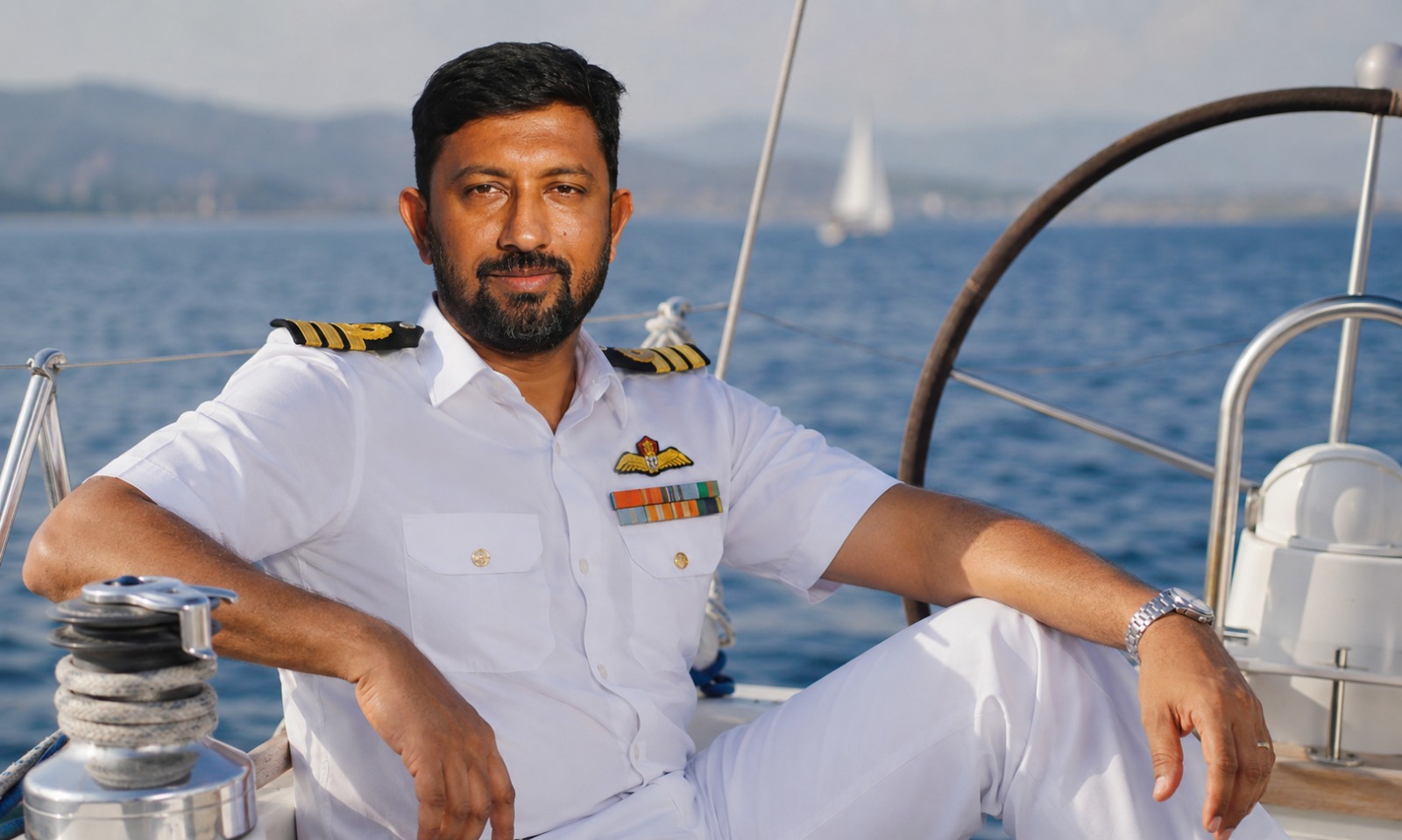
Abhilash Tomy
Indian Navy officer (Retd), Naval Aviator & Yachtsman
Commander Abhilash Tomy, is a retired Indian Navy officer, naval aviator and yachtsman. He is the first Indian to complete a solo, non-stop circumnavigation of the world under sail. He also competed in the 2018 Golden Globe Race. In January 2021, he retired from military service to concentrate on the 2022 Golden Globe Race. He finished second in the race, becoming the only Asian skipper to win a podium finish in a round the world race. Abhilash Tomy is one of the two sons born to Lieutenant commander V. C. Tomy, a former Naval Officer, and Valsamma. Abhilash Tomy was born in Changanacherry in Kerala. Upon completing his schooling, he joined the Naval Academy in Goa, from where he was commissioned into the navy in the year 2000. He completed his flying training in 2002, qualifying as a maritime reconnaissance pilot on the Dornier 228.
Key Factors
Full Name: Commander Abhilash Tomy, KC, NM (Retd)
Born: 1979
Birthplace: Changanassery, Kerala
Profession: Naval Officer, Naval Aviator, Yachtsman
Known For: Solo non-stop circumnavigation of the globe under sail
In the violent emptiness of the Southern Ocean, where waves rise like moving mountains and winds can dismantle a yacht within minutes, Abhilash Tomy once found himself alone with a shattered spine, a damaged boat, and thousands of nautical miles separating him from land. The sea around him was merciless. Communication was limited. Rescue was uncertain. Yet even in that moment, floating somewhere beneath grey Antarctic skies during the 2018 Golden Globe Race, Tomy represented something larger than individual survival. He had already become one of the most outstanding Malayali adventurers of modern India, a sailor who carried Kerala’s maritime spirit into the world’s most unforgiving waters.
For many Indians, ocean sailing remains distant and abstract, overshadowed by cricket stadiums and mountain expeditions. But Abhilash Tomy transformed solo circumnavigation into a story of national imagination. As a naval aviator, disciplined officer, and relentless yachtsman, he pushed India into elite global sailing circles through feats that demanded not only physical endurance but extreme psychological resilience. From the coastlines of Kerala to the lonely capes of the Southern Hemisphere, his life became a meditation on courage, silence, navigation, and the stubborn human instinct to continue even after disaster.
Early Life in Kerala
Abhilash Tomy was born in Kerala, a land historically shaped by monsoons, rivers, ports, fishermen, traders, and centuries of maritime exchange. Though modern Kerala is rarely associated with competitive ocean sailing, the relationship between Malayalis and the sea runs deep through its cultural memory.
Tomy grew up in a family where discipline and service already formed part of everyday life. His father, Lieutenant Commander V. C. Tomy, had served in the Indian Navy, and stories of military life naturally entered the household atmosphere. His mother, Valsamma, provided the emotional grounding of a family constantly shaped by ambition and movement.
There was nothing flamboyant about his childhood. By most accounts, it was rooted in structure, education, and persistence rather than spectacle. Yet the proximity to naval culture quietly planted something important in him, a fascination with endurance, machinery, navigation, and the open sea.
Kerala itself became foundational to his temperament. The state’s combination of discipline, literacy, migration culture, and emotional resilience would later echo through his sailing life. Even decades later, while navigating oceans alone, Tomy often carried himself with the calm restraint associated with Kerala’s military and maritime traditions.
After completing school, he joined the Naval Academy in Goa, stepping fully into the world that had hovered around his childhood.
From Naval Officer to Naval Aviator
The Indian Navy shaped Abhilash Tomy long before the oceans made him famous.
Commissioned into service in 2000, he entered a military institution where technical precision, psychological stability, and physical endurance are inseparable. Naval training is designed not merely to teach skill but to cultivate composure under pressure, a quality that would later become central to his survival at sea.
In 2002, Tomy qualified as a maritime reconnaissance pilot on the Dornier 228 aircraft. Flying maritime patrol missions demanded concentration, situational awareness, and deep familiarity with the ocean itself. Unlike commercial flying, naval aviation often involves surveillance, coordination, navigation, and environmental reading under difficult conditions.
The sea ceased to be scenery. It became a living operational environment.
Military life also introduced him to leadership and isolation. Naval officers spend long periods away from home, functioning in tightly disciplined systems where decision-making can carry life-or-death consequences. Those experiences would later prove crucial during solo sailing, where every technical failure, weather shift, or navigational error becomes intensely personal.
The Navy gave him more than training. It gave him a psychological framework for surviving uncertainty.
Discovering the Call of the Ocean
Before becoming globally known for solo circumnavigation, Abhilash Tomy spent years learning the culture and discipline of competitive sailing.
He represented India in multiple international events, including the Cape Town to Rio Race and the Asian Sailing Championship. These experiences introduced him to offshore racing, where endurance matters more than glamour and sailors develop intimate relationships with weather systems, equipment, and exhaustion.
A turning point came through the Indian Navy’s ambitious sailing initiatives under Vice Admiral M. P. Awati. The Navy commissioned the construction of the yacht INSV Mhadei, a vessel that would become central to India’s ocean-sailing ambitions.
When Commander Dilip Donde undertook the first Sagar Parikrama circumnavigation mission, Tomy served as part of the shore support crew. Watching Donde’s historic voyage changed his own horizon permanently.
He was no longer merely fascinated by sailing.
He wanted to cross oceans alone.
The Historic Solo Circumnavigation
On 1 November 2012, Abhilash Tomy departed from the Gateway of India aboard INSV Mhadei for Sagar Parikrama 2, India’s first solo non-stop circumnavigation mission under sail.
What followed was one of the most remarkable voyages in Indian maritime history.
Solo circumnavigation is not simply travel. It is prolonged isolation under relentless environmental pressure. Sailors must navigate storms, equipment failures, sleep deprivation, navigation calculations, psychological fatigue, and physical deterioration without assistance.
Tomy sailed across the world’s most feared waters, around the Cape of Good Hope, Cape Leeuwin, and the legendary Cape Horn. The Southern Ocean, especially, remains one of the most dangerous environments on Earth, where massive swells and freezing winds test even elite sailors.
For months, he lived alone at sea.
There were no crowds, no rescue teams nearby, no comforting routines of land. Only shifting weather maps, sails, instruments, stars, and the enormous silence of open water.
After covering roughly 23,100 nautical miles, Tomy returned to Mumbai on 31 March 2013.
The achievement was historic. He became the first Indian, second Asian, and among a very small number of people globally to complete a solo non-stop circumnavigation under sail.
India had entered the elite world of long-distance ocean sailing.
And Kerala had produced one of its boldest modern navigators.
The Golden Globe Race and the Storm That Changed Everything
In 2018, Tomy entered the legendary Golden Globe Race, among the most difficult sailing competitions in the world.
The race deliberately rejects modern technological assistance, forcing sailors to navigate much like ocean racers from earlier generations. Competitors endure extreme isolation for months while sailing through some of the planet’s harshest waters.
Tomy was the only Asian entrant.
Eighty-two days into the race, disaster struck in the Southern Ocean. A violent storm dismasted and severely damaged his yacht. During the chaos, he suffered catastrophic spinal injuries.
Far from land and barely mobile, he remained trapped inside a damaged vessel while multinational rescue operations coordinated across dangerous weather systems to reach him.
The story captured international attention not only because of the rescue itself, but because of Tomy’s extraordinary composure during the crisis.
For many sailors, the 2018 race would have ended the dream permanently.
For Abhilash Tomy, it became the beginning of something even more difficult.
The Extraordinary Comeback
Recovery after the 2018 accident was brutal.
Tomy underwent major treatment, eventually living with a titanium rod inserted into his spine. Physically and psychologically, the injury could easily have closed the chapter on competitive sailing forever.
Instead, he returned to preparation.
In 2021, he took premature retirement from the Indian Navy to focus entirely on the next Golden Globe Race. It was an enormous personal gamble. Competitive ocean sailing offers neither the financial security nor institutional structure of mainstream sports.
Yet Tomy remained obsessed with unfinished water.
His comeback reflected something deeper than ambition. It revealed the mentality elite sailors often describe, the inability to remain onshore once the ocean has reshaped your identity.
Preparation for the 2022 race demanded rebuilding strength, adapting physically to injury, and enduring months of technical planning.
He was sailing again not with a fully healed body, but with pain permanently embedded inside him.
Second Place in the 2022 Golden Globe Race
When the 2022 Golden Globe Race began from Les Sables-d’Olonne, Abhilash Tomy returned to the same unforgiving world that had nearly killed him four years earlier.
For 236 days, he sailed non-stop across the globe.
The achievement itself would have been extraordinary even without his injury history. But Tomy did more than finish. He secured second place overall, becoming the first Asian sailor ever to achieve a podium finish in a solo round-the-world race.
International sailing communities viewed the accomplishment with enormous respect.
This was no longer merely an Indian story. It became a global story of endurance and redemption.
The image of Tomy arriving after months at sea, carrying both physical scars and historic achievement, elevated him into one of the most respected figures in contemporary offshore sailing.
Abhilash Tomy and Kerala’s Maritime Pride
Kerala has always lived beside water.
From ancient spice trade routes to fishing communities along the Arabian Sea, maritime culture runs quietly through the state’s history. Yet modern ocean sailing rarely occupied public imagination in Kerala until figures like Abhilash Tomy emerged.
He represents a different model of Malayali achievement, not corporate success or cinema fame, but disciplined exploration rooted in courage and endurance.
For young Indians interested in defence services, sailing, or adventure sports, Tomy expanded what seemed possible. He showed that a Malayali naval officer from Kerala could compete in the world’s harshest endurance events and stand alongside elite global sailors.
His achievements also strengthened India’s maritime identity at a time when the country increasingly seeks to project itself as an oceanic power.
Personality, Discipline, and Philosophy
Those who have interacted with Abhilash Tomy often describe him as understated rather than theatrical.
That personality suits ocean sailing.
Solo sailors survive not through loud confidence but through emotional regulation, technical competence, and the ability to endure monotony and fear simultaneously. Tomy’s naval background reinforced those instincts.
His interviews frequently reveal humility rather than self-celebration. He speaks practically about storms, navigation, fatigue, and recovery. There is little romanticism in the way he describes suffering.
Yet beneath that restraint lies extraordinary mental toughness.
To survive alone at sea for months requires unusual psychological architecture. Sailors must manage fear without panic, loneliness without collapse, and uncertainty without paralysis.
Tomy appears to approach the ocean not as an enemy to conquer, but as a force demanding respect.
Legacy and Inspiration
Commander Abhilash Tomy occupies a singular place in Indian maritime history.
He helped transform offshore sailing from an obscure pursuit into a national story of endurance and ambition. His voyages demonstrated that India could participate meaningfully in elite global sailing culture, not symbolically, but competitively.
For Kerala, he represents something equally important: the continuation of a maritime imagination that stretches from ancient seafarers to modern navigators.
His story resonates because it is ultimately about persistence. Not the dramatic persistence of cinema, but the quieter, harder version built through discipline, pain, repetition, and solitude.
Long after races end and headlines fade, Abhilash Tomy will remain one of the most outstanding Malayali adventurers of modern India, a sailor who crossed impossible oceans, survived devastating storms, and returned to sea again not because it was easy, but because the horizon itself had become part of who he was.
Awards and decorations
2013 – Kirti Chakra (Second officer in the navy to be awarded KC)
2019 – Nau Sena Medal
2009, 2013, 2018 – YAI Offshore Sailor of the Year
2013 – Amrita TV Award for Outstanding Human Endurance and Courage
2012 – Tenzing Norgay National Adventure Award
Only Indian in the International Association of Cape Horners
2013 – Mac Gregor Medal for military reconnaissance
2009 – CNS Commendation
National Maritime Foundation Award
Achievements
Only Indian and 2nd Asian to sail solo, non stop, around the Earth
Runner-up at the 2022 Golden Globe Race
Shore support for Sagar Parikrama I (Navy’s first solo circumnavigation expedition)
Yacht Services Manager of Volvo Ocean Race 2008 stopover at Kochi
Podium finishes in Korea Cup 2014 and 2015
Bronze medal in YAI Nationals 2015
Author of “151 Solitary Days at Sea, Sailing Non-stop, Around the World”, “Kadal Ottakku Kshanichappol” and “Journey to the Edge of the Earth”
Council member of the Yachting Association of India