Aishwarya Sridhar
Wild life photographer
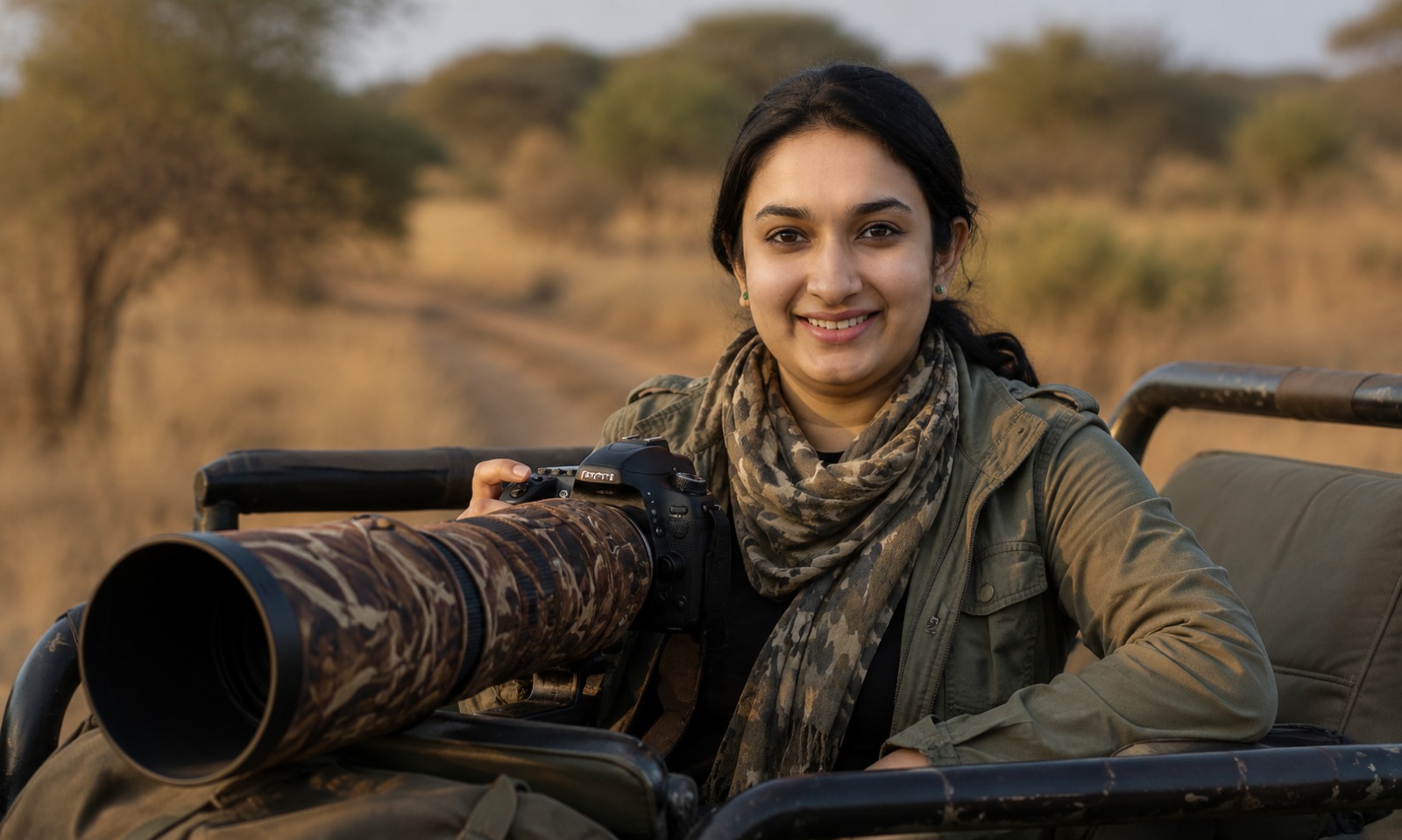
Aishwarya Sridhar is an Indian wildlife photographer, wildlife presenter, and documentary filmmaker residing in Navi Mumbai. She is the youngest girl to have won the Sanctuary Asia- Young Naturalist Award and the International Camera Fair Award. In 2020, Aishwarya became the first Indian woman to win Wildlife Photographer of the Year award. She is also a member of the State Wetland Identification Committee appointed by the Bombay High Court.
Key Facts
Full Name: Aishwarya Sridhar
Born: 12 January 1997
Occupation: Wildlife Photographer, Documentary Filmmaker, Wildlife Presenter
Before sunrise, the forest is never truly silent. There is the low rustle of leaves disturbed by unseen movement, the distant warning call of deer, the sudden tremor of wings cutting through wet morning air. Somewhere inside that fragile wilderness stands Aishwarya Sridhar, waiting patiently behind her lens, not merely to photograph an animal, but to understand a living world constantly threatened by human indifference. Her work carries the stillness of observation and the urgency of activism at the same time.
In 2020, when Aishwarya became the first Indian woman to win the prestigious Wildlife Photographer of the Year award, it was more than an individual achievement. It marked the arrival of a new generation of Indian environmental storytellers, young, globally aware, visually sophisticated, and deeply rooted in conservation ethics. But awards alone do not explain her journey. What makes Aishwarya remarkable is the way she transforms photography and filmmaking into acts of ecological witness. Through wetlands, forests, tigers, migratory birds, and vanishing landscapes, she has emerged as an outstanding Malayali-origin voice in Indian environmental storytelling, combining art, activism, and science with rare emotional intelligence.
Childhood, Family, and Kerala Roots
Although Aishwarya Sridhar grew up in Mumbai and Navi Mumbai, her cultural upbringing carried strong South Indian influences rooted in a Tamil family environment with deep Malayali connections. Her childhood was not shaped by urban glamour or celebrity culture, but by forests, bird calls, monsoon landscapes, and long treks into wilderness areas with her father.
Her father, a member of the Bombay Natural History Society, introduced her early to India’s ecological richness. Weekend outings were not shopping mall visits or entertainment trips. They were journeys into mangroves, forests, and wetlands. These experiences quietly transformed the way she looked at the world.
Nature, for Aishwarya, was never abstract. It was intimate.
She often accompanied her father on treks through the forests of Ratnagiri in Maharashtra, places where biodiversity still survives despite relentless urban expansion. As a child, she learned to observe patiently, to notice movement in silence, and to respect landscapes without attempting to dominate them. Those lessons later became central to both her photography and filmmaking philosophy.
Her South Indian upbringing also nurtured a certain emotional sensitivity toward ecology. Like many families connected to Kerala’s cultural traditions, there existed an understanding of nature not merely as scenery, but as something spiritually and emotionally intertwined with daily life. That sensibility quietly echoes through her work even today.
Education and Academic Excellence
Long before international awards and documentaries, Aishwarya Sridhar was already recognised for extraordinary academic discipline.
At Dr Pillai Global Academy in New Panvel, she emerged as the world topper in Business Studies in the Cambridge International Examinations in 2013, a remarkable achievement that revealed her intellectual sharpness beyond creative pursuits.
Her academic success reflected a future many would have considered ideal, conventional professional success, financial stability, perhaps corporate leadership. Instead, she chose an uncertain path built around wildlife, storytelling, and environmental conservation.
Later, while studying Mass Media at Pillai College, she became increasingly drawn toward visual communication and documentary filmmaking. The transition from academic excellence to environmental storytelling was not impulsive. It reflected a deeper recognition that stories could influence public consciousness in ways statistics and reports often could not.
That understanding became crucial to her later career.
Unlike many wildlife photographers who approach the medium purely artistically, Aishwarya approached it as communication, advocacy, and evidence.
The Birth of a Wildlife Storyteller
Aishwarya’s relationship with photography began when she was just thirteen years old.
At first, it was fascination, the thrill of capturing birds, forests, and fleeting natural moments. But wildlife photography quickly revealed itself to be far more demanding than ordinary image-making. It required discipline, physical endurance, technical skill, and emotional resilience.
Wildlife photography is often romanticised from the outside. The reality is harsher.
Long hours in extreme weather. Dangerous terrain. Failed expeditions. Endless waiting. Unpredictable animal behaviour. Technical setbacks. Physical exhaustion.
For a young woman entering this world in India, the challenges were even greater. Wildlife photography and conservation filmmaking remain heavily male-dominated spaces where fieldwork often demands solitary travel, late-night expeditions, and work in isolated landscapes.
Aishwarya entered these spaces very young.
What distinguished her early was not only technical talent, but narrative instinct. Even before global recognition, her photographs carried emotional context. She was not interested merely in dramatic predator imagery or aesthetic spectacle. She wanted viewers to feel connected to ecosystems themselves.
That instinct gradually transformed her from photographer into storyteller.
Breakthrough Success and Global Recognition
Recognition arrived early, but never accidentally.
Aishwarya became the youngest girl to win the Sanctuary Asia Young Naturalist Award, one of India’s respected honours for emerging conservation voices. She also received the International Camera Fair Award, further establishing herself within wildlife photography circles.
Then came the breakthrough that transformed her into an international figure.
In 2020, she became the first Indian woman to win the Wildlife Photographer of the Year award, organised by the Natural History Museum in London. The achievement carried enormous symbolic weight within Indian environmental media.
Indian wildlife photography already had a strong tradition, but women remained significantly underrepresented at the global level. Aishwarya’s victory challenged that imbalance.
International conservation communities recognised not only the artistic quality of her work, but the ecological sensitivity behind it. Her photographs did not sensationalise wildlife. They emphasised coexistence, vulnerability, and fragile ecosystems under pressure.
Media outlets including BBC Wildlife, The Guardian, and major Indian publications began covering her work extensively.
Yet even amid rising fame, Aishwarya continued focusing on conservation storytelling rather than celebrity visibility.
Documentary Filmmaking and Conservation Activism
If photography made Aishwarya visible, filmmaking revealed the full depth of her environmental commitment.
Her documentary Panje – The Last Wetland, telecast on DD National in 2018, became one of the defining moments of her career.
The film documented the ecological destruction threatening the Panje wetland in Uran near Navi Mumbai, a critical habitat for migratory birds and biodiversity. Instead of presenting the wetland as distant environmental tragedy, the documentary humanised the crisis, showing how urban expansion and land reclamation were erasing fragile ecosystems.
The impact moved beyond cinema.
The documentary contributed to public awareness and legal attention surrounding the wetland issue. Eventually, the Bombay High Court intervened to halt reclamation efforts.
This was not merely filmmaking.
It was environmental intervention through storytelling.
Her later film The Queen of Taru, centred around the wild Bengal tigress Maya, demonstrated a different aspect of her cinematic philosophy. Rather than portraying the tiger simply as a predator or symbol of power, the documentary explored territory, motherhood, survival, and the fragile balance between humans and wildlife.
The film received the Best Amateur Film Award at the Wildlife Conservation Film Festival in New York City, further strengthening her international reputation.
What distinguishes Aishwarya’s filmmaking is restraint.
She avoids turning wildlife into spectacle alone. Her films consistently foreground ecological ethics and emotional connection rather than sensationalism.
National Geographic Explorer and Bambee Studios
As her career evolved, Aishwarya became a National Geographic Explorer, an important recognition within global environmental storytelling networks.
The role connected her work to broader international conversations around climate change, biodiversity collapse, and ecological preservation.
She also co-founded Bambee Studios, a production company focused on natural history and environmental documentaries in India. The studio reflects an important shift happening in Indian media, the emergence of locally rooted ecological storytelling rather than imported wildlife narratives.
For decades, natural history filmmaking in India remained heavily influenced by western documentary traditions. Aishwarya’s work represents a younger generation attempting to build distinctly Indian environmental narratives, grounded in local ecosystems, communities, and conservation realities.
In many ways, she belongs to a generation redefining what environmental communication can look like in India.
A Woman in Indian Wildlife Media
Wildlife media often celebrates adventure while quietly ignoring structural inequality.
Fieldwork remains difficult for women due to safety concerns, logistical limitations, social expectations, and industry bias. Aishwarya has navigated these realities while building credibility in a profession that frequently questions young women’s authority.
Her success matters because it expands representation within conservation spaces.
Young women entering wildlife photography today can now imagine careers that previously seemed inaccessible. But Aishwarya’s significance goes beyond symbolism. She has succeeded through technical excellence, consistency, and rigorous storytelling standards rather than performative visibility.
That distinction is important.
She represents competence first, inspiration second.
Writing, Poetry, and Inner World
Beyond photography and filmmaking, Aishwarya is also a writer and poet, something that becomes visible in the emotional texture of her work.
Her photographs often feel literary.
They linger not only on animals, but on atmosphere, silence, rain-soaked landscapes, fading light, and ecological melancholy. There is often an awareness of fragility behind the frame, as if the image understands that the world it captures may not survive unchanged.
This poetic sensibility separates documentation from art.
For Aishwarya, forests are not merely ecosystems. They are emotional spaces carrying memory, tension, beauty, and grief.
Public Image, Legacy, and Future
In contemporary India, where environmental conversations are increasingly overshadowed by rapid urbanisation and political noise, Aishwarya Sridhar occupies a uniquely important position.
She represents a generation refusing to separate storytelling from activism.
Her work demonstrates that environmental communication can be emotionally powerful without sacrificing scientific seriousness. She belongs to a new class of Indian wildlife storytellers who understand that conservation today depends not only on policy, but on narrative, empathy, and public imagination.
The future possibilities before her are vast, international documentary filmmaking, large-scale conservation initiatives, global climate storytelling, and leadership within environmental communication networks.
But perhaps her greatest contribution already exists in the quiet transformation she creates in audiences.
After seeing her work, forests stop feeling distant.
Wetlands stop feeling invisible.
Wildlife stops feeling abstract.
That may ultimately become Aishwarya Sridhar’s lasting legacy, not simply the awards she won, but the emotional bridge she built between people and the natural world. In doing so, she has emerged as an outstanding Malayali-origin environmental storyteller whose images and films remind modern India that conservation is not only about protecting animals, but about protecting memory, belonging, and the fragile future of life itself.
Awards and recognition
2011: Sanctuary Asia’s Young Naturalist Award
2013: World Topper in Cambridge International Exams in Business Studies
2014: World Sparrow Day Photography and Poem competition- 2nd prize
2016: International Camera Fair Award
2018: Young Digital Camera Photographer of the Year-Winner-Small World
2019: Princess Diana Award
2019: Woman Icon India Award
2020: Jackson Wild Fellowship
2020: Wildlife Photographer of the Year by Natural History Museum, London