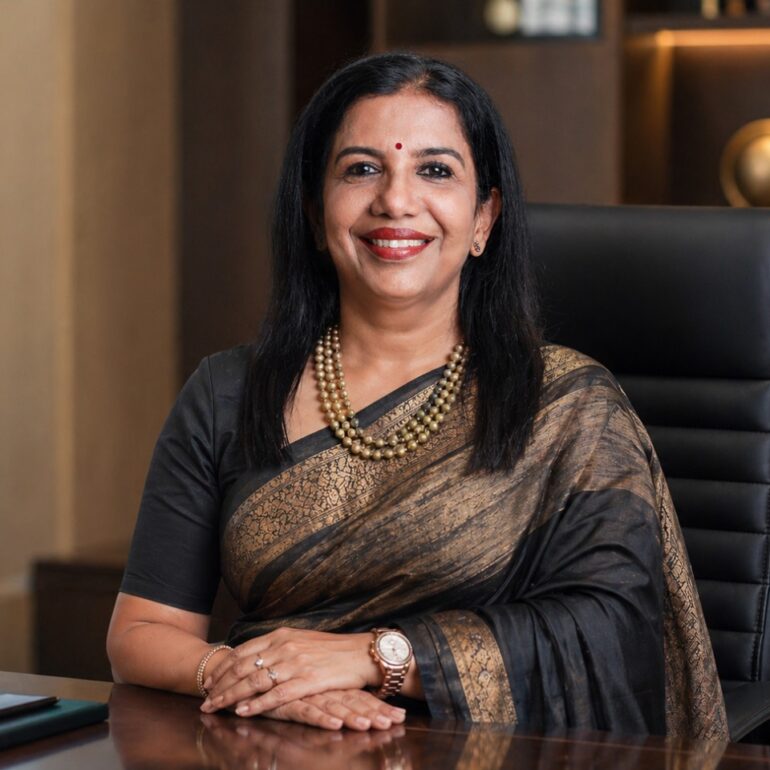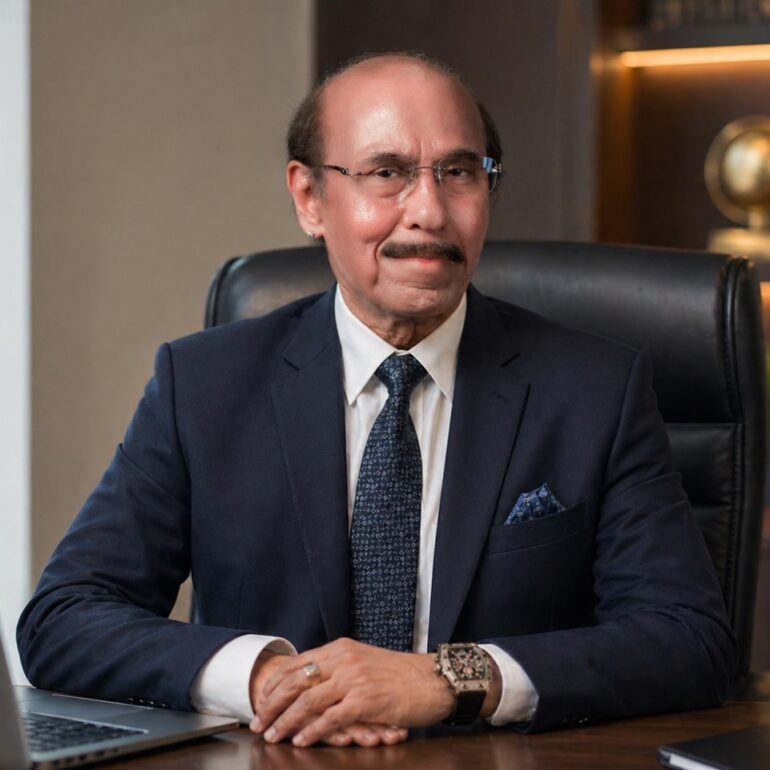
P. Sulaiman
Founder & Chairman of HiLITE Group
P. Sulaiman, the Chairman of HiLITE Group, embodies the spirit of achieving dreams through commitment and hard work. Over the past 29 years, he has emerged as an influential figure by crafting Kerala’s first-ever mall, Focus Mall, in 2007.
Key Facts
Title: Founder of HiLITE
A City That Did Not Exist Before
On the outskirts of Kozhikode, where the city once dissolved into quieter residential stretches, a different skyline has taken shape. Glass-fronted towers, a sprawling mall, office blocks, and residential clusters now coexist in a carefully orchestrated density. This is not accidental growth. It is designed concentration. At the centre of it stands P. Sulaiman, the entrepreneur behind HiLITE Group, who has spent nearly three decades translating a regional city’s latent demand into built form. His work is not just about buildings, but about reimagining how urban life can function in Kerala. It is an outstanding case of ambition meeting geography, where constraints are negotiated, not avoided.
A First-Generation Builder of Opportunity
Unlike many industrial legacies in Kerala that trace back to trading families or inherited capital, Sulaiman’s trajectory belongs to a different category, first-generation entrepreneurship shaped by observation and risk.
Publicly available accounts of his early life remain relatively sparse, but what emerges consistently is a pattern familiar across Kerala’s entrepreneurial class of the 1990s. Exposure to a growing Gulf-influenced economy, awareness of remittance-driven consumption, and an understanding that infrastructure lagged behind aspiration.
In 1996, he founded HiLITE Constructions. At the time, Kerala’s real estate sector was fragmented, dominated by small-scale developers, with limited institutional structure and minimal standardisation.
Entering this market required not just capital, but conviction that demand would eventually catch up with supply.
Sulaiman’s early work focused on residential and commercial projects, but even in these initial phases, there was an implicit shift in thinking. He was not building isolated structures. He was testing the possibility of scale.
Building HiLITE: From Projects to an Ecosystem
Over time, HiLITE evolved beyond a conventional construction company.
The transition is critical to understanding Sulaiman’s strategy. Rather than remaining within the predictable margins of real estate development, he expanded into a multi-vertical model that included retail, IT infrastructure, education, and healthcare.
This was not diversification for its own sake. It was ecosystem building. Projects like HiLITE City illustrate this approach. Instead of developing standalone properties, the group began creating integrated environments where residential, commercial, and retail spaces reinforce each other.
This model addresses a structural limitation in Kerala’s urban development. Cities in the state are dense but not always functionally integrated. Work, residence, and consumption are often spatially separated.
By compressing these functions into a single development, HiLITE effectively created micro-urban centres.
Today, the group’s footprint spans multiple sectors, with HiLITE City and its associated infrastructure acting as a flagship representation of this philosophy.
Reinventing Kerala’s Urban Experience
If there is a single intervention that marks Sulaiman’s impact most visibly, it is the introduction and scaling of organised retail spaces in North Kerala.
Before malls like Focus Mall and later HiLITE Mall, retail in Kozhikode and surrounding regions was largely high-street based. Fragmented, unstructured, and limited in experiential value.
The arrival of organised malls did more than consolidate brands under one roof. It altered consumer behaviour.
Shopping became a destination activity rather than a transactional necessity. Multiplexes, food courts, and entertainment spaces created a layered experience that extended beyond retail.
HiLITE Mall, in particular, expanded this concept at scale. With its size and tenant mix, it positioned Kozhikode as a regional retail hub, drawing consumers not just from the city, but from surrounding districts.
This shift reflects a broader socio-economic transition in Kerala. Rising incomes, exposure to global consumption patterns, and a younger demographic have collectively reshaped expectations.
Sulaiman’s timing aligned with this transition.
Scale with Social Intent
Sulaiman’s public statements and business decisions suggest a philosophy that balances commercial ambition with socio-economic impact.
A recurring theme is employment generation. Large-scale developments like HiLITE City are not just revenue centres. They function as employment ecosystems, spanning retail staff, construction workers, IT professionals, and service providers.
This approach aligns with Kerala’s economic reality. The state has high literacy and human capital but limited industrial infrastructure. Large integrated projects can partially bridge this gap by creating localised economic clusters.
At the same time, Sulaiman’s strategy reflects long-term thinking. Real estate, particularly in Kerala, is subject to cyclical demand, regulatory constraints, and land limitations. Building at scale requires patience and the ability to absorb short-term volatility.
HiLITE’s expansion suggests a willingness to prioritise long-term positioning over immediate returns.
Signature Projects and Strategic Bets
Several projects define HiLITE’s trajectory.
HiLITE City stands as the most ambitious, a mixed-use development combining residential towers, retail spaces, office infrastructure, and public amenities.
The Business Park component signals a strategic move into IT infrastructure, aligning with Kerala’s push to decentralise technology hubs beyond cities like Kochi and Thiruvananthapuram.
Retail expansion remains a core pillar, with malls acting as both revenue drivers and brand anchors.
These projects are interconnected. Retail drives footfall. Office spaces create daily occupancy. Residential units ensure long-term engagement.
This integrated approach reduces dependency on a single revenue stream. It also increases complexity.
Managing such ecosystems requires coordination across sectors, regulatory frameworks, and stakeholder groups. Execution risk remains high, particularly in a state known for its bureaucratic layers and land-use constraints.
Challenges, Criticism, and Market Realities
No real estate narrative in Kerala is complete without acknowledging constraints.
Land acquisition is complex. Regulatory approvals can be slow. Environmental considerations are stringent. Public scrutiny is high.
HiLITE’s scale inevitably attracts both attention and criticism. Large developments raise questions about sustainability, urban congestion, and equitable growth.
Market cycles add another layer of uncertainty. Demand in real estate can fluctuate sharply, influenced by economic conditions, migration patterns, and policy changes.
Competition has also intensified. Both regional developers and national players are increasingly entering Kerala’s urban markets.
Sulaiman’s challenge lies in maintaining differentiation. Integrated ecosystems provide an advantage, but they also require continuous reinvestment and adaptation.
The Man Behind the Brand
Sulaiman maintains a relatively low public profile compared to the scale of his projects.
This understated presence contrasts with the visibility of his developments. The buildings speak louder than the individual.
Within industry circles, he is often described as strategic and execution-focused. Decisions appear to be guided less by short-term market signals and more by long-term positioning.
Family involvement exists, as is common in Indian business groups, but HiLITE’s growth suggests an increasing institutionalisation of operations.
This transition, from founder-driven execution to structured management, will be critical for future scalability.
Legacy and the Road Ahead
P. Sulaiman’s contribution to Kerala’s urban landscape is measurable.
He has helped shift Kozhikode from a traditional commercial town into a more structured urban centre with defined retail and business districts.
But legacy in real estate is not just about what is built. It is about how those spaces function over time. HiLITE’s developments will be judged on sustainability, adaptability, and continued relevance.
Looking ahead, several factors will shape the group’s trajectory. Digital commerce is altering retail dynamics. Remote work is reshaping office demand. Sustainability is becoming non-negotiable.
For HiLITE, the next phase may require recalibration. For Sulaiman, success appears to be defined less by completion and more by continuity.
In that sense, his journey remains open-ended.
What he has built so far is not just infrastructure, but a framework for how regional cities in India can evolve, deliberately, strategically, and at scale.
And that, in itself, is an outstanding transformation.