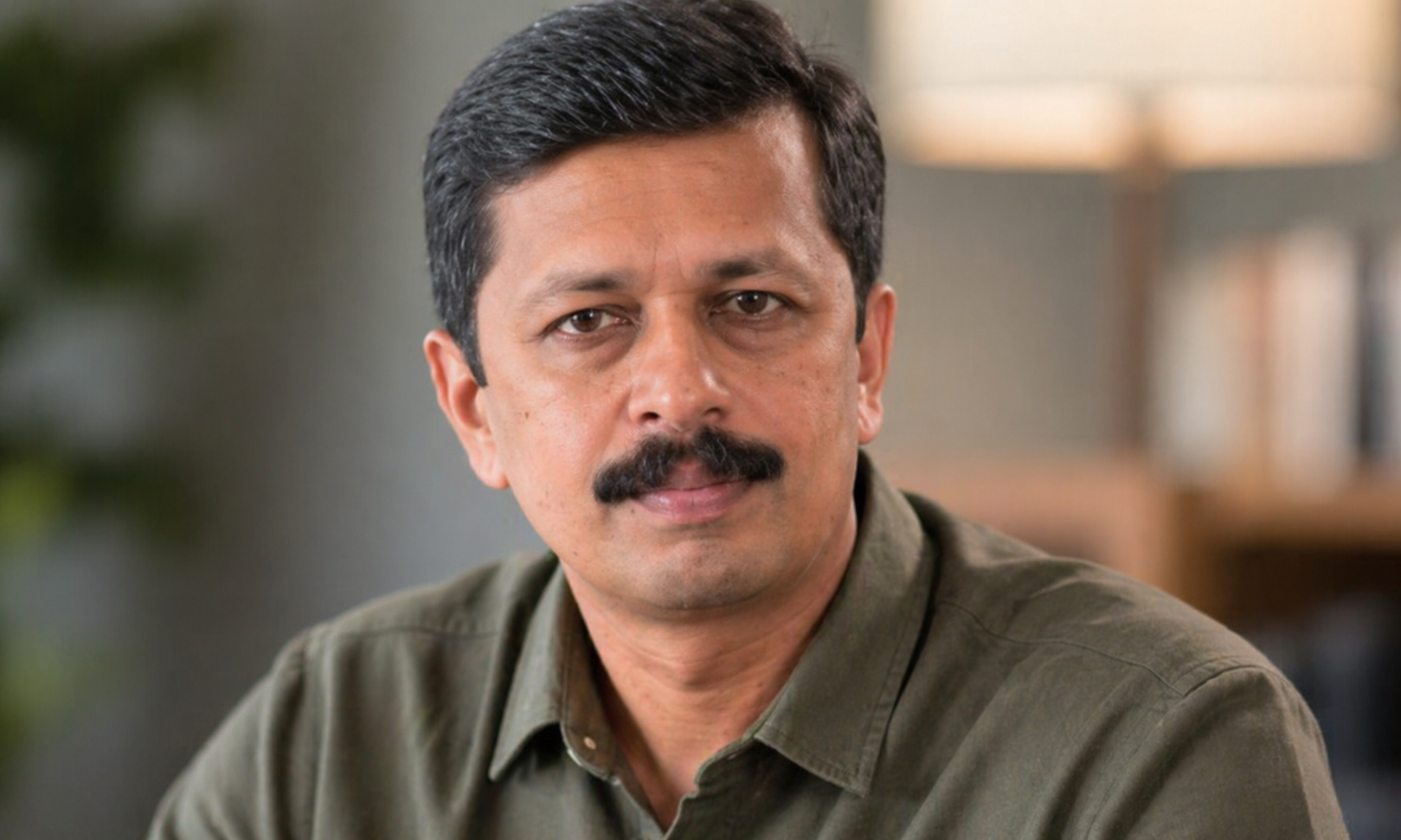
S. Hareesh
Born: 15 May 1975 (age 50)
Place: Neendoor, Kottayam, Kerala, India
Title: Writer, Screenwriter
Genre: Novel, short story, translations, films
Years active: 1995–present
A Landscape of Stories and Power
S. Hareesh was born in Kerala, in a socio-cultural environment layered with contradictions. The state is often described through its progressive achievements, literacy, political awareness, and social reform. Yet, beneath this narrative lies a complex history of caste hierarchies, ritual practices, and localized power structures.
Hareesh grew up within this layered reality.
His early environment was not merely geographical but cultural, shaped by oral traditions, local myths, temple rituals, and everyday conversations that carried unspoken codes. These influences would later become central to his writing.
Kerala’s literary culture also played a formative role. Reading is not an isolated activity in the state; it is embedded in public life. Newspapers, literary magazines, and debates form part of the intellectual atmosphere.
Hareesh absorbed this culture but did not replicate it.
Instead, he developed a sensibility that questioned its assumptions, particularly the gap between Kerala’s progressive self-image and its underlying social realities.
A Voice Emerging from the Margins of Form
Hareesh entered Malayalam literature through short stories, a form that has historically been central to the state’s literary tradition.
His early works did not conform to established narrative expectations. They resisted linear storytelling, often blending realism with elements of the surreal. Characters appeared rooted in recognizable settings, yet their actions and experiences carried an undercurrent of distortion.
These stories gained attention within literary circles for their distinct tone.
They did not announce themselves loudly. Instead, they lingered. Readers encountered them not as straightforward narratives but as experiences that demanded interpretation.
Influenced by both Malayalam literary traditions and global currents of experimental fiction, Hareesh positioned himself at an intersection, where folklore, modernity, and psychological exploration could coexist.
The Shock and Substance of Meesha
Hareesh’s most widely known work, Meesha, represents both a literary achievement and a cultural flashpoint.
The novel is not easily reducible to a single narrative thread. It moves through multiple layers, personal histories, social structures, and mythic undertones, constructing a world where caste, sexuality, and power intersect.
At its core, Meesha examines how systems of control are sustained.
Not through overt violence alone, but through ritual, belief, and internalized hierarchies. The novel’s treatment of caste is neither didactic nor abstract. It is embedded in everyday interactions, gestures, and silences.
The controversy surrounding the book, triggered by a serialized excerpt that was perceived as offensive to temple-going women, led to protests and threats, forcing Hareesh to temporarily withdraw the work. The episode transformed Meesha from a literary text into a site of public debate.
Yet, beyond the controversy, the novel stands as a complex exploration of Kerala’s social fabric.
Hareesh’s other works, including his short story collections, continue to explore similar terrains, fragmented realities, unsettling imagery, and narratives that resist closure. Translations of his work into English and other languages have expanded his readership, situating him within broader discussions of Indian contemporary literature.
Themes and Literary Style: Folklore, Power, and the Uncanny
S. Hareesh’s writing operates within a distinctive thematic and stylistic framework.
Caste is central.
Not as a static category, but as a dynamic force that shapes relationships, desires, and perceptions. His narratives expose how caste operates subtly, embedded in everyday life rather than confined to explicit conflict.
Sexuality appears as another recurring theme, often intertwined with power. Desire in Hareesh’s work is rarely romantic. It is charged, ambiguous, sometimes unsettling.
Folklore plays a crucial role.
Drawing from Kerala’s oral storytelling traditions, he incorporates mythic elements into contemporary settings. These are not nostalgic references but active components of narrative, shaping how characters understand their world.
His style blends realism with surrealism.
Scenes begin in familiar environments but gradually shift, introducing elements that disrupt conventional logic. This creates a sense of unease, where the reader is never entirely certain of what is real and what is imagined.
Language is both grounded and experimental.
He uses colloquial Malayalam alongside layered narrative structures, allowing multiple voices and perspectives to coexist.
Literature as a Site of Conflict
The Meesha controversy revealed more than public sensitivity.
It exposed the tensions within Kerala’s socio-political landscape, where progressive ideals coexist with deeply ingrained conservatism.
The objections to the novel centered on a perceived insult to religious practices. However, the intensity of the reaction pointed to broader anxieties about representation, who has the right to depict, critique, or reinterpret cultural traditions.
Hareesh’s decision to withdraw the novel, followed by its later reinstatement, became part of the narrative.
It raised questions about censorship, the role of writers, and the limits of artistic freedom.
In this context, Hareesh’s work cannot be separated from its reception.
It exists not only as literature but as a participant in public discourse.
Expanding Narrative Possibilities
Within contemporary Malayalam literature, S. Hareesh occupies a distinct position.
Writers like Benoy Thomas and Subhash Chandran explore psychological and philosophical themes, while others engage directly with social realism.
Hareesh bridges these approaches.
His work is socially grounded yet stylistically experimental. It engages with real issues, caste, power, identity, while employing narrative techniques that challenge conventional realism.
This duality expands the possibilities of Malayalam fiction.
It allows for narratives that are both politically relevant and formally innovative.
A Writer Who Divides and Persists
Hareesh’s work has received critical acclaim as well as sustained debate.
Awards and recognitions acknowledge his contribution to contemporary literature, but his reputation is shaped as much by controversy as by praise.
Readers often respond to his writing in polarized ways.
Some see it as a necessary confrontation with uncomfortable truths. Others view it as excessively provocative.
This division is not incidental.
It reflects the nature of his work, which does not seek consensus.
His influence on younger writers is already visible.
There is a growing interest in blending folklore with modern themes, in experimenting with narrative form, and in addressing social issues through indirect, layered storytelling.
Writing Against Comfort
S. Hareesh’s writing emerges from a specific place, Kerala’s complex social and cultural landscape, but it speaks to broader concerns about power, identity, and the stories societies tell themselves.
He does not offer clarity. He complicates.
His narratives resist resolution, leaving readers in a space of discomfort that mirrors the unresolved tensions of the world they inhabit.
In a literary culture that often seeks coherence, Hareesh insists on fragmentation. In a society that prefers certainty, he foregrounds ambiguity.
This is what makes his work necessary.
It challenges not just what is written, but how it is read.
His evolving voice suggests that Malayalam literature continues to expand, not by abandoning tradition, but by interrogating it.
That is his outstanding contribution, to write against comfort, and in doing so, to reveal the uneasy truths that lie beneath it.
Awards and recognition
2008 – Geetha Hiranyam Endowment by Kerala Sahitya Akademi (Rasavidyayude Charithram)
2009: Thomas Mundassery Award for short story
2018: Kerala Sahitya Akademi Award for the Best Story Writer (Adam)
2020: V. P. Sivakumar Memorial Keli Award
2020: Nandanar Award
2017: Kerala State Film Award for Best Screenplay (Aedan)
2020: JCB Prize for Literature (Moustache – English translation of Meesa)
2019: Kerala Sahitya Akademi Award for Novel which was announced in February 2021