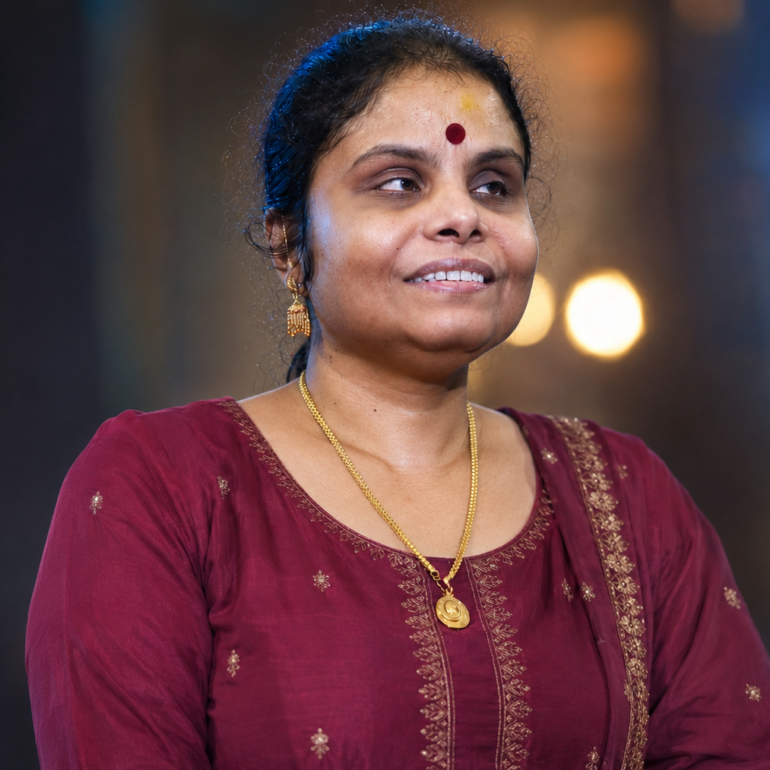
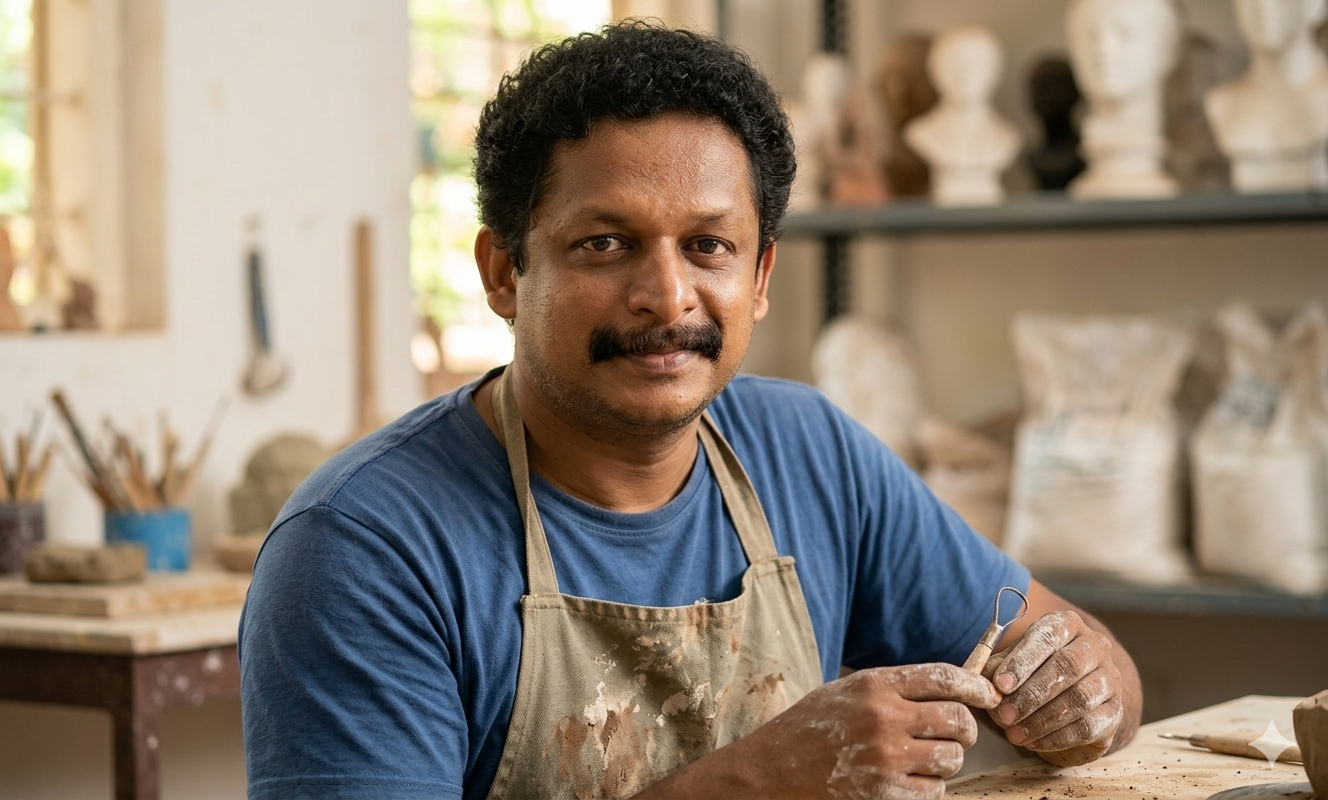
Mahesh K Narayanan
Top Sculpture Artist in Kerala
Mahesh K Narayanan is a visual artist from Kerala whose work reflects a deep sensitivity to memory, rural landscapes, and everyday human experiences. Through his practice, he explores how ordinary spaces quietly shape emotion, identity, and imagination.
Born: May 26, 1985
Place: Pulassery, Pattambi, Palakkad, Kerala
Education: Diploma in painting, Shilpachitra Fine Arts College, Pattambi
Form Rising from the Earth
The first encounter with a sculpture by Mahesh K Narayanan rarely feels like an encounter with an object. It feels closer to stepping into a memory, one shaped by soil, weather, and the slow erosion of time. His surfaces are rarely polished to perfection. They retain the marks of making, the drag of fingers through wet cement, the resistance of material. In these textures lies an outstanding tension, between permanence and decay, between what is built and what is being lost. His figures do not merely occupy space. They seem to emerge from it, as if the land itself has chosen to remember something before it disappears.
A Rural Imagination
Mahesh K Narayanan was born on May 26, 1985, in Pulassery, a village near Pattambi in Kerala’s Palakkad district. This geography is not incidental to his work. It is foundational.
Growing up in a rural environment, he was surrounded by agricultural rhythms, seasonal changes, and a way of life deeply embedded in ecological cycles. The village was not just a setting but a system of relationships, between humans, animals, land, and tradition. These early experiences would later reappear in his work, not as direct representations, but as emotional and conceptual undercurrents.
His childhood exposure to folk practices, temple art, and everyday craft traditions offered a visual vocabulary that differed from formal academic art. It was tactile, functional, and rooted in lived experience.
This grounding in rural life continues to inform his artistic sensibility. His sculptures often carry a quiet nostalgia, not sentimental, but observational, reflecting a world that is gradually receding under the pressures of modernization.
From Canvas to Form
Mahesh’s formal entry into art came through his training at Pattambi Shilpachitra Fine Arts College, where he pursued a diploma in painting and graduated with first-class honors.
Painting, rather than sculpture, was his initial discipline.
His early works focused on visual storytelling through color and composition, often exploring themes of nature, community, and environmental change. His time working in his elder brother’s studio as a commercial artist further refined his technical skills, particularly in composition, surface treatment, and visual communication.
The transition to sculpture, however, was almost accidental.
During the construction of his house, leftover cement became a medium of experimentation. What began as a casual attempt to create a half-length figure evolved into a turning point. The tactile immediacy of sculpting, the ability to shape form directly with the hand, opened up new possibilities.
From that moment, sculpture became central to his practice.
Without formal academic training in sculpture, he adopted a self-directed learning approach, assisting established sculptors in Kerala and absorbing techniques through observation and practice. This apprenticeship-based learning gave his work a certain rawness, an absence of rigid academic formalism.
Material, Form, and Process: The Language of Substance
Mahesh K Narayanan’s sculptural language is deeply material-driven.
He frequently works with cement, clay, metal, and mixed media, materials that are accessible, durable, and capable of holding texture. Cement, in particular, plays a central role in his work. It allows for scale, flexibility, and a certain immediacy that aligns with his intuitive process.
His surfaces are rarely smooth. They are marked, layered, and often deliberately uneven. These textures are not decorative. They carry meaning. They evoke erosion, weathering, and the passage of time.
His process is iterative. Forms are built, reworked, and sometimes partially erased. This gives his sculptures a sense of incompletion, as if they are still in the process of becoming. It also reflects his conceptual interest in transformation, how identities, landscapes, and traditions evolve or disappear.
Relief sculpture is another important aspect of his practice. Drawing from Kerala’s visual traditions, he creates wall-based works that integrate mythological motifs, flora, fauna, and human figures into dense, layered compositions.
Themes and Conceptual Framework: Ecology, Memory, and Loss
At the conceptual core of Mahesh’s work is a sustained engagement with environmental and cultural change.
His sculptures often address:
- Deforestation and ecological degradation
- Urbanization and displacement
- Loss of traditional lifestyles
- The intrusion of industrial systems into natural environments
One of his notable works, Maramuthashi, installed in Hampi, is emblematic of this approach. The piece reflects on the consequences of deforestation, using form and fragmentation to evoke both memory and warning.
His work does not operate through overt political messaging. Instead, it constructs visual metaphors. Trees become bodies. Animals merge with human forms. Landscapes fracture into abstracted shapes.
There is a recurring tension between harmony and disruption. His compositions often depict coexistence, humans, animals, and nature in balance, but this equilibrium is frequently unsettled, suggesting the fragility of such relationships in contemporary contexts.
Major Works and Public Presence: Sculpture in the Open
Mahesh K Narayanan’s work extends beyond galleries into public and institutional spaces.
His projects include:
- A 32-foot-tall statue of Shirdi Sai Baba in Hiriyur, Karnataka, one of the largest of its kind in South India
- Large-scale installations at Infosys Hinjewadi, including mandapas and a 100-meter wall sculpture
- Works such as Emergence at Don Bosco College, Bangalore
- Installations like Molding Professionals and Glass Tower at Christ University, Lavasa
These works demonstrate his ability to operate across scales, from intimate relief sculptures to monumental public installations.
The Sai Baba sculpture, in particular, carries both technical and emotional significance. Its unveiling was marked by a moment of unexpected human connection, when a devotee, overcome with emotion, embraced the sculpture. Such moments highlight the affective power of his work, its capacity to move beyond aesthetics into lived experience.
Between Tradition and Transition
Within the broader context of contemporary Indian sculpture, Mahesh occupies a distinct position.
Unlike sculptors working within highly conceptual or globalized frameworks, his work remains rooted in regional experience. Yet, it engages with themes that are globally relevant, environmental crisis, cultural erosion, and the impact of industrialization.
His approach can be contrasted with artists like Anish Kapoor, whose work explores abstraction and perception, or Subodh Gupta, who uses everyday objects to comment on globalization.
Mahesh’s practice is more grounded, materially and thematically.nIt aligns more closely with a lineage of Indian artists who engage with land, labor, and locality, while still contributing to contemporary discourse.
Navigating the Margins
The path of a sculptor working outside major metropolitan art circuits is rarely straightforward.
Mahesh’s career reflects several challenges:
- Limited institutional visibility
- Dependence on commissioned work
- Balancing artistic exploration with commercial viability
Public art projects and private commissions provide opportunities, but they also shape the nature of work. Large-scale projects require negotiation, with clients, budgets, and timelines.
At the same time, the art market’s focus on gallery-based practices can marginalize artists working in public or applied contexts.
Mahesh’s practice exists within this tension, between autonomy and adaptation.
Toward a Material Ethics
Mahesh K Narayanan’s work suggests a direction for Indian sculpture that is both grounded and responsive.
His emphasis on material, texture, and ecological themes resonates with contemporary concerns around sustainability and environmental responsibility.
As climate change and urban expansion reshape landscapes, artists like Mahesh offer a way of thinking through these transformations, not through data or policy, but through form.
His future trajectory may involve deeper engagement with interdisciplinary practices, integrating sculpture with architecture, landscape design, and public space.
For younger artists, his journey offers a different model. One that values persistence over visibility, process over polish, and context over abstraction.
In this sense, his legacy is not only in the works he creates but in the questions he raises, about what it means to make art in a changing world, and how material itself can become a witness.
It is an outstanding contribution, not because it dominates the art world, but because it quietly insists on remembering what the world is in danger of forgetting.