
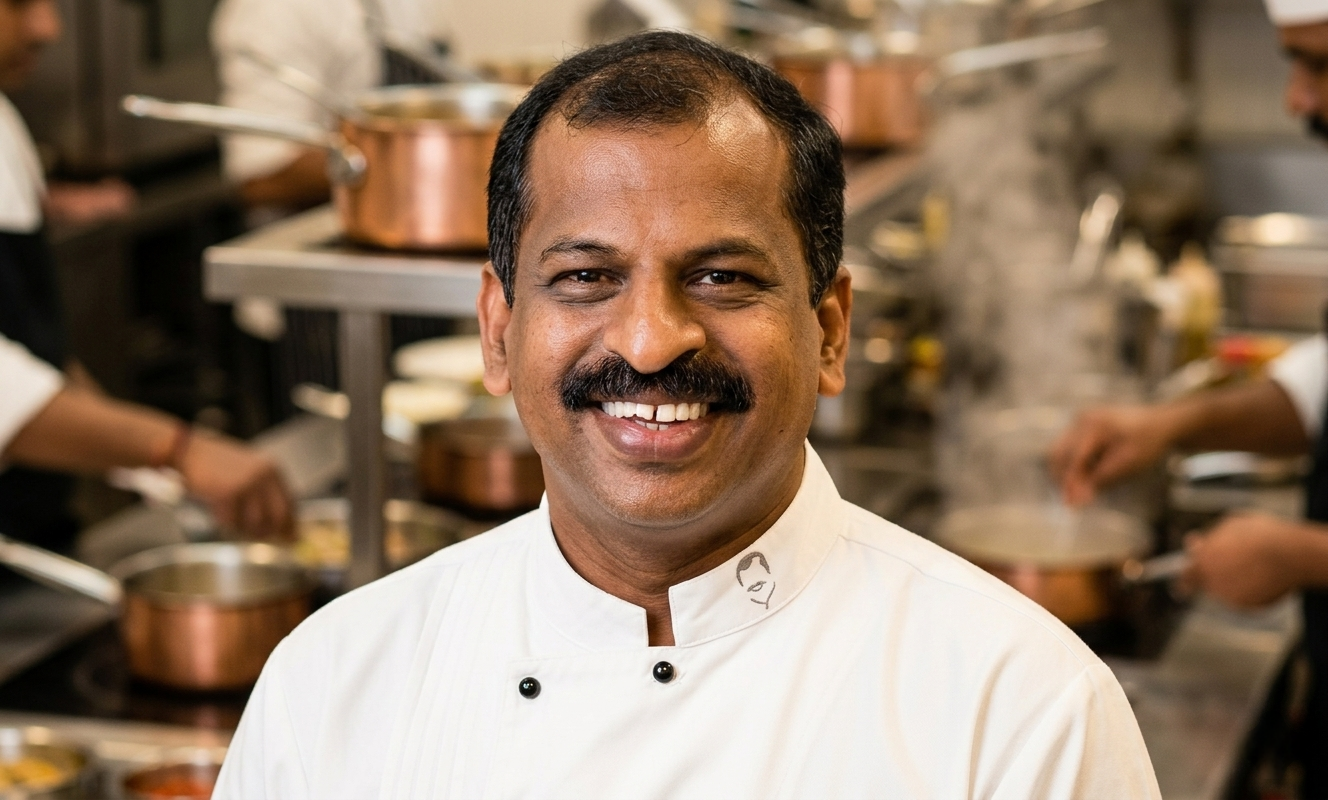
Chef Suresh Pillai
Real Name: Suresh Sasidharan Pillai
Place: Thekkumbhagom, Kollam, Kerala[1]
Citizenship: British
Cooking style: Kerala cuisine
Fire, Coconut, and Control
The pan is already hot when the curry leaves hit the oil, a sharp crackle, a burst of aroma, and then a careful pause. Suresh Pillai does not rush the next step. The fish goes in only after the spice base settles into balance, heat, acidity, fat. In his kitchen, Kerala is not a memory. It is a method. A fish curry is plated not in a clay pot but with deliberate precision, each element calibrated for both familiarity and surprise. It is an outstanding tension, between what is known and what is being reimagined. Here, the everyday flavors of coastal Kerala are restructured, not to distance them from their origins, but to make them legible in a global culinary language.
Taste Before Technique
Chef Suresh Pillai’s culinary journey begins, like many in Kerala, at home.
Raised in a state where food is inseparable from geography, coconut, backwaters, spice routes, his early experiences were shaped by domestic cooking rather than formal gastronomy. Meals were seasonal, ingredient-driven, and rooted in local availability.
This background matters.
Kerala cuisine, often described broadly, is in fact highly regional. Coastal, central, and northern traditions differ in technique and flavor profiles. Pillai’s early exposure allowed him to internalize these variations before he encountered professional kitchens.
His entry into the culinary profession was not immediate or glamorous. It followed the conventional route through hotel management and entry-level kitchen roles, where discipline, repetition, and hierarchy define the learning process.
Here, technique was acquired.
But the foundation remained sensory, an understanding of how spices behave, how coconut transforms texture, how acidity is balanced in fish-based dishes.
Learning the Language of Fine Dining
Suresh Pillai’s career gained momentum through his work in India’s hospitality sector, particularly within high-end hotel kitchens. These environments introduced him to structured culinary systems, brigade hierarchies, standardized processes, and the discipline required for consistency at scale.
The defining shift, however, came during his time in the United Kingdom.
Working in competitive, globally influenced kitchens, he encountered a different expectation of Indian food. It was not enough for dishes to be authentic. They had to be articulated, presented, and contextualized for an audience unfamiliar with their origins.
This is where Pillai’s approach began to crystallize.
He did not dilute Kerala cuisine to fit global expectations. Instead, he translated it. Techniques were refined, plating modernized, and flavors calibrated without erasing identity.
His work abroad contributed to a broader shift in how Indian regional cuisines were perceived, not as monolithic “curry,” but as distinct, sophisticated traditions.
Return to India and Entrepreneurial Leap: Building a Culinary Identity
Returning to India marked a transition from chef to entrepreneur.
The launch of his restaurant ventures, particularly under the “Chef Pillai” brand, was not merely about opening dining spaces. It was about constructing a culinary identity that could sustain both artistic and commercial demands.
This phase required navigating multiple challenges:
- Adapting fine dining concepts to local markets
- Balancing price points with ingredient quality
- Building a brand that could scale without losing specificity
His restaurants positioned Kerala cuisine within a premium dining framework, something historically underdeveloped compared to North Indian or pan-Indian fine dining models.
Expansion followed, with outlets across cities, each attempting to maintain consistency while adapting to local audiences.
Culinary Philosophy and Style: Precision Within Tradition
At the core of Suresh Pillai’s cooking is a refusal to treat Kerala cuisine as static.
Authenticity as Framework, Not Constraint
He retains core flavor structures, coconut, tamarind, black pepper, curry leaves, but reworks their expression through technique and presentation.
- Seafood as Identity
Kerala’s coastal cuisine is central to his menus. Dishes like karimeen pollichathu or fish molee are reinterpreted without losing their essential character.
- Balance and Restraint
His cooking avoids excessive layering. Spices are used to support, not overwhelm. This aligns with global fine dining principles while remaining rooted in regional logic.
- Visual Language
Presentation is contemporary, clean plating, controlled portions, attention to color and texture. This visual shift plays a significant role in repositioning Kerala cuisine for new audiences.
Reinventing Kerala Cuisine: From “Naadan” to Global Table
Kerala cuisine has historically been underrepresented in India’s fine dining landscape.
While widely consumed domestically, it has often been categorized as “naadan,” homestyle, rustic, and therefore not positioned within premium culinary spaces.
Pillai’s work challenges this categorization.
By recontextualizing traditional dishes within structured menus, curated experiences, and contemporary plating, he shifts perception. The same ingredients and recipes acquire new meaning when presented differently.
This aligns with a broader movement in Indian gastronomy, where regional cuisines are being re-evaluated and elevated.
However, this process is not without tension.
The question remains, at what point does reinterpretation risk detachment from origin?
Pillai navigates this by maintaining flavor integrity, even as form evolves.
Leadership and Kitchen Culture: Building Beyond the Individual
A chef’s influence extends beyond dishes.
In his kitchens, Suresh Pillai emphasizes discipline, consistency, and training. The transition from individual chef to restaurateur requires building teams capable of replicating standards.
This involves:
- Training young chefs in both technique and philosophy
- Maintaining quality across multiple outlets
- Balancing creativity with operational efficiency
His role as a mentor is significant in a region where structured culinary training in regional cuisine has often been informal.
The Chef as Public Figure
Suresh Pillai’s visibility extends beyond restaurants.
Through television appearances, digital platforms, and public events, he has cultivated a recognizable persona. This visibility serves multiple functions:
- It expands audience reach
- It reinforces brand identity
- It positions him within India’s emerging culture of celebrity chefs
However, this visibility also introduces a balancing act. Public appeal must coexist with professional credibility.
So far, his media presence has largely aligned with his culinary identity, informative, grounded, and focused on food rather than personality-driven spectacle.
Between Craft and Commerce
Scaling a chef-driven brand is inherently complex.
As restaurants expand, maintaining consistency becomes difficult. Variations in staff, supply chains, and local preferences can affect quality.
There is also the broader critique of commercialization.
Can a cuisine rooted in regional specificity retain authenticity when adapted for premium dining and wider markets? Does elevation risk alienation from its original context?
These are not criticisms unique to Pillai. They apply to the global movement of regional cuisines entering fine dining spaces.
His challenge lies in maintaining equilibrium, ensuring that innovation does not become abstraction.
A Cuisine in Transition
Suresh Pillai’s work sits within a larger transformation of Indian gastronomy.
Regional cuisines are increasingly being recognized for their complexity and potential for reinterpretation. In this context, his contribution lies in positioning Kerala cuisine within that conversation.
His future trajectory will likely involve further expansion, both geographically and conceptually. The question is not whether Kerala cuisine will gain global recognition, but how it will be represented.
Pillai’s influence ensures that this representation will include both tradition and innovation.
His place among India’s leading chefs is secured not by scale alone, but by the specificity of his vision.
It is an outstanding legacy in progress, one that continues to reshape how a cuisine rooted in coconut, spice, and coastline is understood, not just as regional food, but as a structured, evolving culinary language capable of speaking to the world.