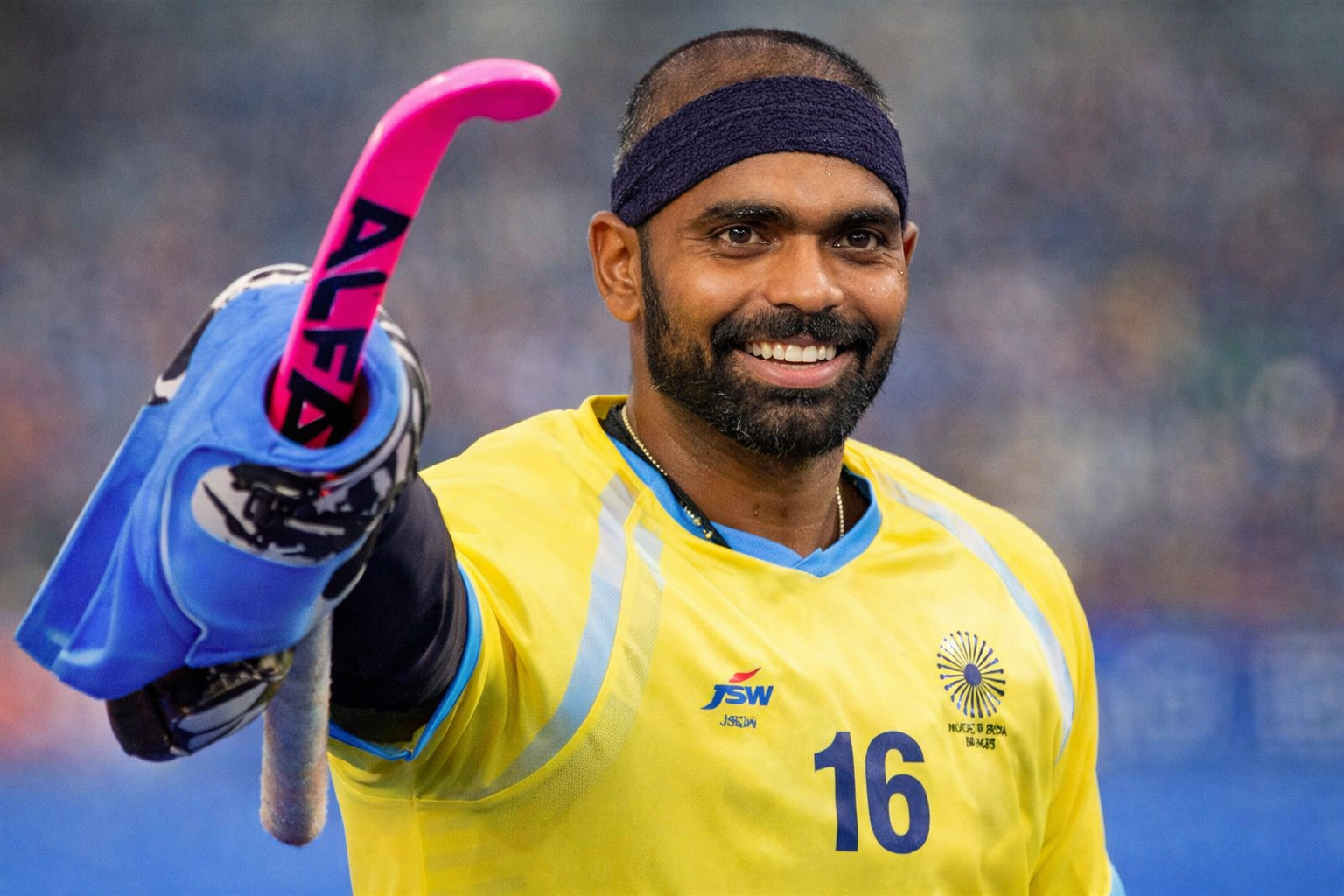
P. R. Sreejesh
Indian field hockey coach and legendary former goalkeeper
P. R. Sreejesh is considered one of India’s greatest sports personalities because he played a huge role in bringing Indian hockey back to glory on the world stage. With his incredible reflexes, leadership, and fighting spirit, Sreejesh became the backbone of the Indian hockey team for many years.
Nickname: Great Wall of India
Born: 8 May 1988 (age 37)
Place: Kochi, Kerala, India
Field: Hockey
Playing position: Goalkeeper
The Save That Echoed Across Generations
The clock is not just ticking, it is collapsing.
Seconds remain in the bronze medal match at the Tokyo 2020 Olympics. Germany has one final penalty corner. One last chance to deny India a medal that has been missing for forty-one years. The ball is injected, trapped, struck, and in that instant, everything narrows to reflex.
P. R. Sreejesh moves not with hesitation but with memory, muscle, instinct, years compressed into a single dive. The save is not spectacular in the theatrical sense. It is precise, calculated, outstanding in its calm brutality. The ball ricochets away. The whistle follows.
And then, a moment that feels almost too human for sport, Sreejesh collapses onto the goalpost, arms wrapped around it, as if holding history in place.
This is not just a medal. It is release. For Indian hockey, for a generation of players, and for a goalkeeper who spent years standing between hope and heartbreak.
Early Life and Roots in Kerala: From Kizhakkambalam to the National Stage
P. R. Sreejesh was born on May 8, 1988, in Kizhakkambalam, a semi-rural pocket near Kochi, Kerala. Unlike the traditional hockey belts of Punjab or Odisha, Kerala’s sporting identity has historically leaned toward athletics, football, and volleyball. Hockey, while present, did not dominate the cultural imagination.
His family background was modest. His parents were not athletes, nor was there a structured sporting lineage guiding him. What existed instead was a familiar Kerala pattern, education first, sport as possibility rather than certainty.
Sreejesh did not begin his journey as a goalkeeper. In his early school days, he experimented with track and field. It was only after joining the GV Raja Sports School in Thiruvananthapuram that hockey entered his life with seriousness.
Even then, goalkeeping was not an obvious choice. It is a position that demands sacrifice without guarantee of glory. Yet, under the guidance of coaches who recognized his reflexes and physical presence, Sreejesh transitioned into the role that would define him.
Kerala’s structured sports school ecosystem, though limited in scale, played a decisive role. It offered discipline, exposure, and a pathway, however narrow, into national-level competition.
Rise Through Indian Hockey: Learning to Wait, Learning to Endure
Sreejesh’s progression through Indian hockey was neither immediate nor linear.
He entered the junior national setup in the mid-2000s, a period when Indian hockey was navigating one of its most uncertain phases. The team was rebuilding after years of administrative instability and declining international performance.
For a young goalkeeper, the pathway was even more complex. India already had experienced names occupying the position. Opportunities were scarce, and mistakes were unforgiving.
Sreejesh’s early years were defined by Inconsistency in selection, Long periods on the bench and The need to constantly prove readiness.
His senior debut in 2006 marked entry, not arrival.
What followed was a gradual accumulation of trust. Coaches began to recognize his composure under pressure, his willingness to learn, and his ability to recover from errors, a critical trait for any goalkeeper.
Over time, he developed not just technically, but psychologically. He learned the art of patience, of staying mentally engaged even when not playing, of preparing for moments that might not come for months.
Career Defining Moments: Building a Legacy Save by Save
- 2014 Asian Games: Reclaiming Gold
India’s gold medal at the 2014 Asian Games marked a turning point. It secured direct qualification for the Olympics and signaled a revival of Indian hockey. Sreejesh’s role in that campaign, particularly in high-pressure moments, established him as India’s first-choice goalkeeper.
- 2016 Champions Trophy: The Shootout Specialist
At the 2016 Hockey Champions Trophy, Sreejesh produced a series of remarkable saves, especially in shootouts. His performance against top-tier teams demonstrated that India could compete with the world’s best. He was no longer just reliable. He was decisive. Sreejesh also took on leadership responsibilities, captaining the Indian team during a transitional phase. His leadership style was understated, focused more on stability than theatrics.
- Tokyo 2020: The Defining Chapter
The bronze medal match against Germany was a microcosm of Sreejesh’s career: India raced ahead, Germany fought back and the game oscillated between control and chaos.
In the final seconds, it came down to one save. Technically, it was about positioning, reading the drag-flick, and reacting within milliseconds. Emotionally, it was about absorbing decades of expectation.
That save did not just win a medal. It ended a narrative of decline that had shadowed Indian hockey since 1980.
The Goalkeeper’s Mind: Precision Under Pressure
Goalkeeping in hockey is a discipline of margins.
- Technical Strengths
Reflex speed: Ability to react to deflections and close-range shots
Positioning: Minimizing angles rather than relying on acrobatics
Penalty corner defense: Reading drag-flick variations
- Style Evolution
Early in his career, Sreejesh relied more on reflex. Over time, he refined his positional play, reducing unnecessary movement and conserving energy.
- Psychological Framework
A goalkeeper operates in isolation. One mistake is often irreversible. Sreejesh developed emotional control under sustained pressure, the ability to reset quickly after conceding and focus during long periods of inactivity.
- Global Comparison
Against elite international goalkeepers, Sreejesh stands out not for flamboyance but for efficiency. He is not the most acrobatic, but he is among the most reliable in high-stakes situations.
Setbacks, Injuries, and Comebacks: The Quiet Battles
Sreejesh’s career has not been immune to disruption. He faced injuries that sidelined him during critical phases, periods of dip in form and the questions about whether India needed a younger replacement.
In elite sport, goalkeepers often face a unique form of scrutiny. Errors are visible, successes expected.
Sreejesh’s comebacks were marked by renewed fitness regimes, technical adjustments and a refusal to concede his place without contest.
His return to form ahead of Tokyo was not accidental. It was constructed, deliberately, through discipline and recalibration.
Beyond the Goal Line
Sreejesh’s influence extends beyond saves.
- Mentorship
He has played a key role in guiding younger players, particularly goalkeepers, helping build a pipeline of talent.
- Cultural Shift
Indian hockey’s resurgence is not just tactical. It is cultural, a shift toward professionalism, fitness, and belief. Sreejesh embodies that shift.
- Symbol of Stability
In a team that has undergone multiple transitions, he has remained a constant. That continuity matters in high-performance environments.
The Man Behind the Mask
Off the field, Sreejesh presents a contrast to his on-field intensity.
He is articulate, often humorous, and grounded. His social media presence reflects a personality that does not take itself too seriously, even while carrying immense responsibility.
He balances professional discipline, family life and public engagement.
This balance has contributed to his longevity, allowing him to navigate pressure without losing perspective.
Kerala’s Sporting Ecosystem: An Unlikely Hockey Story
Sreejesh’s success is also a story about geography.
Kerala is not a traditional hockey powerhouse. Its infrastructure for the sport has historically lagged behind states like Punjab, Haryana, or Odisha.
Yet, it has produced elite athletes across disciplines. Kerala has limited hockey-specific infrastructure, less visibility compared to cricket or football and dependence on institutional support systems.
Sreejesh bridges two realities: The constraints of a non-traditional hockey region and the possibilities unlocked by disciplined pathways.
In Kerala’s sporting landscape, he stands alongside icons from athletics and football, expanding the state’s athletic identity.
Holding the Line, Holding the Moment
In the end, the image returns, Sreejesh against the post in Tokyo, holding on as if the past might slip away if he lets go. It is an outstanding image not because it is dramatic, but because it is honest.
His career has not been defined by a single tournament or a single save. It has been built over years of waiting, learning, failing, and returning. Goalkeepers do not control the game. They endure it. They absorb its chaos and impose order when it matters most.
For Indian hockey, Sreejesh represents something deeper than medals. He is proof that resurgence is possible, that systems can evolve, that belief can be rebuilt one save at a time.
And perhaps that is his greatest contribution, not just stopping goals, but stopping doubt, long enough for a generation to believe again.
Awards and nominations
2014 – FIH Awards – Male Goalkeeper of the Year (Nominated)
2016 – FIH Awards – Male Goalkeeper of the Year (Nominated)
2017 – Padma Sri
2020–2021 FIH Awards (Male Goalkeeper of the Year)
2021 – Khel Ratna Award
2022 – World Games Awards (Athlete of the Year)
2022 – FIH Awards (Male Goalkeeper of the Year)
2024 – FIH Awards (Male Goalkeeper of the Year)
2025 – Padma Bhushan
2025 – Hockey India Awards Goalkeeper of the Year (Nominated)