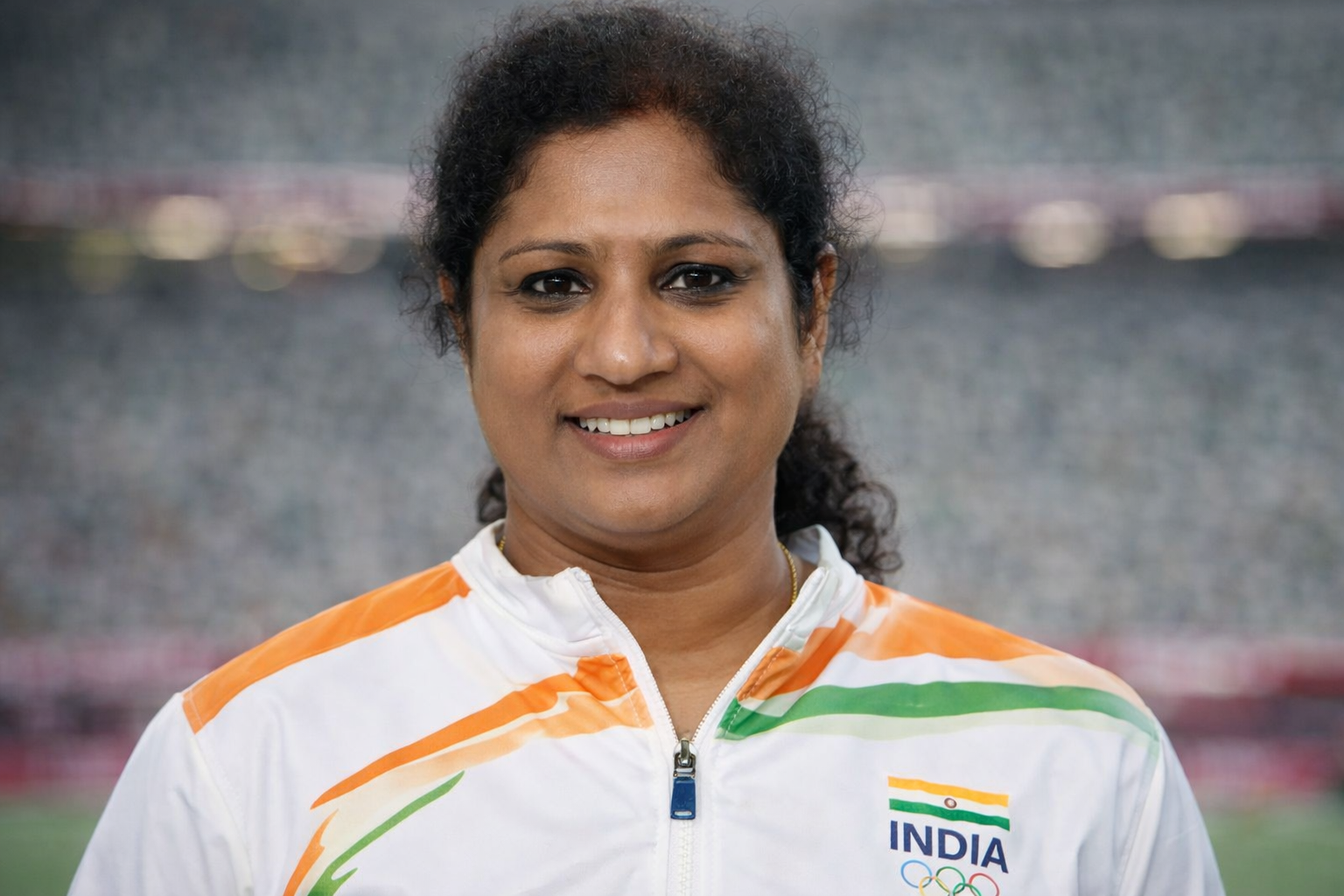
Shiny Wilson
On the cinder track, under the humid weight of an Asian summer, Shiny Wilson leans forward, her stride tightening into something sharper, more deliberate. The race is no longer about pace. It is about will. About who breaks first.
The 800 metres is a brutal distance, half sprint, half endurance, entirely unforgiving. And yet, in that final stretch, Shiny looks composed. Not effortless, never that, but controlled, like someone who understands pain and has made a quiet pact with it.
This is where she built her legend. Not in the headlines, not in the noise, but in these narrow margins where races are won by instinct, discipline, and an almost stubborn refusal to slow down.
Full name: Shiny Kurisingal Abraham-Wilson
Nationality: Indian
Born: 8 May 1965 (age 60)
Place: Thodupuzha, Idukki, Kerala, India
Sport: Track and field
Early Life & Background: A Runner From the Margins
Born on May 8, 1965, in the hilly district of Idukki, Kerala, Shiny grew up in a landscape defined by steep climbs and long distances. It was not a place that consciously produced athletes, but it shaped endurance in quieter ways.
Her family was not part of any sporting lineage. Like many girls in rural India in the 1970s, her early life was framed by expectations that had little to do with athletics. Sport, especially for women, was not seen as a career. It was, at best, a distraction.
Yet, Kerala carried a different undercurrent. The state had already begun nurturing a sporting culture through schools and public institutions. Physical education teachers often doubled as talent scouts. It was in this ecosystem that Shiny’s ability first surfaced.
She was not initially trained. She simply ran faster, longer, and more consistently than those around her.
A school-level competition changed everything. Coaches noticed her stride, her stamina, her unusual composure for a young runner. What followed was not a dramatic breakthrough but a gradual shift, from casual participation to structured training.
At a time when female athletes had limited access to infrastructure, nutrition, and scientific coaching, Shiny’s journey was defined by scarcity. But scarcity, in her case, sharpened focus rather than limiting ambition.
Rise to Prominence: Building a Champion
By the early 1980s, Shiny had moved into competitive athletics at the national level. Her association with Indian Railways, a major institutional backbone for Indian athletes, provided her with stability, access to coaching, and exposure to higher competition.
The transition from school meets to national championships is often where many athletes plateau. For Shiny, it became a launchpad.
Her training was rigorous but not sophisticated by modern standards. It relied heavily on repetition, mileage, and race exposure. Yet, she developed an intuitive understanding of race strategy, when to conserve, when to surge, and how to position herself in crowded fields.
Key turning points in this phase included:
- Early dominance in national 800m and 400m events
- Recognition as one of India’s most promising middle-distance runners
- Selection for international competitions at a relatively young age
What set her apart was not just speed. It was consistency. In a sport where peaks are often short-lived, Shiny began building something more durable.
International Career & Achievements: A Career of Rare Longevity
Shiny Wilson’s international career spanned over a decade, a rarity in middle-distance running.
Olympic Appearances
She represented India in four consecutive Olympic Games:
- 1984 Los Angeles
- 1988 Seoul
- 1992 Barcelona
- 1996 Atlanta
This alone places her in an elite category within Indian athletics. Olympic qualification in track events demands both timing standards and competitive consistency, something she sustained across changing phases of her career.
Asian Games & Championships
Her performances at the Asian level were where she truly left her mark:
- Multiple medals at Asian Games, including gold and silver in relay events
- Dominant presence in Asian Athletics Championships, especially in the 800m
- Part of India’s formidable 4x400m relay teams, which were among the best in Asia during the late 1980s and early 1990s
National Dominance
Domestically, she was nearly untouchable in her prime:
- Held national titles across 800m and 400m
- Maintained top-level performance for over a decade
- Became a benchmark for middle-distance excellence in India
Her career statistics reflect something deeper than medals, a sustained presence at the top in an era with limited support systems.
Defining Moments: Where Legacy Was Forged
- The Breakthrough Asian Stage
Her early Asian Championship victories were not just wins, they were signals. India, long dependent on sporadic success in athletics, had found a consistent performer in middle-distance events. Technically, these races showcased her ability to maintain pace under pressure, a critical trait in 800m racing where tactical errors are costly.
- Olympic Qualification Across Four Cycles
Qualifying once for the Olympics is an achievement. Doing it four times is a statement about durability. Each Olympic cycle brings new competitors, evolving standards, and physical wear. Shiny navigated all three, adapting her training and racing style to remain competitive.
- Relay Excellence at the Asian Games
As part of India’s 4x400m relay teams, she contributed to some of the country’s most memorable performances. Relay racing demands a different mindset. It is less about individual rhythm and more about synchronization, baton exchanges, and collective pressure. Shiny’s presence brought stability to these teams.
Style, Strength, and Athletic Identity
The 800m is often described as a “thinking race.” It punishes both overconfidence and hesitation.
Shiny’s racing style was defined by:
- Controlled aggression: She rarely led from the start but stayed within striking distance
- Strong finishing kick: Her final 200m surge was one of her defining weapons
- Tactical awareness: She understood race dynamics, especially in crowded fields
Compared to contemporaries in Asia, she may not have been the fastest starter, but she was among the most consistent closers.
Her strength lay in rhythm. She ran races like sequences, not bursts.
Challenges & Comebacks: The Invisible Battles
No long career in athletics is linear. Shiny faced:
- Injuries, inevitable in high-mileage middle-distance training
- Institutional limitations, including lack of sports science support
- Pressure of expectations, especially as one of India’s leading female athletes
Returning from setbacks required more than physical recovery. It demanded psychological resilience.
In an era without advanced rehabilitation systems, comebacks were often self-driven. Athletes relied on discipline, intuition, and sheer determination.
Shiny’s repeated returns to form underline a key aspect of her career, she was not just talented, she was mentally durable.
Legacy & Impact: Beyond Medals
Shiny Wilson’s legacy operates on multiple levels.
- A Pathbreaker for Women
At a time when Indian women’s athletics was still emerging, she provided a template of Long-term career viability, International competitiveness and Professional commitment to sport.
- Influence on Future Generations
Athletes who came after her, particularly from Kerala, inherited a more defined pathway. Her career helped normalize Women competing internationally, Institutional support for female athletes and Visibility of track events beyond cricket-centric narratives.
- Recognition
Her contributions have been acknowledged through National awards including the Arjuna Award and Continued respect within Indian athletics circles as a pioneer.
Cultural & Historical Context: Running Through Transition
To understand Shiny Wilson is to understand Indian athletics in transition.
The 1980s and 1990s were formative decades Infrastructure was limited, Exposure to global competition was increasing and Women’s participation was expanding but still constrained.
Shiny’s career intersected with this shift.
She was part of a generation that bridged two eras From amateur, under-supported athletics and To a more structured, competitive sporting environment
Her success did not just reflect personal excellence. It marked systemic progress, however gradual.
The Quiet Power of Endurance
There are athletes who dominate headlines, and then there are those who define disciplines. Shiny Wilson belongs to the latter.
Her career was not built on a single iconic moment but on accumulation, race after race, season after season, year after year. In a sport that demands both speed and patience, she mastered the balance.
Today, Indian athletics has broader visibility, better infrastructure, and deeper talent pools. But the foundations were laid by athletes who ran when the system was still catching up. Shiny was one of them.
And if you return to that image, the final lap, the tightening stride, the refusal to fade, you begin to see her not just as a runner, but as a rhythm. One that continues, quietly, in every Indian athlete who steps onto the track believing that endurance can outlast limitation.