
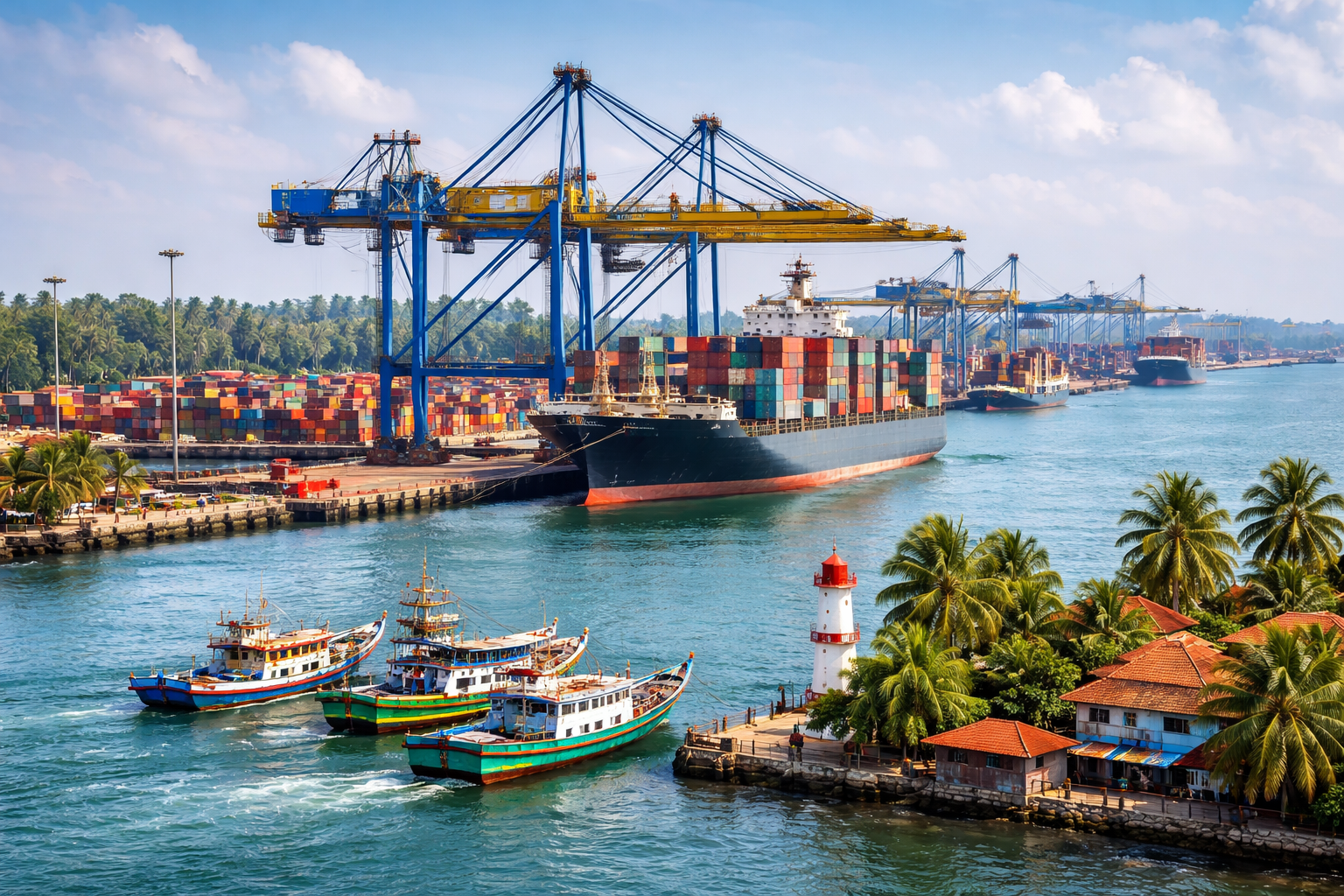
Top Ports in Kerala
A clear, high-impact look at the ports shaping Kerala’s role in India’s global trade network
- Vizhinjam International Seaport
- Cochin Port (Cochin Port Authority)
- Beypore Port
- Kollam Port
- Azhikkal Port
- Alappuzha Port
- Munambam Port
- Neendakara Port
- Kodungallur Port
- Kasaragod Port
Major & Emerging Maritime Hubs in Kerala
Kerala’s coastline stretches over 580 kilometres along the Arabian Sea, placing it directly on one of the world’s busiest maritime corridors, the East–West shipping route connecting Europe, the Middle East, and Asia. For centuries, this geography has defined Kerala’s identity as a trading hub, from ancient spice routes to modern container logistics.
From the established strength of Cochin Port to the game-changing potential of Vizhinjam International Port, Kerala’s maritime infrastructure is entering a new phase. These ports are not just gateways for cargo; they are catalysts for economic growth, industrial development, and global connectivity.
This guide ranks the major ports in Kerala (2026) based on strategic importance, cargo capacity, infrastructure, and future potential.
1. Vizhinjam International Seaport
Vizhinjam International Seaport, located near Thiruvananthapuram, is the most ambitious maritime project in Kerala’s history and arguably one of the most strategically important ports in India.
What sets Vizhinjam apart is its natural deep-water depth (around 18–20 metres), allowing it to handle ultra-large container vessels without extensive dredging. This gives it a major advantage over many Indian ports.
The port is being developed as a transhipment hub, meaning it can handle cargo that would otherwise be routed through international ports like Colombo, Dubai, or Singapore. This has the potential to significantly reduce India’s dependence on foreign ports.
Operated under a public-private partnership model with Adani Ports, Vizhinjam is equipped with modern container terminals, automated handling systems, and advanced logistics infrastructure.
Its location, just 10 nautical miles from the international shipping lane, makes it uniquely positioned for global trade.
Once fully operational, Vizhinjam is expected to transform Kerala’s economy, attracting logistics companies, industrial clusters, and international shipping lines.
It stands at the top of this list because of its future potential, global relevance, and strategic importance in India’s maritime vision.
2. Cochin Port (Cochin Port Authority)
Cochin Port is the most established and historically significant major port in Kerala. Located in Kochi, it has been a central hub for trade since colonial times.
The port operates multiple facilities, including the International Container Transhipment Terminal (ICTT) at Vallarpadam, which is India’s first transhipment terminal. While it has faced competition from global hubs, it remains a key node in India’s container network.
Cochin Port handles a diverse range of cargo, including containers, petroleum products, LNG, and bulk commodities. It is also one of India’s leading ports for cruise tourism, adding a unique dimension to its operations.
Infrastructure includes modern berths, container yards, and connectivity through road, rail, and inland waterways.
The port’s strategic location on the southwest coast ensures access to major shipping routes, though depth limitations compared to Vizhinjam remain a challenge.
Recent developments include modernisation projects, expansion of logistics facilities, and integration with coastal shipping networks.
Cochin Port stands out for its legacy, diversified operations, and continued relevance in Kerala’s shipping and logistics ecosystem.
3. Beypore Port
Beypore Port, located in Kozhikode, is one of the oldest ports in Kerala, with a history that dates back over a thousand years. It was once a key centre in the ancient spice trade, connecting Kerala to the Middle East.
Today, Beypore functions as an intermediate port, handling coastal cargo and small-scale international trade. While it does not match the scale of Cochin or Vizhinjam, its importance lies in regional connectivity and heritage.
One of Beypore’s unique features is its association with traditional shipbuilding, particularly the construction of “Uru” wooden vessels, which are still exported to Gulf countries.
The port handles cargo such as construction materials, timber, and general goods, supporting local industries.
Recent efforts have focused on modernising infrastructure and enhancing cargo capacity, though expansion is limited by geographic constraints.
Beypore stands out for its historical significance and niche maritime activities, making it an important part of Kerala’s coastal economy.
4. Kollam Port
Kollam Port is another historically significant port that has evolved into a regional cargo hub. Located in southern Kerala, it plays a role in coastal shipping and small-scale international trade.
The port primarily handles cargo such as cashew, minerals, and construction materials, reflecting the economic profile of the region.
Kollam has also been part of initiatives to promote coastal shipping, which is gaining importance as a cost-effective alternative to road transport.
Infrastructure improvements have been gradual, focusing on enhancing cargo handling and connectivity.
While it does not operate at the scale of major ports, Kollam’s strategic location and regional importance ensure its continued relevance.
It stands out as a supporting port in Kerala’s logistics network, particularly for southern districts.
5. Azhikkal Port
Azhikkal Port, located in Kannur district, is one of the key emerging ports in Kerala, positioned to support industrial growth in North Kerala.
The port has been developed to handle cargo such as coal, timber, and bulk goods, catering to nearby industries and infrastructure projects.
Its proximity to Kannur International Airport adds to its strategic value, enabling multimodal logistics possibilities.
Recent development plans include expanding cargo handling capacity and improving connectivity.
Azhikkal is particularly important for decentralising Kerala’s port infrastructure, reducing reliance on Kochi.
It stands out for its growth potential and regional economic impact, especially in northern Kerala.
6. Alappuzha Port
Alappuzha Port, once a major trade centre during colonial times, has seen a decline but still holds relevance in coastal shipping and tourism-linked maritime activity.
Historically, it was a key export hub for coir and spices. Today, its role is more limited, but it continues to support local trade and fishing activities.
There have been discussions around reviving the port to boost coastal logistics and tourism.
Alappuzha stands out for its historical importance and potential for revival, especially in niche sectors.
7. Munambam Port
Munambam Port, located near Kochi, has grown into an important fishing and small cargo port in Kerala. Over the years, it has become closely linked with the region’s seafood trade and coastal economy. The harbor is usually active with fishing vessels, ice plants, and seafood transport operations that support thousands of livelihoods.
Its strategic location near Kochi gives it commercial importance beyond traditional fishing activities. The port also plays a growing role in coastal shipping and marine-related businesses, making it one of the emerging maritime hubs in central Kerala.
8. Neendakara Port
Neendakara is one of Kerala’s most important fishing harbors and a major center for the state’s marine exports. Located near Kollam, the port is known for its strong connection to Kerala’s seafood industry, especially deep-sea fishing and fish processing activities.
The harbor remains busy throughout the year with fishing boats, auction centers, and export-related operations. Neendakara also supports a large network of workers connected to fishing, transportation, and seafood processing. Its contribution to Kerala’s coastal economy makes it one of the state’s most significant marine trade centers.
9. Kodungallur Port
Kodungallur Port carries immense historical importance as one of the oldest trading centers in Kerala. Centuries ago, it was part of the ancient Muziris trade network that connected Kerala with Rome, the Middle East, and other global civilizations through the spice trade.
Though it no longer functions as a major modern commercial port, Kodungallur remains deeply connected to Kerala’s maritime history and cultural identity. The region still holds archaeological and historical significance linked to Kerala’s early international trade relations.
10. Kasaragod Port
Kasaragod Port is an emerging coastal trade and fishing hub in North Kerala. The port mainly supports regional fishing activities and local maritime commerce, while also contributing to transportation and coastal livelihood sectors.
Its location near Karnataka gives it additional strategic importance for regional connectivity and trade movement along the western coast. With growing focus on coastal infrastructure development in Kerala, smaller ports like Kasaragod are gradually gaining more attention for their economic potential and regional importance.
Final Take
Kerala’s maritime landscape is at a turning point.
Vizhinjam represents the future, global, deep-sea, and transformative
Cochin Port remains the backbone, reliable and diversified
Beypore, Kollam, and Azhikkal support regional economies
Alappuzha reflects legacy with potential revival
Together, these major ports in Kerala form a layered ecosystem, balancing history, present capability, and future ambition.
For a state defined by its coastline, the next decade of growth will not just happen on land; it will arrive by sea.