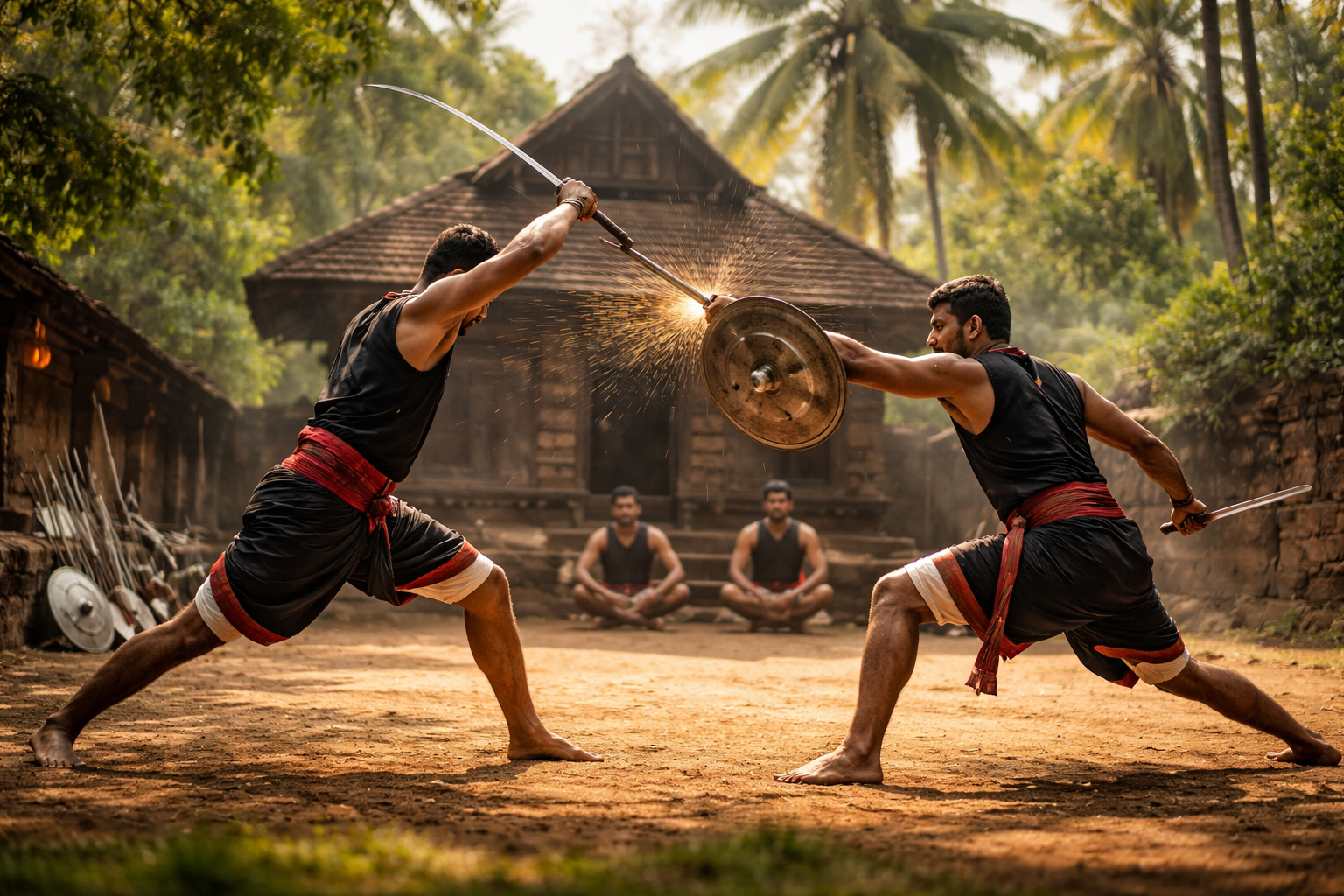
Top Martial Arts of Kerala
A deep exploration of Kerala’s warrior traditions, discipline systems, and living combat heritage
- Kalaripayattu
- Vadakkan Kalari (Northern Style)
- Thekkan Kalari (Southern Style)
- Marmashastram
- Ankathari (Weapon Combat System)
- Kolthari (Wooden Weapon System)
- Verumkai (Bare-Hand Combat)
- Adithada
- Kettukari (Staff Fighting)
- Urumi Combat
Outstanding Martial Arts of Kerala
Kerala is often described through its landscapes, backwaters, forests, and coastlines. But beneath this serene exterior lies a powerful legacy of discipline, combat, and physical mastery. The martial arts of Kerala are among the oldest structured fighting systems in the world, rooted in a time when warfare, healing, and spirituality were deeply interconnected.
These martial traditions were never just about fighting. They were systems of body conditioning, mental discipline, and energy control, often linked to Ayurveda and temple rituals. Warriors trained not only to defeat opponents but to understand the body, its vulnerabilities, strengths, and rhythm.
1. Kalaripayattu
Kalaripayattu is the foundation of all traditional martial arts in Kerala, often cited as one of the oldest combat systems in existence. Its origins are traced back over 2,000 years, with strong links to ancient Dravidian warfare traditions and early Indian military systems.
Training takes place in a kalari, a specially designed arena that is both a training ground and a sacred space. The system is structured in progressive stages, beginning with meipayattu (body conditioning), followed by kolthari (wooden weapons), ankathari (metal weapons), and finally verumkai (bare-hand combat).
One of the most distinctive aspects of Kalaripayattu is its emphasis on flexibility and fluidity. Movements are inspired by animals, creating a style that feels almost dance-like yet highly lethal. The use of weapons such as the urumi, a flexible sword, showcases the sophistication of the system.
Culturally, Kalaripayattu is deeply connected to Kerala’s identity. It influenced classical art forms like Kathakali and is often integrated into temple rituals.
In modern times, it has gained global recognition, practiced both as a martial art and a form of physical training. Its blend of combat, healing, and performance makes it the most complete martial tradition in Kerala.
2. Vadakkan Kalari (Northern Style)
Vadakkan Kalari, or the northern style of Kalaripayattu, is the most widely practiced and visually dynamic form. Originating in North Kerala, particularly in regions like Kannur and Kozhikode, it is closely associated with legendary warrior tales such as those of the Vadakkan Pattukal.
This style emphasizes agility, high kicks, leaps, and weapon mastery. Training begins with rigorous physical conditioning, focusing on flexibility and balance. The movements are expansive and energetic, designed for open combat scenarios.
Weapons play a central role, with extensive training in swords, spears, and shields. The style is known for its offensive approach, prioritizing speed and precision.
Culturally, Vadakkan Kalari is tied to Kerala’s folklore and warrior narratives. It represents the heroic ideal of the warrior, disciplined, fearless, and skilled.
Today, it remains the most recognized form of Kalaripayattu globally, often showcased in performances and demonstrations.
3. Thekkan Kalari (Southern Style)
Thekkan Kalari, the southern style, offers a contrasting approach to the northern system. Originating in South Kerala, particularly in regions like Thiruvananthapuram, it is more grounded and internal.
This style focuses heavily on close combat, grappling, and pressure point techniques. Unlike the expansive movements of Vadakkan Kalari, Thekkan Kalari is compact and strategic.
A key element is the knowledge of marma points, vital points in the human body. Practitioners are trained to both attack and heal these points, linking the martial art closely with Ayurveda.
Thekkan Kalari reflects a more defensive and tactical philosophy, emphasizing control over aggression.
In modern practice, it is valued for its therapeutic aspects as well as combat efficiency.
4. Marmashastram
Marmashastram is not a standalone martial art but a critical component of Kerala’s combat systems. It deals with the study of marma points, vital energy points in the human body.
Originating from ancient Ayurvedic texts, this system was integrated into Kalaripayattu to enhance combat effectiveness. A skilled practitioner could incapacitate an opponent with minimal force by targeting these points.
At the same time, Marmashastram is deeply connected to healing. The same knowledge used in combat is applied in therapeutic treatments, making it a dual-purpose system.
Culturally, it represents the philosophical depth of Kerala’s martial traditions, where destruction and healing coexist.
Today, it is studied both as a martial science and a form of traditional medicine.
5. Ankathari (Weapon Combat System)
Ankathari refers to the advanced stage of Kalaripayattu focused on metal weapon combat. It represents the transition from training to actual battlefield readiness.
Practitioners learn to handle weapons like swords, spears, daggers, and the iconic urumi. Each weapon requires a unique rhythm and technique.
The training is intense and precise, emphasizing coordination, timing, and control.
Historically, Ankathari was essential for warriors preparing for real combat. It reflects the practical application of Kerala’s martial systems.
Today, it is preserved within traditional kalaris and showcased in performances.
6. Kolthari (Wooden Weapon System)
Kolthari is the intermediate stage of Kalaripayattu, focusing on wooden weapons. It serves as a bridge between body training and metal weapon combat.
Weapons include long staffs, short sticks, and curved wooden implements. Training develops reflexes, coordination, and spatial awareness.
Kolthari is essential because it builds the foundation for more advanced combat techniques.
It remains widely practiced and is often the most accessible form for beginners.
7. Verumkai (Bare-Hand Combat)
Verumkai represents the pinnacle of Kalaripayattu training, focusing on unarmed combat.
It combines strikes, locks, grappling, and pressure point techniques. The goal is complete control over the opponent without weapons.
Verumkai reflects the internal mastery of the practitioner, where technique, timing, and awareness come together.
It is highly relevant today as a form of self-defense and physical training.
8. Adithada
Adithada is a striking and blocking system within Kalaripayattu. It focuses on offensive and defensive techniques using hands and legs.
The system trains practitioners to respond quickly to attacks, combining speed with precision.
Adithada is often seen as a precursor to Verumkai, preparing students for advanced combat.
9. Kettukari (Staff Fighting)
Kettukari is a specialized form of staff fighting within Kolthari. It focuses on the use of long sticks in combat.
The style emphasizes reach, control, and rhythm. Movements are fluid and continuous, creating a defensive and offensive balance.
Kettukari remains a key part of traditional training systems.
10. Urumi Combat
Urumi combat is one of the most advanced and dangerous aspects of Kalaripayattu. The urumi is a flexible sword that requires exceptional skill to control.
The weapon is worn around the waist and used in fluid, circular movements. It can strike multiple opponents simultaneously.
Urumi combat symbolizes the peak of mastery and discipline within Kerala’s martial traditions.
Final Take
The martial arts of Kerala are not just systems of combat. They are systems of knowledge.
They teach the body to move, the mind to focus, and the spirit to endure.
From Kalaripayattu to lesser-known traditions, each form carries a story of survival, discipline, and cultural identity.
And in every movement, Kerala’s warrior past continues to live.