
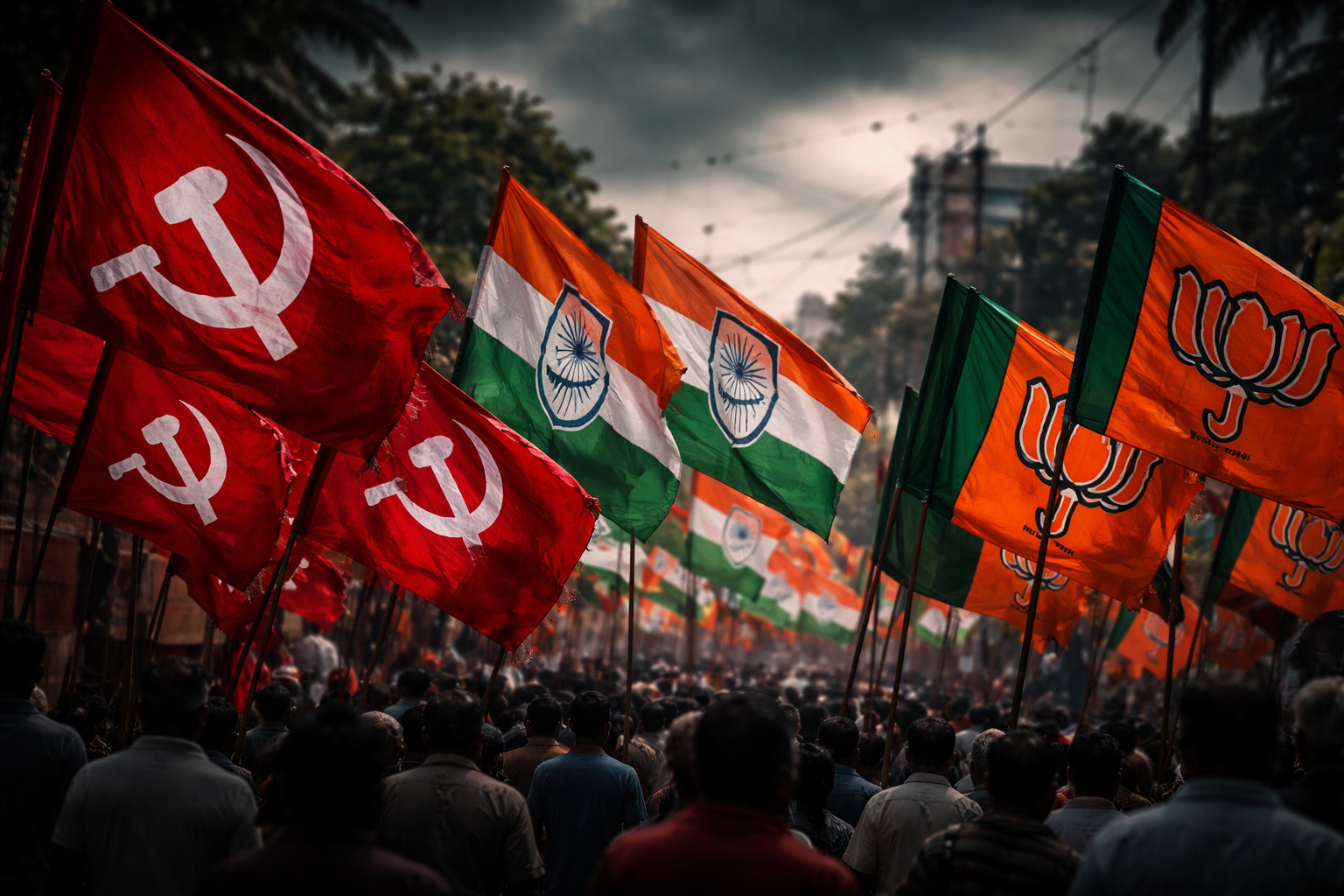
Top Most Important Political Parties in Kerala
A deep-dive into the forces shaping Kerala politics today
- Communist Party of India (Marxist) – CPI(M)
- Indian National Congress (INC)
- Bharatiya Janata Party (BJP)
- Indian Union Muslim League (IUML)
- Communist Party of India (CPI)
- Kerala Congress (M)
- Janata Dal (Secular) – JD(S)
- Revolutionary Socialist Party (RSP)
- Kerala Congress (Joseph Group)
- Welfare Party of India (Kerala Unit)
Influential Political Parties in Kerala
Kerala’s political landscape is unlike anywhere else in India. It is sharp, ideological, highly literate, and deeply participatory.
At the heart of Kerala politics in 2026 lies a structured bipolar contest between two major coalitions: the Left Democratic Front (LDF) led by the Communist Party of India (Marxist), and the United Democratic Front (UDF) led by the Indian National Congress. Over the past decade, a third force, the National Democratic Alliance (NDA) led by the Bharatiya Janata Party, has also been attempting to expand its footprint.
This guide ranks the top political parties in Kerala based on influence, electoral performance, grassroots strength, and current relevance in the 2024–2026 context. Together, these parties define the direction of governance, policy, and public debate in the state.
1. Communist Party of India (Marxist) – CPI(M)
The Communist Party of India (Marxist), or CPI(M), is the most dominant political force in Kerala today and the backbone of the LDF alliance. With deep ideological roots in Marxism and leftist governance, CPI(M) has shaped Kerala’s political identity for decades.
The party’s strength lies in its grassroots cadre network, trade unions, and strong organizational discipline. It has historically positioned itself as a champion of workers, social welfare, and public sector development. Under the leadership of figures like Pinarayi Vijayan, CPI(M) has transitioned into a more governance-focused entity, balancing ideology with administrative pragmatism.
The 2021 Kerala Assembly election marked a significant turning point, as CPI(M)-led LDF broke the traditional pattern of alternating governments by securing a second consecutive term. This reinforced its dominance in Kerala politics 2026.
Geographically, CPI(M) has strongholds across Kannur, Kozhikode, and parts of central Kerala. It also maintains significant influence in local self-governments.
Key achievements include welfare schemes, infrastructure development, and public health management, especially during crises like floods and the pandemic. However, the party has also faced criticism over political violence and centralized leadership.
CPI(M) ranks first due to its organizational strength, electoral success, and policy influence, making it the most powerful political party in Kerala today.
2. Indian National Congress (INC)
The Indian National Congress remains the principal opposition force in Kerala and the leading party within the UDF alliance. Historically dominant, Congress has played a central role in shaping Kerala’s political and social framework.
The party’s ideology is rooted in centrist and secular politics, appealing to a broad spectrum of voters including minorities, middle classes, and rural communities. It has traditionally alternated power with the Left, maintaining a strong presence across the state.
Congress has strongholds in central Kerala districts like Ernakulam, Kottayam, and Pathanamthitta, along with pockets in Malabar. Its leadership includes prominent figures like Oommen Chandy (late), Ramesh Chennithala, and emerging younger leaders.
However, in recent years, the party has faced challenges including internal factionalism and declining electoral performance. The 2021 Assembly election was a setback, raising questions about its organizational coherence.
Despite this, Congress remains highly relevant due to its alliance network, historical legacy, and voter base. It continues to dominate the UDF and plays a crucial role in parliamentary elections.
Congress ranks second because it is still the primary alternative to the Left, shaping opposition politics and maintaining significant influence.
3. Bharatiya Janata Party (BJP)
The Bharatiya Janata Party represents the NDA in Kerala and has been steadily attempting to expand its presence in a state where it historically struggled.
Ideologically rooted in Hindutva and nationalism, BJP has focused on building a base among Hindu communities and urban voters. While its electoral success has been limited compared to other states, it has made gradual progress in vote share.
The party’s biggest breakthrough came in the 2016 Assembly election when it won its first seat in Kerala. Though it failed to retain it in 2021, its influence continues to grow, especially in parliamentary elections and local bodies.
BJP’s strongholds include parts of Thiruvananthapuram, Palakkad, and northern Kerala pockets.
The party benefits from strong central leadership and organizational backing. However, it faces challenges due to Kerala’s entrenched Left vs Congress political structure and strong secular voter base.
BJP ranks third because of its growing influence, national backing, and strategic importance in Kerala politics 2026.
4. Indian Union Muslim League (IUML)
The Indian Union Muslim League is one of the most influential regional parties in Kerala and a key component of the UDF alliance.
IUML represents a significant section of Kerala’s Muslim population, particularly in Malabar districts like Malappuram, where it holds strong electoral dominance.
The party has a well-organized grassroots structure and plays a crucial role in coalition politics. It has consistently performed well in both Assembly and parliamentary elections.
IUML’s leadership includes prominent figures like P.K. Kunhalikutty and E.T. Mohammed Basheer. Its political positioning emphasizes community representation, education, and socio-economic development.
Despite being a community-focused party, IUML has maintained relevance by aligning with broader UDF policies and governance frameworks.
It ranks fourth due to its consistent electoral success and decisive role within the UDF.
5. Communist Party of India (CPI)
The Communist Party of India is the second-largest party in the LDF coalition and an important ideological partner of CPI(M).
Though smaller in size, CPI plays a key role in governance and policy-making within the Left Front. It has a strong presence in select constituencies and contributes to the coalition’s overall strength.
The party follows a leftist, socialist ideology, focusing on workers’ rights, secularism, and public welfare.
CPI has strongholds in parts of central and southern Kerala and maintains influence through trade unions and local bodies.
It ranks fifth due to its strategic importance within the ruling coalition.
6. Kerala Congress (M)
Kerala Congress (M) is one of the most prominent regional parties, known for representing the interests of farmers and Christian communities in central Kerala.
Originally part of the UDF, the party shifted to the LDF in recent years, significantly altering coalition dynamics.
Its influence is concentrated in districts like Kottayam and Idukki, where it holds strong grassroots support.
The party has played a kingmaker role in multiple elections, leveraging its regional strength to negotiate power within alliances.
It ranks sixth due to its strategic relevance and community-based influence.
7. Janata Dal (Secular) – JD(S)
JD(S) is a smaller but influential party within the LDF alliance in Kerala.
Though its national presence is centered in Karnataka, its Kerala unit has carved out a niche in select constituencies.
The party focuses on social justice, secularism, and regional development, aligning well with Left ideology.
JD(S) ranks seventh due to its support role within the ruling coalition.
8. Revolutionary Socialist Party (RSP)
The Revolutionary Socialist Party has a long history in Kerala politics and is currently aligned with the UDF.
RSP has strong roots in socialist ideology and maintains influence in specific regions, particularly Kollam.
Though its electoral footprint is limited, it remains relevant due to its historical legacy and alliance role.
It ranks eighth for its continued presence in coalition politics.
9. Kerala Congress (Joseph Group)
Another faction of the Kerala Congress, this group is aligned with the UDF and represents similar regional and community interests.
Though smaller than Kerala Congress (M), it retains influence in central Kerala politics.
It ranks ninth due to its localized but consistent political presence.
10. Welfare Party of India (Kerala Unit)
The Welfare Party of India has emerged as a minor but noticeable political force, particularly in urban and minority-focused constituencies.
Though it has limited electoral success, it has gained visibility through issue-based politics and social activism.
It represents a new wave of alternative political voices in Kerala.
It ranks tenth as an emerging player with potential future relevance.
Final Flag
Kerala’s political landscape in 2026 remains one of the most structured and ideologically driven in India.
What sets Kerala apart is its voters. Informed, critical, and deeply engaged.
Here, political power is not just won. It is constantly evaluated.
And that is what keeps Kerala politics dynamic, competitive, and uniquely alive.