Top Languages of Kerala
Most spoken, well-known, and culturally significant languages in Kerala
- Malayalam
- Tamil
- Tulu
- Kannada
- Konkani
- Hindi
- English
- Urdu
- Telugu
- Tribal Languages (Paniya, Malamuthan, and others)
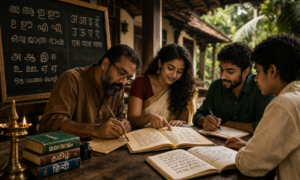
Outstanding Languages of Kerala
Kerala is often seen as linguistically uniform, but that’s only on the surface. Yes, Malayalam dominates, spoken by over 97% of the population, but beneath that lies a rich mix of regional, migrant, and tribal languages that shape the state’s identity.
From border languages like Tamil and Kannada to coastal tongues like Tulu and Konkani, and deeply rooted tribal languages, Kerala is quietly one of India’s most linguistically diverse states.
This guide covers the most searched, widely spoken, and culturally important languages in Kerala.
1. Malayalam
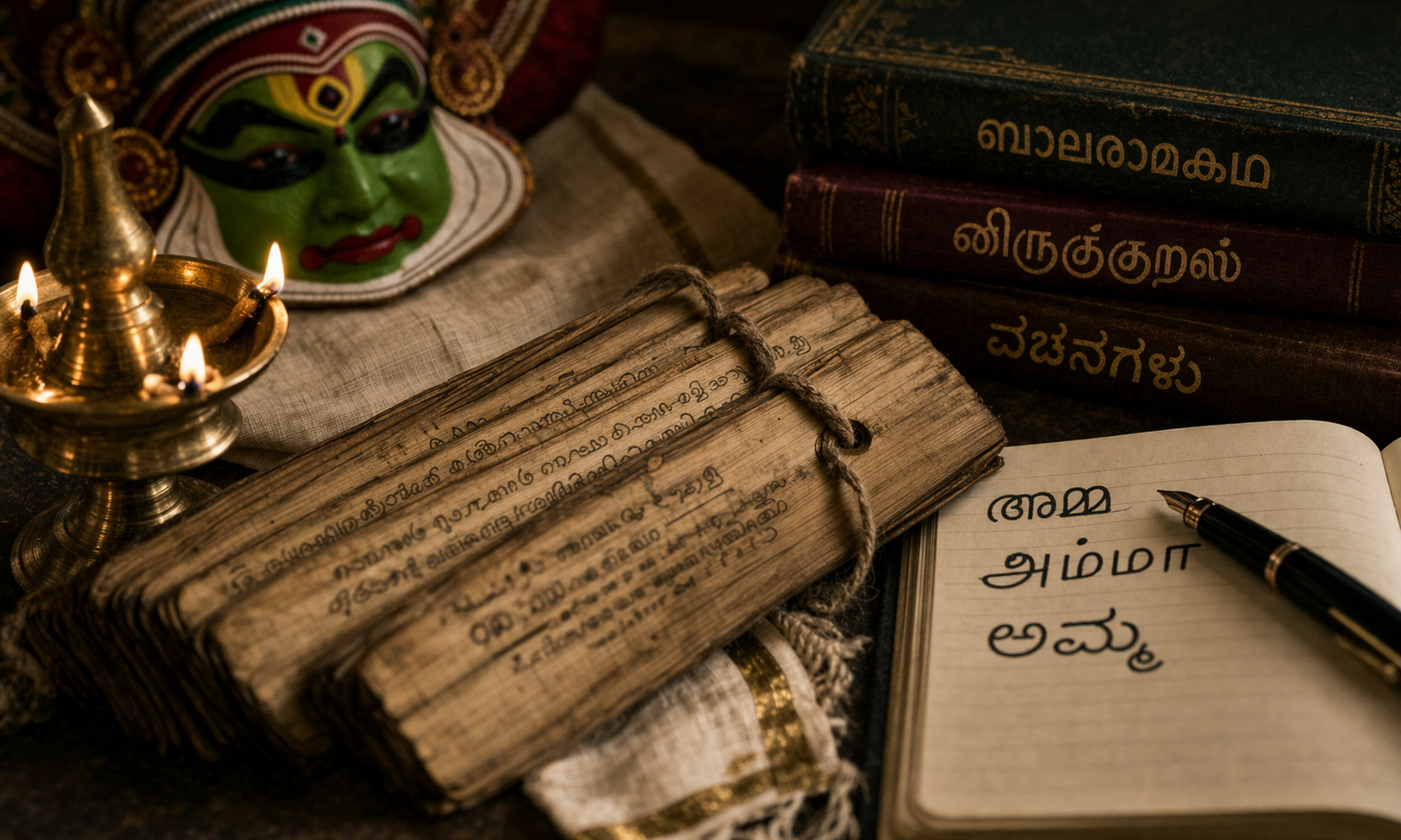
Malayalam is the official and dominant language of Kerala, forming the backbone of its culture, identity, and communication. It belongs to the Dravidian language family and is spoken by over 35 million people globally, with the majority in Kerala.
What makes Malayalam unique is its evolution. It developed from Old Tamil but absorbed heavy influences from Sanskrit, giving it a rich vocabulary and complex grammar. The script itself is highly distinctive, rounded, and visually dense.
Malayalam is not just a spoken language. It has one of the strongest literary traditions in India, with centuries of poetry, philosophy, and modern literature. Writers like Kumaran Asan and Vaikom Muhammad Basheer shaped its modern identity.
In daily life, Malayalam exists in multiple dialects. The language spoken in Kasaragod is very different from that in Thiruvananthapuram, reflecting regional diversity within a single language.
It is also the primary language of education, administration, media, and cinema in Kerala.
Malayalam is more than a language. It is the emotional and cultural core of the state.
2. Tamil
Tamil is the second most widely spoken language in Kerala, especially in districts bordering Tamil Nadu such as Idukki, Palakkad, and Thiruvananthapuram.
As one of the oldest living languages in the world, Tamil shares deep historical roots with Malayalam. In fact, Malayalam evolved from ancient Tamil before developing into a separate language.
In Kerala, Tamil is not just a migrant language. Many communities have been speaking it for generations, creating a hybrid linguistic culture where Malayalam and Tamil often blend.
You’ll hear Tamil widely in border towns, marketplaces, and among labor communities. In some regions, people switch seamlessly between Tamil and Malayalam in daily conversation.
Tamil also plays a strong role in Kerala’s cultural landscape through cinema, music, and trade connections.
Its presence reflects Kerala’s close historical and geographical ties with Tamil Nadu.
3. Tulu
Tulu is a lesser-known but culturally significant language spoken mainly in the Kasaragod district of North Kerala.
It belongs to the Dravidian language family and is primarily spoken in the Tulu Nadu region, which spans coastal Karnataka and northern Kerala.
Tulu has a strong oral tradition, with folklore, rituals, and cultural performances deeply tied to the language.
In Kerala, Tulu-speaking communities maintain their linguistic identity while also being fluent in Malayalam and Kannada.
The language is closely associated with traditions like Theyyam and Bhoota Kola, which reflect ancient belief systems.
Although it does not have widespread institutional use, efforts are being made to preserve and promote Tulu through academies and cultural programs.
Tulu represents Kerala’s connection to a broader coastal cultural belt.
4. Kannada
Kannada is spoken in parts of northern Kerala, especially in Kasaragod district, which borders Karnataka.
Many communities in this region are bilingual, using both Kannada and Malayalam in daily life.
Kannada is one of India’s major classical languages with a long literary history, and its influence in Kerala is largely regional and community-based.
In border areas, Kannada is used in education, trade, and cultural practices.
The coexistence of Kannada and Malayalam in these regions creates a unique linguistic blend, especially in dialects and vocabulary.
Kannada’s presence highlights Kerala’s cultural overlap with neighboring states.
5. Konkani
Konkani is spoken by a small but culturally significant community in Kerala, particularly in Kochi and parts of Kasaragod.
It is an Indo-Aryan language, unlike most other languages in Kerala which are Dravidian.
Konkani-speaking communities in Kerala are often associated with trade, business, and migration histories.
The language has multiple dialects and scripts, including Devanagari and Roman, reflecting its diverse evolution.
In Kerala, Konkani is preserved through community institutions, cultural events, and religious practices.
It represents Kerala’s historical connections to the western coastal trade networks of India.
6. Hindi
Hindi is not native to Kerala but has become increasingly common due to migration and education.
With a growing number of workers from North India, Hindi is widely used in urban areas, construction sites, and service industries.
It also serves as a link language, helping communication between people from different linguistic backgrounds.
In cities like Kochi and Thiruvananthapuram, Hindi is commonly heard alongside Malayalam and English.
Its rise reflects changing demographics and economic patterns in Kerala.
7. English
English plays a major role in Kerala as a secondary and global language.
It is widely used in education, business, media, and tourism.
Kerala has one of the highest literacy rates in India, and English proficiency is relatively strong compared to many other states.
In urban areas, English is often mixed with Malayalam in daily conversation, especially among younger generations.
It also acts as a bridge language for international communication, particularly for the large Malayali diaspora.
8. Urdu
Urdu is spoken by a small section of Kerala’s Muslim population.
It is mainly used in religious contexts, cultural expressions, and among certain communities.
Though not widely spoken compared to Malayalam or Tamil, Urdu adds to Kerala’s linguistic diversity.
9. Telugu
Telugu is spoken by migrant communities and some settled populations in Kerala.
It is more common in urban and industrial areas where workers from Andhra Pradesh and Telangana reside.
The language has limited regional influence but contributes to Kerala’s multicultural environment.
10. Tribal Languages (Paniya, Malamuthan, and others)
Kerala is home to several indigenous tribal languages, including Paniya, Malamuthan, and others.
These languages belong to the Dravidian family and are spoken by specific tribal communities in regions like Wayanad and the Western Ghats.
They are often unwritten and preserved through oral traditions, songs, and rituals.
These languages are among the most vulnerable, as many are gradually being replaced by dominant languages like Malayalam.
However, they remain crucial for understanding Kerala’s indigenous culture and history.
Final Talk
Kerala may look linguistically simple, but it is layered.
Malayalam dominates identity and daily life
Tamil and Kannada connect borders
Tulu and Konkani reflect coastal diversity
Hindi and English show modern influence
Tribal languages preserve ancient roots
Kerala’s language story is not about one voice.
It’s about many voices coexisting, evolving, and shaping a culture that is both local and global.