
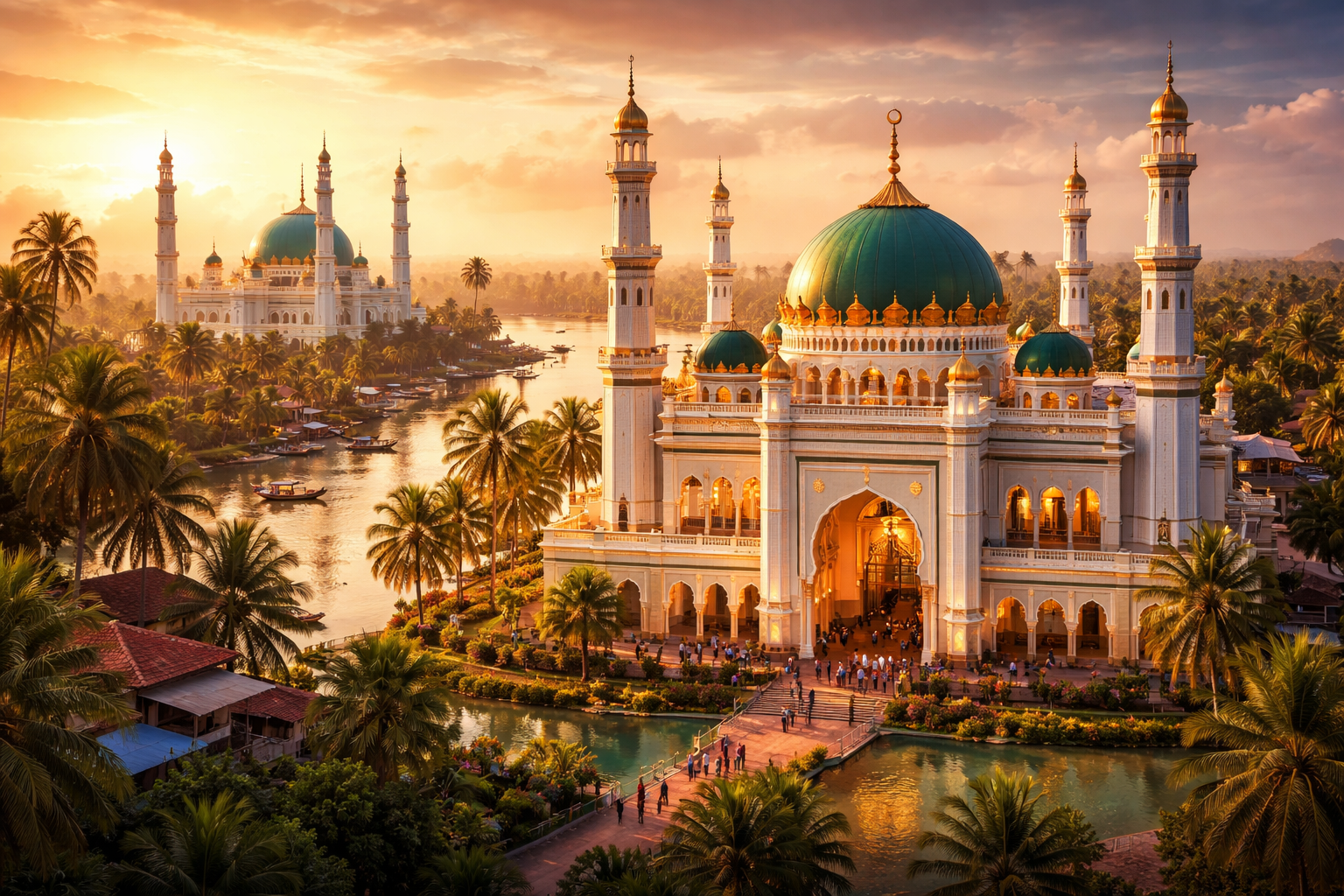
Top Mosques in Kerala
Top 10 most searched, historic, and culturally significant mosques
- Cheraman Juma Masjid, Kodungallur
- Palayam Juma Masjid, Thiruvananthapuram
- Mishkal Mosque, Kozhikode
- Ponnani Juma Masjid, Malappuram
- Malik Dinar Mosque, Kasaragod
- Thazhathangady Juma Masjid, Kottayam
- Madayi Mosque, Kannur
- Mampuram Mosque, Malappuram
- Jamiul Futuh Grand Mosque, Kozhikode
- Beemapally Mosque, Thiruvananthapuram
Outstanding Mosques in Kerala
Kerala’s mosques are unlike anywhere else in India. They do not always follow the classic domes and minarets you expect. Instead, many reflect Kerala’s own architectural language, sloping tiled roofs, wooden carvings, and interiors that resemble traditional homes or temples. This is because Islam here arrived through trade, not conquest, blending deeply with local culture.
From ancient mosques tied to early Arab traders to modern grand structures, Kerala’s Islamic heritage is layered, inclusive, and historically rich. This list brings together the most searched, widely visited, and culturally important mosques across the state.
1. Cheraman Juma Masjid, Kodungallur
Cheraman Juma Masjid is often considered the oldest mosque in India, with origins traditionally traced back to 629 CE. Built under the guidance of Malik Bin Dinar, it represents the earliest connection between Kerala and the Islamic world through Arab traders.
What makes this mosque extraordinary is its architecture. Unlike typical Islamic structures, it follows Kerala temple-style design, wooden beams, sloping roofs, and oil lamps instead of chandeliers. This reflects how Islam adapted to local culture rather than replacing it.
The mosque carries a strong legend. It is believed that Cheraman Perumal, a Chera king, converted to Islam and facilitated its construction. Whether historical or symbolic, this story adds depth to the site’s identity.
Inside, the atmosphere is calm and minimal. There is no overwhelming ornamentation. The focus is on simplicity and devotion. Despite modern renovations, efforts have been made to preserve its original character. Today, it attracts both devotees and history enthusiasts.
Cheraman Juma Masjid is not just a place of worship. It is a symbol of Kerala’s long-standing connection with global trade, cultural exchange, and religious coexistence.
2. Palayam Juma Masjid, Thiruvananthapuram
Palayam Juma Masjid stands at one of Kerala’s most symbolic locations, a junction where a mosque, a temple, and a church coexist side by side. This alone makes it a powerful representation of Kerala’s religious harmony.
Built in the early 19th century, the mosque has evolved over time, blending traditional and modern architecture. It features large prayer halls, clean lines, and a welcoming structure that accommodates thousands of worshippers.
What makes Palayam unique is not just its design, but its social role. It is deeply connected to the city’s daily life. During festivals like Attukal Pongala, the mosque actively supports devotees, offering shelter and water, reinforcing Kerala’s culture of coexistence.
The mosque is always active, with regular prayers, community programs, and gatherings. It serves as both a religious and social center. Located in the heart of Thiruvananthapuram, it is easily accessible and frequently visited by locals and tourists alike.
Palayam Juma Masjid represents modern Kerala, diverse, inclusive, and deeply rooted in shared spaces.
3. Mishkal Mosque, Kozhikode
Mishkal Mosque is one of the most architecturally unique mosques in Kerala. Built in the 14th century by a wealthy Arab merchant, it stands as a reminder of Kozhikode’s role in global maritime trade.
Unlike typical mosques, Mishkal has no domes or minarets. Instead, it resembles a traditional Kerala building with multiple wooden floors, intricate carvings, and a sloping roof. This design reflects the influence of local craftsmanship.
The mosque has survived invasions, fires, and reconstructions, yet it retains its historic identity. Inside, the wooden pillars and ceilings create a warm, almost timeless atmosphere. Located in Kuttichira, a historic Muslim neighborhood, the mosque is part of a larger cultural landscape that includes ponds, markets, and old trading routes.
Mishkal Mosque is not just a religious space. It is an architectural masterpiece and a living reminder of Kerala’s cosmopolitan past.
4. Ponnani Juma Masjid, Malappuram
Ponnani Juma Masjid is often called the “Mecca of Kerala Muslims.” Located in Malappuram, it has been a major center for Islamic learning and scholarship for centuries.
The mosque is deeply connected to the Malabar Muslim community. It served as a hub for religious education, attracting scholars and students from across the region.
Architecturally, it follows the traditional Kerala style, simple, functional, and deeply rooted in local design. The emphasis here is not on grandeur but on purpose.
The town of Ponnani itself has a rich history tied to trade and religion, and the mosque sits at its heart. Even today, it remains active, hosting prayers, teachings, and community gatherings.
Ponnani Juma Masjid is more than a place of worship. It is a center of knowledge, tradition, and cultural continuity.
5. Malik Dinar Mosque, Kasaragod
Malik Dinar Mosque in Kasaragod is one of the oldest and most revered mosques in Kerala. It is believed to have been established by Malik Ibn Dinar, one of the early propagators of Islam in India.
The mosque complex includes tombs of prominent Islamic figures, making it both a place of worship and pilgrimage. Architecturally, it combines traditional Kerala elements with later Islamic influences. The structure has evolved over time but retains its spiritual significance.
The mosque is especially busy during religious gatherings and festivals, drawing devotees from across the state. Its location in northern Kerala highlights the spread of Islam along the Malabar coast through trade routes.
Malik Dinar Mosque stands as a powerful symbol of Kerala’s early Islamic heritage and its deep-rooted traditions.
6. Thazhathangady Juma Masjid, Kottayam
Thazhathangady Juma Masjid is one of the oldest mosques in Kerala, believed to date back to the 9th century.
Located near the Meenachil River, the mosque is known for its stunning wooden architecture. The interiors feature detailed carvings, traditional ceilings, and a design that closely resembles Kerala temple architecture.
What makes this mosque unique is its preservation. Despite renovations, it has retained much of its original structure and aesthetic. The setting adds to its appeal. Surrounded by water and greenery, it feels peaceful and timeless.
It is not just a religious site but also a heritage monument, attracting visitors interested in architecture and history.
7. Madayi Mosque, Kannur
Madayi Mosque, located on a hilltop in Kannur, is one of the oldest mosques in Kerala. It is traditionally associated with Malik Ibn Dinar and early Islamic missionaries.
The mosque offers a unique setting. Positioned on Madayi hill, it provides panoramic views of the surrounding landscape, adding a sense of calm and elevation to the experience.
The structure has been rebuilt over time, with modern elements like white marble incorporated into the design. However, its historical significance remains intact.
The mosque also has cultural importance, hosting festivals and gatherings that attract large crowds. Madayi Mosque blends history, spirituality, and scenic beauty, making it one of the most distinctive mosques in Kerala.
8. Mampuram Mosque, Malappuram
Mampuram Mosque is one of the most important pilgrimage centers for Muslims in Kerala. Located in Malappuram, it is associated with the revered saint Sayyid Alavi Thangal.
The mosque attracts thousands of devotees, especially during annual festivals, which are marked by large gatherings and spiritual activities.
Unlike purely architectural landmarks, Mampuram’s significance lies in its spiritual legacy. It is deeply connected to Sufi traditions and local religious practices.
The atmosphere here is intense, devotional, and communal. Mampuram Mosque represents the living spiritual culture of Kerala’s Muslim community.
9. Jamiul Futuh Grand Mosque, Kozhikode
Jamiul Futuh is one of the newest and largest mosques in Kerala, completed in 2022.
Located in Kozhikode, it represents modern Islamic architecture. Unlike traditional Kerala mosques, it features grand domes, tall minarets, and large prayer halls.
The mosque is part of Markaz Knowledge City, linking religion with education and community development.
It can accommodate thousands of worshippers, making it one of the largest mosques in India.
Jamiul Futuh reflects the evolution of mosque architecture in Kerala, from traditional wooden structures to modern monumental designs.
10. Beemapally Mosque, Thiruvananthapuram
Beemapally Mosque is one of the most popular mosques in South Kerala. It is associated with Beema Beevi, a revered female saint.
The mosque is known for its annual festival, Beemapally Uroos, which attracts people from all communities.
Architecturally, it blends traditional and modern elements, with colorful exteriors and spacious interiors.
What makes Beemapally unique is its inclusivity. People from different religions visit the shrine, reflecting Kerala’s culture of shared spirituality.
It is both a mosque and a dargah, combining worship with pilgrimage.
Final Bow
Kerala’s mosques are not just religious structures. They are stories of trade, migration, adaptation, and coexistence.
From the ancient Cheraman Mosque to the modern Jamiul Futuh, each one reflects a different phase of history.
If you explore them deeply, you do not just see architecture. You see how cultures meet, blend, and evolve over time.